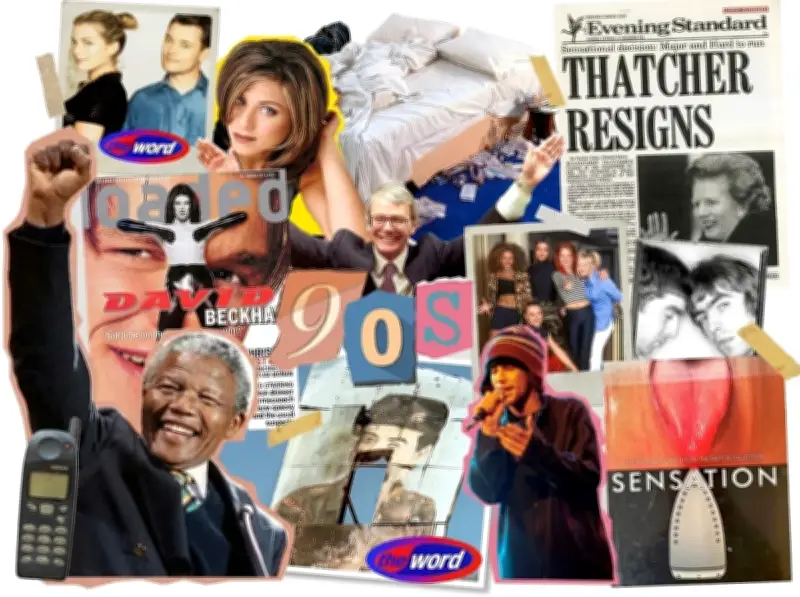
Simon Mills, who began the decade as editor of the teen pop culture magazine SKY and later moved to The Sunday Times Magazine before co-writing an Evening Standard gossip column with Nicky Haslam, remembers the 1990s as an exciting, hedonistic time. He describes it as a period when pop music, pop art and champagne-popping parties were central, but with a crucial difference: suddenly everyone seemed to be invited.
After the go-getting 1980s, when elitism, minimalism and materialism were the aesthetics and aspirations, the 1990s felt like a cultural democratisation. Raves, not private clubs, were where people went, and style no longer looked to America or Europe. Mills notes that for him, the 1990s started in 1988, the fabled Second Summer of Love, when the whole city seemed to move to a four-on-the-floor beat and a Roland TB303 squelch for months on end.
House music and a new spirit
Every weekend that summer, and in subsequent 1990s summers, Mills went to warehouses such as Clink Street and Battlebridge Road, to far-away Essex fields, and even bussed out to an equestrian stables in Henley, to lose himself and dance. He recalls that everyone could do the dance, feel the rhythms and catch the vibe. House music was uniting, pacifying and euphoric, and the capital quickly co-opted this black Chicago music for its own multi-coloured soundtrack.
Mills acknowledges that people felt fuzzy on Mondays but jobs were held down and mortgages paid. He suggests that pop culture influenced the moods and ideas of a whole nation, noting that football terrace violence was down, men learned to kiss and hug one another, and British pop music embraced its own black, white and brown influences. While history frames the 1990s as all Oasis, Suede, Blur, Elastica and Pulp, for many Londoners it was also The Young Disciples, Omar and Jamiroquai, a music scene that sparked connection and unification, what curator Edward Enninful calls a “shared impulse”.
Art, fashion and accessible travel
This new spirit had a trickle-down effect on other areas of lifestyle. Where 1980s fashion had been all monochrome power dressing and sartorial brutalism, colour made a comeback in the 1990s. Mills describes it as a decade of attitude not wardrobe, laughs not labels. In the financial recession of the early 1990s, he says, why go to an expensive designer store when a Rachel haircut and a long-sleeved Hanes T-shirt hoodie, or a smile and pair of Birkenstocks, just like the ones Kate Moss was wearing in The Face magazine’s Corinne Day shoot, was much more the thing?
Over in east London, large parts of it still a wasteland back then, the YBAs were making art that was visually impactful and easily disseminatable, but more importantly, approachable and un-snooty. Mills attended Damien Hirst’s first-ever solo show, 1991’s In and Out of Love, staged at a vacant shop on Woodstock Street, just off Bond Street, enjoying a quiet and modestly attended affair. The Royal Academy’s famous Sensation exhibition in 1997, he says, was more like a rock concert, drawing over 300,000 visitors and setting a British record for a contemporary art exhibition.
The 1990s was when easy and accessible, cut-price air travel became part of the collective schedule, with cheap flights from London not just to Ibiza and Corfu but to exotic Mittel-European and Scandinavian destinations as well. Mills recalls that travelling to Eastern Europe to check out the rave scene in Prague or Gdansk for the weekend, sometimes for as little as £15, seemed like an unmissable bargain.
A hopeful wider world
Through this highly mobile, idealistic and hedonistic, rainbow-hued prism, the wider world appeared to be over the worst of itself too. From 1990 to 1994 South Africa dismantled apartheid, and the whole planet seemed very happy about it. In 1990, a USA-led air and ground initiative drove Saddam Hussein’s invading army out of Kuwait in just 100 hours. Mills notes that people generally admired and approved of the Americans for doing the right thing.
There were the now largely forgotten Oslo Accords, interim peace agreements of 1993 and 1995 that encouraged Israel and the Palestine Liberation Organization to negotiate a framework for peace and coexistence. The civil war in the former Yugoslavia ended, and in 1993, John Major issued the Downing Street Declaration, establishing a core “principle of consent”, asserting that Northern Ireland’s constitutional status would only change with the majority consent of its population. A 1994 IRA ceasefire followed, making way for the Good Friday Agreement, finalised by Tony Blair in 1998. Mills reflects that it felt like no more wars, forever.
Technology and the decade’s downside
Mills asks how people got along without smartphones and an omnipresent internet, answering: fine. When the digital age arrived properly during the 1990s, people took it in their stride, naively regarding their Nokias, Motorolas and Ericssons as simply useful and exciting social tools, rather than essential appendages to dominate and distract. He notes that the internet was there but no one really bothered too much about the wonky world wide web, which was for airlines and banks to operate more efficiently, not to sidetrack and doomscroll people into oblivion. He describes what people were experiencing as modern technology at its exciting, untyrannised, benignly connected, socio-cultural sweet spot.
The writer Michael Bracewell once noted that the 1990s were like the 1960s, 1970s and 1980s “whizzed through the blender of information technology”. Mills suggests this might be true. The downside of 1990s culture, he says, was its hipsterisation of what had gone before, other decades recycled with an added sneer — elitism via cynicism. In a blur of good times there was a tendency to behave selfishly and irresponsibly, at the lowest ebb, almost wilfully intent on dumbing down. It became fashionable to present as a sort of anti-intellectual, belief-shunning yobbo, championing irony and Union Flag-draped Albion nostalgia, hence lads and ladette culture, Loaded magazine, The Word and The Girlie Show. This notion peaked with the meta-heavy Fat Les England football song Vindaloo, its video a parody of The Verve’s Bittersweet Symphony.
Now, 30 years on, Mills says some of the decade’s tastes and choices may seem regrettable, but much of it, the stuff one can actually remember at least, remains truly wonderful. He recounts reading a recent missive on Facebook added by Meg Mathews, the former Mrs Noel Gallagher, reminiscing about the original Oasis concerts at Knebworth in 1996 when she was put in charge of the band’s guest list. Over the weekend some 250,000 fans attended two gigs, with more than 2.5 people applying for tickets. Mathews’s guest list had seven thousand people. Mills sums up the 1990s as a good time had by all, with elitism over and everyone invited.