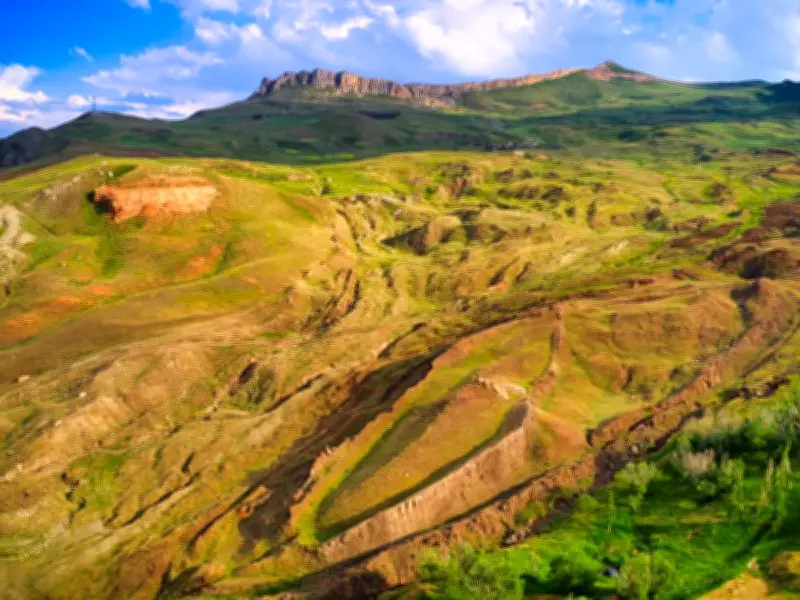
Researchers investigating a boat-shaped formation in Turkey claim they have uncovered evidence it could be Noah's Ark. The team behind Noah's Ark Scans says a site near Mount Ararat could be the resting place of the 4,300-year-old vessel described in the Bible as saving humanity and animals during the Great Flood.
Many geologists insist the Durupınar formation is natural, but the American research team says radar scans and drilling have led to clues suggesting the mound is "100% not geological." The team has revealed seven findings supporters point to as evidence.
Boat-shaped outline and soil differences
According to a report from Noah's Ark Scans, the boat-shaped formation matches the dimensions given in Genesis and is in the exact location described. The mound measures roughly 515 to 538 feet long, which they say lines up with the Bible's description of Noah's Ark being 300 cubits in length.
Results from a 2024 soil study found that the boat-shaped area contained significantly higher levels of organic material than the surrounding hillside. Andrew Jones, founder of Noah's Ark Scans, who has investigated the area for nearly 30 years, said: "The studies showed that there is three times more organic matter inside the boat-shaped area than immediately outside it," adding: "The soil within the formation is different from the soil on the mountainside."
The team also conducted its first core drilling campaign at the site, reaching a depth of 18 meters at one location and drilling between 5 and 8 meters at several others. More than 300 samples were collected and sent to laboratories at Ankara University for analysis, Jones said. The samples will be examined for indicators such as decayed wood, animal remains and traces of human activity.
Underground patterns and absence of bedrock
Dr. Khosrow Bakhtar, a veteran researcher who previously worked for the Department of Defense, brought "BakhtarRadar" technology to the Durupınar formation to discover more about the site's structure. Using the technology, which wipes out geological noise like rocks and dirt, Bakhtar claims he detected an array of unnatural, organised patterns buried deep below the surface, including what he says are massive underground corridors and chambers running through the 515-foot boat-shaped mound.
Jones added that the scans showed right-angle formations, possible tunnels, layered structures and underground voids, some of which researchers believe could be human-made. "Some of the possible voids are located 3 to 4 meters below the surface, while others extend to depths of around 13 meters," he said.
Jones said the recent drilling, soil sampling and ground-penetrating radar have given his team new reasons to challenge that the formation is naturally occurring. "They've criticized in the past, saying all those scans you can interpret different ways, 'This is a solid mass of rock, a syncline or a block of bedrock,'" Jones said. "Well, we've core drilled… over 12 locations. We did not find bedrock at all."
Jones said the drilling uncovered rich black soil, which researchers plan to test for organic content this winter. "Noah's Ark was a giant wooden boat, according to the Bible," he said. "As wood decays, you're gonna find elevated organic matter. This year, as we drilled into the formation, we did not find a solid rock layer, like the critics said. But we did find large deposits of highly rich black soil that has hopefully high organics."
Anomalies, stones and marine fossils
Researchers believe Bakhtar's scans could be interpreted as evidence of a single buried object. "This is the most significant finding for 40 years or 45 years of my career. I have never seen this kind of anomalies before. I have never in my life," Bakhtar said in a video shared on Noah's Ark Scans' social media. "If these anomalies were not important, we would have seen them at all, but the fact that they showed so clearly indicates that they come from something. I am 100% sure that they come from the same original object. What that original object was, a ship or a spacecraft or what, I do not know."
Massive carved stones found near the Durupınar formation are claimed by researchers to be ancient "drogue stones" or anchor weights used to stabilize Noah's Ark in rough waters. Researchers have identified 26 large carved stones with holes in a valley leading toward the boat-shaped site near Mount Ararat.
Marine fossils, sea shells, and sand dollars cover the region. Fossil remains found deposited around the boat-shaped site, which sits roughly 6,500 feet above sea level, could also show evidence of the Great Flood, Jones argued. "We still have the lab work to do," Jones said. "And I hope everyone can follow along and see what we find."