With so much art desperate to represent something, to showcase the artist’s point of view, to force polemics down your eyeholes, something is lost. As you are required to receive the lesson, the active role of the viewer disappears. You know, the fun part. It’s there in everything from TV to Opera, a desire to instruct that is often little more than an extension of social media consensus. You might simply call it Bad Art.
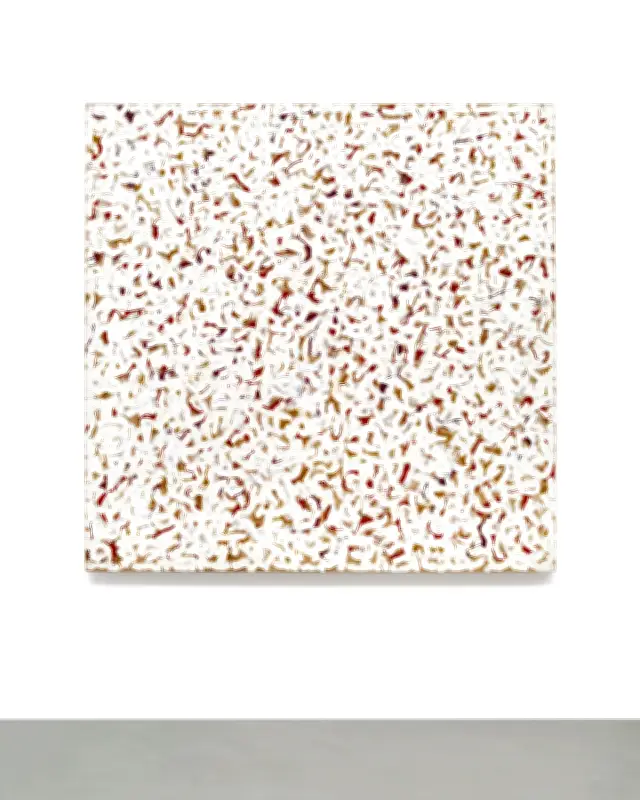
It is with some relief then, to find the Barbican presenting this first exhibition of Robert Ryman’s work in over 30 years. After recovering from an Art Week clogged with fevered egos, there is welcome respite here with an artist interested in ‘The Real Thing’. Meaning, the act of creating art, not trying to say anything with it. His predominantly white, minimalist work, concentrates on the movement of a brush, the depth of paint, the very act of mark-making; he said he was trying to “paint the paint”.
The Real Thing: Ryman’s Minimalist Vision
The fittings, the nails and brackets used to hang his work from the walls, are as important as the images. It’s about the presence of them in the room, in relation to the walls, and the floors, and to the viewer. You have to fill in the blanks. And the effect is sublime.
This is a super-careful curation and installation of his work. Ryman died in 2019 at the age of 88, but here there are meticulous recreations of the way in which he hung these works. The exact type of waxed paper and tape he used to attach his fibreglass Surface Veil paintings to the wall. The same blue chalk marks left behind when his work Orrin is stapled to the wall. This is all staples and pencil marks and paintings spilling out over their edges. The things that other artists would try to hide, he left in. The meaning they desperately wanted to show, he took out. Intellect was beside the point. The act of making art was foregrounded. The real thing.
A Journey from Jazz to Punk
He always insisted despite the apparent abstraction of his work that he was “a realist.” And it restores the thrill of creation. Ryman’s work is one that cannot work in the Instagram age of art viewed on screen. It can only be viewed in person, when all the fuss about this legendary figure can truly hit you. One of his works, Signet 11” x 11” (1966) consists merely of one single large brushstroke which travels horizontally then sweeps downward. In theory, who would ever care? To stand before it though, is exhilarating. You get it.
And through the vast spaces of the Barbican gallery, you have the opportunity to buy into his world. For art fans, Ryman represents a glorious fantasy figure. The security guard at MOMA who took one look at Mark Rothko’s work and thought, ‘I could do that,’ and did. The jazz musician on the New York club scene in the 50s who took that philosophy back home to his studio. The loner in the loft, following his own singular path. This is all there.
And as this figure stripping art all the way back, there is a distinct echo between Ryman and New York music, a journey from jazz to punk in the 70s and then No Wave in the 80s, when the city’s music hit upon noise abstraction as an anti-rock n roll, anti-image end point. Ryman is the godfather of all this, and yet his work was not an end point for him, it was a journey into greater understanding.
Maximal Enthusiasm for the Minimal
We can see his excitement, with the bebop-infused hectic mark-making he developed in the early 60s. How he experimented with size, with position on the wall - sometimes placing works at a right angle to it – with materials like aluminium. You begin to see a maximal enthusiasm for the minimal, an infectious spirit. His work provides a tangible sense of seeking new realms of experience. In his notebooks you can read that he was always scrawling things like this: ‘What is it that makes a painting wonderful? A state of consciousness… The essence of all painting is feeling – if someone can experience delight, wonder, be enlightened…’ Reams of this stuff, like a mantra going through his head to sustain him through the years. It is not punk nihilism, the glee is apparent.
There’s a delicious moment late on in the show, after you have been past wall after wall of predominantly white works, where at last in 2013, he tries something different: a series of white paintings. “In the past I have used white,” he said, “but in these new paintings I decided to actually paint white.” Heh. The works are called Series (White) and to be fair he is using white on top of a black background here, more of a contrast than white on a white canvas. But it gives a clue to this exhibition: what may easily be dismissed as literally empty work, what we in fact have here is the genius work of a mischievous monk. He’ll show you enlightenment and give you a laugh doing so…
Robert Ryman: The Real Thing is at the Barbican until 28 Feb.