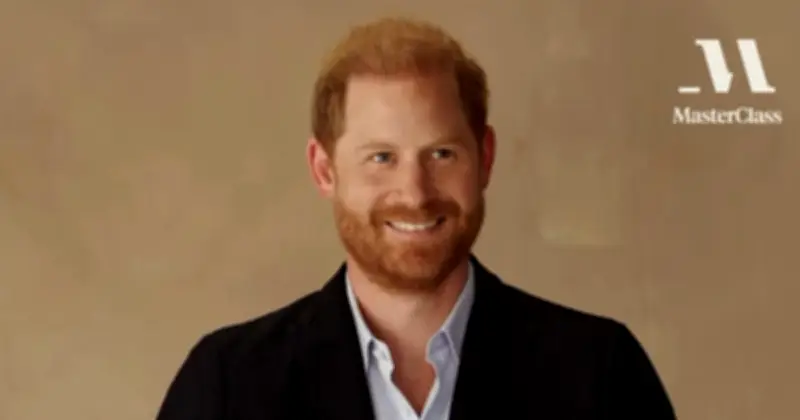
Prince Harry has revealed he would like to teach others how to fly helicopters, in a newly released MasterClass episode exploring his lifelong battle with grief.
In the interview, the Duke of Sussex, 42, speaks in depth about the “adrenaline crash” he felt after arriving in Canada in 2019, ahead of his and Meghan Markle's decision to step back from the Royal Family. He also reveals that he “slipped into depression” for two weeks during that time.
Dream class and military background
In an Instagram reel featuring a round of questions and answers, Harry reveals his dream class to teach would be helicopter flying. The Duke completed his initial helicopter training in 2010, earning his provisional flying wings after training on Firefly and Squirrel aircraft. He then trained to fly a British Army Apache attack helicopter, before acting as a co-pilot gunner during his two tours of Afghanistan.
Elsewhere in the video, Harry is asked how he would introduce himself to someone he's never met, to which he responds, “Hi, I'm Harry”.
Depression after Canada move
The full new interview sees Harry reveal that he “slipped into depression” for two weeks after he moved to Canada with Meghan Markle and their son, Prince Archie, back in 2019. The decision to relocate came shortly before the Duke and Duchess of Sussex made the bombshell announcement that they would step back from their senior royal roles and move to the US.
He told the programme: “Being in Canada, away from the stressful environment where presumably my body was just pumped full of adrenaline, within two or three days, I experienced this adrenaline crash, something that I’d never experienced before.
“It was as if I needed stress in order to get the adrenaline to make my brain function because I became useless around the house,” he continues. “I actually slipped into depression for about two weeks, and I felt like I couldn’t function without adrenaline.”
Grief and military service
The programme was filmed earlier this summer in California and sees Harry join neuroscientist Dr Mary-Frances O’Connor to explore the effects that grief has on the brain and body. It is understood that he discusses his own experience of losing his mother, Diana, Princess of Wales, at the age of 12, and the long-lasting impact that has had on him.
For Harry, the experience in Canada followed years of struggling with the grief of losing his mother, who tragically died in a Paris car crash in 1997. He says in the episode: “For 15, 20 years, when I was being asked, ‘Are you okay?’ My response was, ‘I’m fine.’ It was numbness, emotional shutdown. And without knowing it, adrenaline was pushing me, was driving me.”
“It was the driving force of what led me to join the military at the age of 20. It was the perfect distraction. I couldn’t really think about much else apart from the task at hand,” he adds.
After returning from his second tour in Afghanistan in 2013, Harry explains how he began to recognise that his experiences in the military had triggered his earlier trauma. “The things that I saw, the things I experienced, appeared to be a trigger for other traumas that had stored themselves within me,” he says.
“I started to realise that I probably had become seriously depleted when just putting a simple dress shirt on — the tightening of the collar — literally felt like I was suffocating, and I would be experiencing panic attacks just in the car on the way to work,” he recalls. “And that’s when I realised, ‘Okay, there’s something bigger, there’s something else that you need to look into here.’”