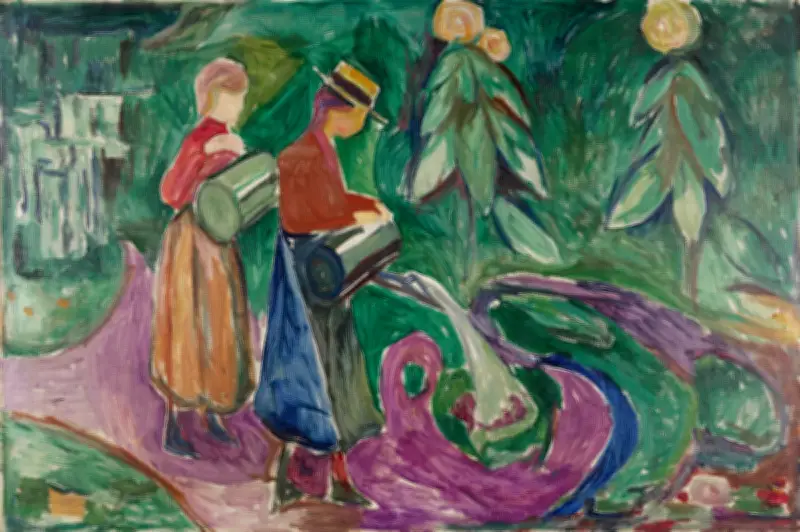
An exhibition at Oslo's Munch Museum, titled Edvard Munch and the Chocolate Factory, presents the artist's 1922 Freia frieze in a new light, connecting the idyllic scenes to the bitter realities of cocoa sourcing, labor struggles, and women's emancipation. The frieze, comprising 12 canvases, was commissioned for the women's canteen at the Freia chocolate factory in Oslo.
The Frieze's Debut Outside the Factory
This is the first time the frieze has been displayed in Norway outside the factory walls, and only the second time it has left the factory since its installation in 1923. The exhibition runs until October 2026 while Freia's canteen undergoes renovations. Freia, once a symbol of Norwegian national pride, is now owned by US food giant Mondelēz International.
Idyllic Scenes Versus Harsh Realities
The frieze depicts fruit pickers, watering girls, and dancing couples in a pastoral setting. However, curator Ana María Bresciani notes that the young women workers, often called "chocolate girls," likely had no experience of such leisure. "I don’t think they had access to summer cottages, they probably didn’t have access to swimming and they probably didn’t have much access to art just yet," Bresciani said.

Munch himself wrote that the paintings aimed to educate the workers: "The little chocolate girls, sat there eating, understanding the pictures better and better." Yet, complaints arose about missing doors and chimneys in the houses, which Munch reluctantly added only on condition that a chauffeur wait for him outside the factory.
Economic Disparities and Criticism
Chocolate mogul Johan Throne Holst paid Munch 80,000 Norwegian kroner (equivalent to about 2.5 million kroner or £192,000 today) for the frieze, while the women earned meager wages. The Oslo daily Arbeiderbladet criticized this on 15 October 1923: "While the workers are kept on starvation wages, large capital is invested in costly paintings, which in time could be sold at a large profit."
Freia's Progressive Facade
Despite the criticism, Freia portrayed itself as a progressive employer, offering workers one free bath per week, monthly manicures, modern toilets, uniforms, a factory doctor, and subsidized porridge and cocoa milk. These benefits were part of a strategy to build the nation state.
Munch's Ambition and Public Art
The Freia frieze is one of only two public works by Munch, the other being the Aula series at the University of Oslo. Bresciani suggests Munch sought fame through public commissions: "He was really interested in public commissions because he thought his art was to be lived with among the people – and he was a strategist when it came to that." He had plans for a public work at Oslo's new city hall but never received the commission.
Exhibition Details
Edvard Munch and the Chocolate Factory is on display at the Munch Museum, Oslo, until 11 October 2026.