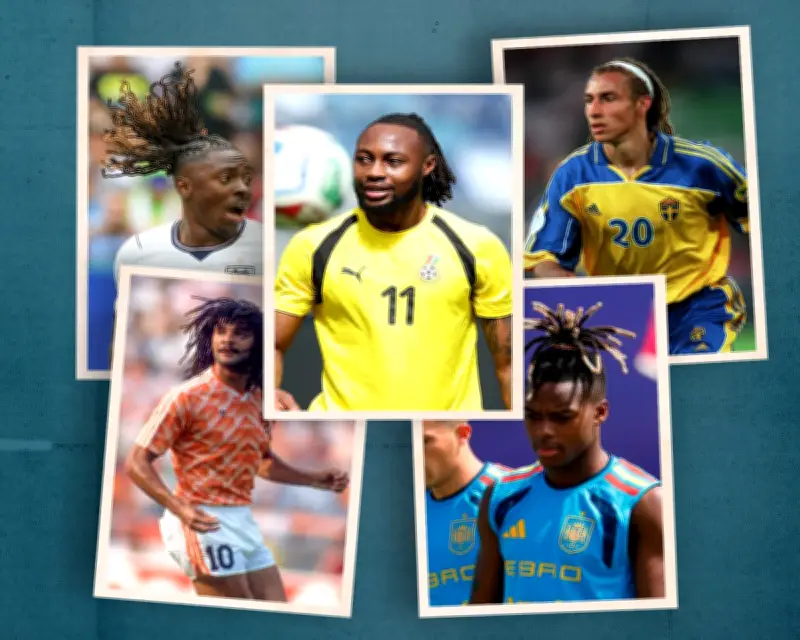
At the World Cup this summer, locs have become as ubiquitous as free kicks. Defenders pin theirs back for clear sight-lines; forwards loosen and shape theirs for the cameras. Antoine Semenyo of Ghana paired his with a sharp undercut. Spain’s Nico Williams bleaches his tips. Belgium winger Jeremy Doku has a mix of blond tinted tips, cornrowed. England’s Eberechi Eze has a variant styled into cornrows, while France’s Michael Olise opts for a slickly styled taper fade. Manu Koné has sported braided locs, and Switzerland’s Johan Manzambi has gone for jumbo locs with Senegalese twists.
From One Style to Many
Locs have always been present in football, but the range is new. In the past, players like Ruud Gullit and Henrik Larsson wore locs in the same style throughout their careers for convenience. Today, locs shift from tournament to tournament, sometimes match to match. Fidelis Okafor, a barber in Nottingham, notes that until recently locs were a specialist service; then Leicester City’s Abdul Fatawu Issahaku recommended him to the Ghanaian national team, and he was flown to their World Cup training camp in Boston for retwists—a routine maintenance method that helps locs hold through heat and sprinting.
Sheldon Edwards of HD Cutz in south London runs a larger operation: three of his 13 staff travelled with the US squad, also working with Swiss, Dutch and Algerian players. Cape Verde brought braider Lorreta Rocha to their Connecticut base. Edwards traces the resurgence of locs to Jamaica’s Rastafarian culture, where they represent faith, identity and resilience. “For decades, they were misunderstood and judged. Seeing all the World Cup footballers wearing locs on the biggest stage shows how far perceptions have shifted,” Okafor adds. “It’s about culture and confidence and authenticity.”

Overcoming Prejudice
Locs used to cost players trials. Ian Wright heard from peers: “They would tell me, ‘they didn’t let me go through the trial because I had locs,’” he said on Gary Neville’s Stick to Football podcast. Psychologist Johanna Lukate, author of Dis(entangled), sees this pattern: players read as unprofessional, parents steering kids away from locs out of fear. The term “dreadlocks” itself is traced to colonial framing by writers Ayana Byrd and Lori L. Tharps in their 2014 book Hair Story. A UK workplace study found that where a fade reads as “appropriate” 80% of the time, the figure for locs and cornrows is closer to 65%.
Celebrity hairstylist Jayèma, who worked with England players including Marcus Rashford this summer, believes this ubiquity has affected false stereotypes: “Footballers have a platform that’s impossible to ignore.” Today’s stars can reach elite level with locs, like Portugal’s Rafael Leão, who has needle-worked locs and deals with New Era, Adidas and Dolce & Gabbana. Tunnel walks and pre-match looks give exposure. “When high-profile players wear locs confidently on the biggest stages, it normalises the hairstyle for millions of young fans,” says Jayèma. “Visibility matters.”