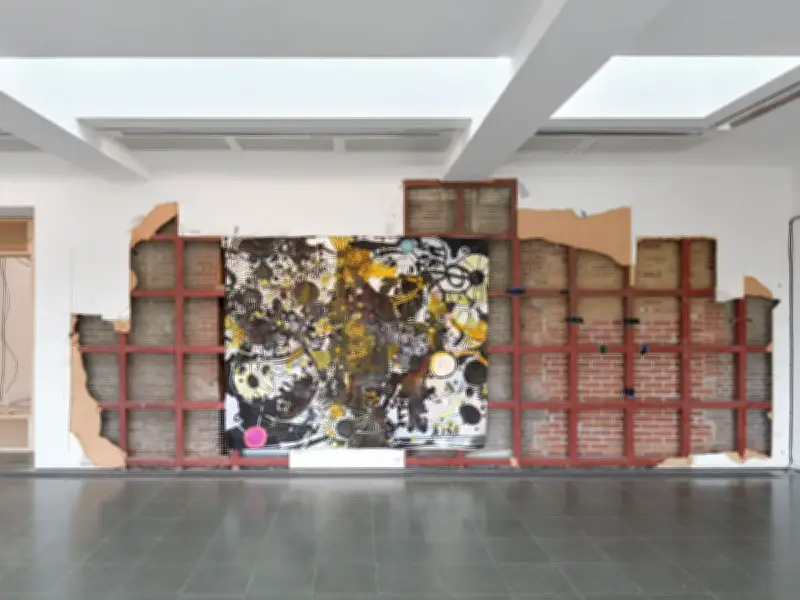
A decaying body made of bread lies crumbling at the opening of Justin Caguiat's show, Change Ringing, at Serpentine South, while bells chime discordantly. Psychedelic landscapes hang on the walls, with skeletons, skulls, and falling girls emerging from the cosmologies. Behind them, the gallery's walls have cracked, exposing brickwork, wiring, and more strange bread artifacts. The effect is like walking into a cult ceremony in a squat where all the residents, through some stupendous ritual, have beamed up to Venus.
Transformation Through Destruction
Multi-disciplinary artist Justin Caguiat – an American with Filipino heritage, born in Japan – is interested in transformation wrought through destruction and rebirth. He chooses art over mind control or drugs to affect those who enter his spaces. This Serpentine South takeover turns the gallery itself into art, in a disorientating experience that rewards time and patience. He doesn't turn the gallery into art by mere décor; rather, the gallery engages with the art and transforms it further, becoming an amplifier.
The bells – in the shapes of flowers and seeds – follow the English change ringing practice, where church bells sound in mathematical non-repeating patterns. Usually achieved by pensioners holding ropes, Caguiat has made them mechanical, responding to a score by composer Lily Pickett. In a central space, called Hysteresis Loop, they trigger heating pads connected to copper discs covered in thermochromatic pigments.
Paintings That Change Before Your Eyes
The paint on the discs responds to shifts in heat and light, so when the bells chime and the light shifts in the room, the paintings change before your eyes. At first barely noticeable, it quickly becomes addictive, with wires hanging down from copper plates mounted high on the walls, making them feel like alien relics. Throughout the rest of the gallery, bells on walls follow the ever-changing pattern and ring out – often making you jump – giving a sense not of solemn holiness but of disruption and even death.
For Caguiat, death doesn't seem like the end, more a change of state. His bread body seems like a body rescued from, and turning into, rubble from a war zone, but it suggests sustenance and communion too. On a wall in another room, a bread angel is pinned to the wall, untreated, already cracking and decaying in the air. There's a tension between holy desires and the realities of the flesh, resolved by a Buddhist sense of death as change not obliteration, despite the Christian overtones. The bread and wax totems littered about – a bunny, a hand – also feature a children's TV character, giving the formal rituals of Christianity new playfulness.
Psychedelic Cosmos and Hidden Film
In a small, almost hidden side room, an old-school projector plays a film featuring the artist in locations around the world, playing with disguises in public settings and kitsch-style with genres. It feels childlike, with a sense of wonder, possibility, and glee in disrupting the normal drudge of things. That sense of excitement gives this show a crucial lovability among the darkness.
At its heart are large unstretched paintings hanging from the exposed fittings of the ripped-apart walls. Made for a previous exhibition in Spain called Zodiac Machine, these are truly psychedelic works – not simply Grateful Dead peace and love tie-dye, but dense cosmos out of which disturbing scenes and figures emerge. While these works look like realist works from inside the rings of Saturn, within their swirling fogs of suns and smoke are images closer to Klimt. One is revealed to be a girl falling from the sky, Danae the dreamer falling through space and losing form. Another densely gold and amber work reveals a skeleton form, as if Turner's Death on a Pale Horse has found new form as it is absorbed and transmogrified beyond the grave. A blood-red boiling broth has giant eyeballs bubbling on its surface, watching and waiting for more forms to come from the miasma. Goya's The Disasters of War was his main influence, a series of prints showing violence around the Peninsular War in the early 19th century.
In coming to experience this show, there is a sense of it putting back the power in our hands, to stop being witnesses and imagine new ways of living. No drugs required. Justin Caguiat: Change Ringing is at Serpentine South until 10 Jan 2027.