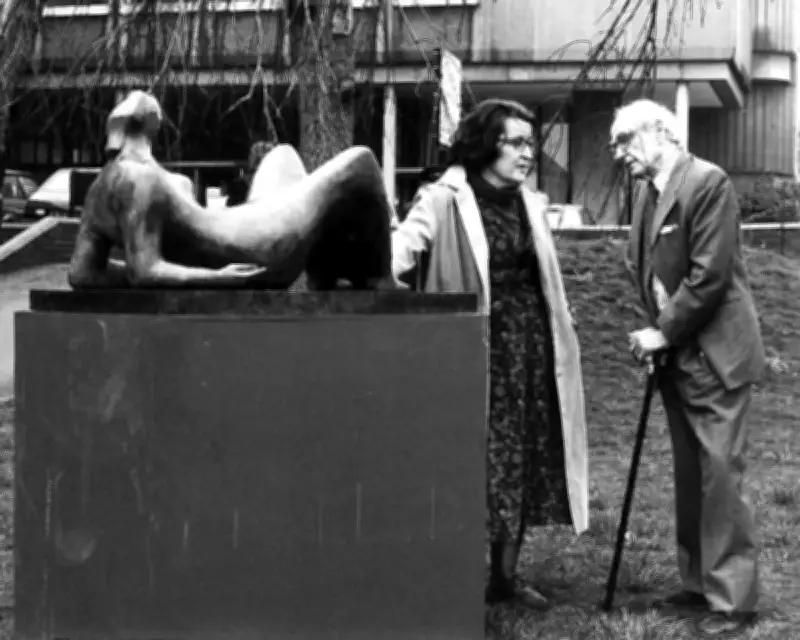
Gillian Spencer, the art gallery and museum director who helped revive Yorkshire's museum services in the 1970s and 80s, has died aged 95. Appointed as Wakefield's museums and art galleries officer in 1973, she found the city's collections crumbling in a polluted, coal-heated building she described as "a machine to destroy the collections". The City Art Gallery, with its incomparable collection of 20th-century painting and sculpture, was being run with a policy to hang pictures on the basis of "largest and lightest".
Repairing a Hepworth masterpiece
The gallery held crucial early works by two celebrated local artists, Henry Moore and Barbara Hepworth. When Gillian discovered Hepworth's Mother and Child sculpture (1934) damaged in store, she embarked on a revealing correspondence with the artist. Hepworth responded with fury but was calmed by Gillian's gentle and insistent manner, which described the realities in Wakefield and confided how Hepworth's 1968 exhibition at the Tate had given her strength during her divorce. Hepworth offered immediately to repair the sculpture.
Building Wakefield's art legacy
Gillian's instinctive understanding of the value of art for education and human happiness led her to support acquisitions of contemporary art, including works by Norman Adams, Bryan Kneale, Nicholas Pope and Euan Uglow. Born in South Norwood, south London, she was the first child of Peter Chapman, a schoolteacher, and Ada (nee Bryne). Evacuated with her younger brother Robin during the second world war to live with their mother's sisters in Blaina, south Wales, both children later attended Selhurst grammar school, Croydon. Gillian studied history at Newnham College, Cambridge, graduating in 1958, followed by a postgraduate diploma in archaeology at University College London.

A career in museums
Gillian began as a trainee at Winchester City Museum, becoming curator of Saffron Walden Museum in 1958. In 1959 she married the writer Colin Spencer, a childhood friend, and they had a son, Jonathan. The couple separated in 1965 and divorced in 1968. Posts in the education departments of Bristol City Museum and Norwich Castle Museum followed until her appointment to Wakefield. Her priority there, at local government reorganisation in 1974, was to assemble a group of young curators in art, archaeology and local history.
Conversations with Gillian were literate and thoughtful, while her political nous enabled her to grow Wakefield's stature as a city for art. She opened the former Elizabethan grammar school as an exhibition gallery in 1976 and laid the ground for the arrival of the Yorkshire Sculpture Park in 1977 and the Hepworth Wakefield, which replaced the City Art Gallery in 2011. After retirement in 1991 Gillian remained in the city and served on the fabric committee of Wakefield Cathedral. She is survived by Jonathan, three grandsons and two great-grandchildren.