A new book by Karl Kolbitz, Divine Presence: Depictions of Marble in Late Gothic and Early Renaissance Painting, delves into the supernatural significance of marble in art from the 14th to 15th centuries. The book argues that before the Enlightenment, marble was seen as a living, spiritual material, not just a luxury commodity.
Marble as a Mystical Substance
Kolbitz, a creative director and author, invites readers to consider a pre-science mentality where miracles, dragons, and astrology governed worldviews. In Greco-Roman and medieval science, divinity permeated all matter, including stone. The Latin word for marble, “marmor,” derives from the Greek “marmairein,” meaning “to glisten.” Aristotle believed marble was the solidification of the Earth’s “breath” or vapours. Vitruvius suggested the Earth actively generates marble at a perceptible rate, while astrological and alchemic ideas led one bishop in Brittany to claim that ingesting lapis lazuli could cure excessive sweating or reconcile sinners to God.
Artistic Depictions Defy Pictorial Rules
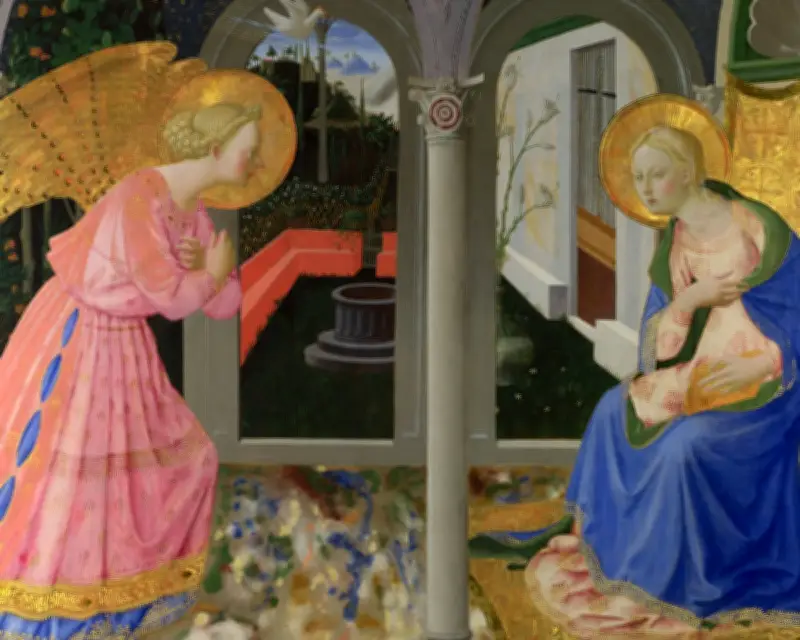
Kolbitz identifies instances where marble depictions are exempt from pictorial rules, evoking transcendence. In Zanobi Strozzi’s The Annunciation (1440–45), a wildly abstract marble floor contrasts with the controlled figures and architecture. Piero della Francesca’s Annunciation (c. 1467–69) features solid blue marble in the sky, blending hard earth and heaven. In Mantegna’s Lamentation Over the Dead Christ (c. 1483), the fictive marble pattern suggests the blood-red morbidity of Christ’s body. Giotto’s Scrovegni Chapel (c. 1303–05) mimics “book-matching,” where cut marble is arranged to create a desired pattern.

Versos as Fictive Marble
The practice of painting the back of a picture (verso) as fictive marble elevated humble wood into a pseudo-precious item, akin to adorning books and reliquaries with gems. Kolbitz’s cloth-covered book features a gilded top edge and the verso of Albrecht Dürer’s Christ as the Man of Sorrows (c. 1492–93) on its cover. He notes that “both sides of these objects were venerated, so the versos could function as meditations on the divine creation, Christ’s suffering and resurrection, or luminous visions of paradise.”
Straddling the Legible and Illegible
Kolbitz’s book originated from research on entryways in Milan, many adorned with marble. He argues that painting marble patterns offered artists a way to evoke gateways to the cosmos or divinity. Part of marble’s attractiveness is its ability to straddle the legible and illegible, drawing the eye while confusing it with natural chaos. The book is not an academic survey but promotes left-field thinking about beliefs around marble. Kolbitz writes, “We are far removed from the realities of people living in the 14th and 15th centuries. On the other hand, traces of their ways of thinking still persist in contemporary life,” citing the continuing fascination with crystals, stones, and astrology.
Divine Presence: Depictions of Marble in Late Gothic and Early Renaissance Painting by Karl Kolbitz is published by Hatje Cantz (£44).