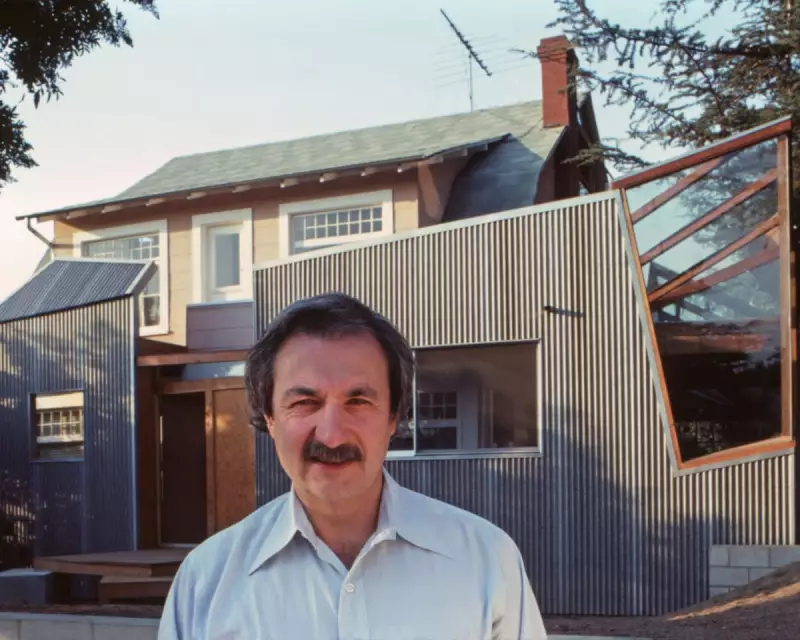
The architectural world has lost one of its most flamboyant and influential figures. Frank Gehry, the Canadian-American architect whose sculptural, titanium-clad creations became global landmarks, has died at the age of 96. Best known for the Guggenheim Museum Bilbao, a building that single-handedly transformed a city's fortunes, Gehry spent a lifetime rebelling against the straight lines of modernism, crafting structures that resembled billowing sails, quarrelling couples, and crumpled paper.
From Santa Monica to Stardom: The Making of a Starchitect
Gehry's journey to becoming a so-called 'starchitect' began not with a grand public commission, but with his own home. In 1977, he purchased a modest pink stucco house in Santa Monica, California, and proceeded to deconstruct and rebuild it with corrugated metal and chain-link fencing. The result outraged his neighbours but announced a new, gritty populism in architecture, drawing parallels with the work of artists like Robert Rauschenberg.
This early work set the stage for a career defined by exaggerated geometries. A house for filmmaker Jane Spiller in 1980, with its plywood interior bursting through a metal shell, was described by critic Nicolai Ouroussoff as feeling "like the architectural equivalent of a couple quarrelling in the kitchen." Gehry's style evolved from this industrial bricolage to more refined, yet no less dramatic, sculptural forms, as seen in his design museum for the Vitra furniture campus in Germany.

The Bilbao Effect and the Peak of Spectacle
Everything changed in 1997 with the opening of the Guggenheim Museum in Bilbao, Spain. Confronting post-industrial decline, the city gambled on Gehry's vision: a breathtaking complex of swirling forms sheathed in 33,000 thin titanium sheets. It was an instant sensation, attracting 1.3 million visitors in its first year and catalysing an urban renaissance dubbed the "Bilbao Effect". The term became shorthand for the transformative power of iconic cultural architecture.
Propelled to international fame, Gehry followed with the Walt Disney Concert Hall in Los Angeles in 2003. A cluster of stainless-steel volumes, it glimmers like giant metal shavings on the city skyline. Inside, the timber-lined auditorium offers an intimate acoustic experience, with an organ whose pipes explode from the wall like a "box of exploding french fries." This period saw Gehry's innovative use of aerospace software to model his complex curves, liberating architectural form-making and inspiring a wave of imitators.
A Complex Legacy: From Masterpieces to 'Pure Crap'
Yet, the relentless pursuit of the next Bilbao had its pitfalls. Later projects met with criticism. Seattle's Experience Music Project was seen by many as a disappointment, while the 2014 Fondation Louis Vuitton in Paris, built for Bernard Arnault, was criticised for shoddy workmanship. Gehry's global ambitions, like the long-delayed Guggenheim Abu Dhabi, led some to question if spectacle had overtaken substance.
Gehry himself was a vocal critic of much contemporary building. At a 2014 press conference in Spain, he bluntly declared that "98% of what is built and designed today is pure crap." His first and only UK building, the Maggie's Centre in Dundee (2003), was a surprisingly sober and compassionate design, modelled on a traditional Scottish cottage. Later involvement in London's Battersea Power Station development produced luxury housing some found formulaic.
Frank Gehry's 60-year career leaves an indelible mark on the skylines of the world. From the Dancing House in Prague to the shimmering fish scales of Bilbao, he proved that architecture could be emotional, chaotic, and profoundly popular. He was the maximalist master who showed that, sometimes, less is indeed a bore.