Artist Deana Lawson's latest photography exhibition at the Gagosian gallery in New York City uses surveillance images from beauty supply stores to analyze power, personhood, and the intersection of race and surveillance. Titled Edge Control, the show takes its name from the gels and pomades used to slick hairs along a Black woman's hairline, but in Lawson's exhibit, the phrase also becomes a tool to examine the beauty industry, consumerism, and how surveillance and race intersect.
Surveillance images as large-scale portraits
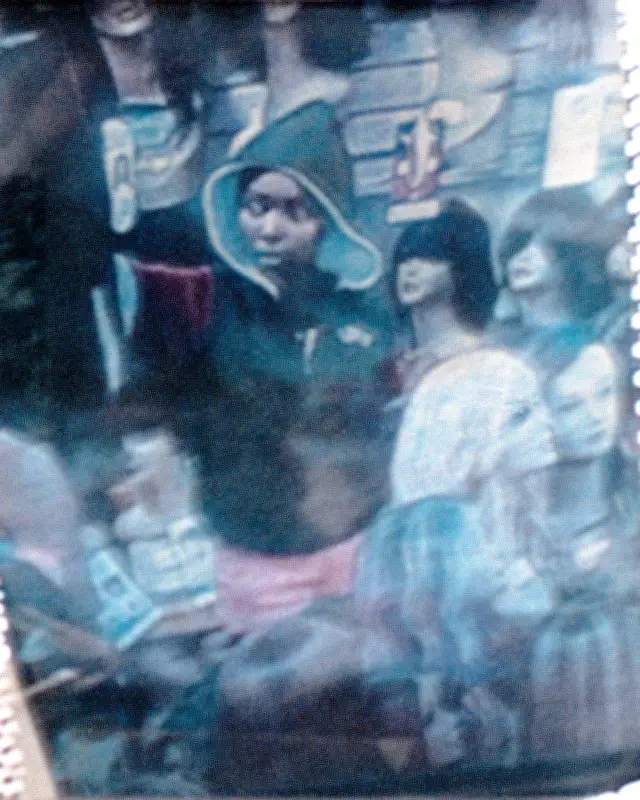
To explore these intersections, Lawson uses photos of alleged beauty supply store shoplifters, presented in large scale and outside their original contexts. Many beauty supply stores post surveillance photos of alleged shoplifters caught in the act of stealing products as a warning to customers. The stores, which almost exclusively sell Black haircare products within Black neighborhoods, are rarely owned by Black people. The small, indistinct images tend to fade in the background amid the various colors of shampoo bottles and hair accessories.
Lawson's images, however, are large portraits framed by mirrors, forcing the onlooker to simultaneously see themselves looking at these shoplifters. The viewer is small and narrow while the shoplifters are life-size, and what was once quiet, passive spectatorship immediately becomes active participation. This evolution is further emphasized once a viewer moves to the middle of the gallery room where two holograms stand, revealing Black women's bodies that shift depending on the viewer's angle. These pieces demonstrate how Lawson manipulates perception: these alleged shoplifters are not frozen in time, they are in motion, just as the viewers are.
Questioning wrongdoing and perception
The notion of wrongdoing is questionable as the exhibition becomes a house of mirrors exploring who is and is not being watched. The exhibit's official description proclaims that Lawson does not intend to cast moral judgment over these images, but rather "foregrounds the implications of agency and transformative potential of beauty products within our late capitalist society". Lawson is not trying to villainize or glorify these shoplifters, but she does protect them. The shoplifter photos are evasive – the original images are low resolution, some of the shoplifters are masked and a few of the photos are so blurry that the viewer is unable to make out the subject's face.
Lawson aims for neutrality in the depiction of her subjects by making the artistic decision to show them in stark contrast to other Black people whose images were not gathered from surveillance cameras. On the right wall opposite Lawson's shoplifter images, the photographer's signature style portraits hang: lush images of Black men and women in very private settings. In all these artworks, the subjects' gaze always meets the viewers', reinforcing their humanity and leveling the playing field. In fact, due to their size, the subjects seem to be looking down at you.
Blackness through a continuum
In the early 20th century, Black photographers would immortalize their Black subjects in suits, nuns' habits or graduate gowns to usher in a new form of race pride – and respectability – into the mainstream. Lawson's subjects are casually dressed – if at all. She's not interested in a dignified kind of Blackness, but rather the beauty of Blackness within the mundane. By placing all of these images together within the same space, Lawson forces the viewers to view Blackness through a continuum of life in all of its contradictions, rather than a flat binary of good and bad behavior.
The relationship between the Black subjects on both sides of the room is contingent upon the viewer's own judgment. However the viewer judges these subjects reveals their own biases. But in this exhibition, one's biases are not private, inconsequential flaws. They're ideological constraints that must be confronted.
Edge Control succeeds at capturing the extreme vulnerability of people who are being surveilled without their knowledge in active pursuit of beauty. At the same time, Lawson narrows the gap between spectator and participant as the viewer is confronted with multiple gazes–including their own–so that no one person is valued differently than the other. With power being briefly reassembled, parity is achieved. Edge Control is on view at the Gagosian in New York City until 24 October.