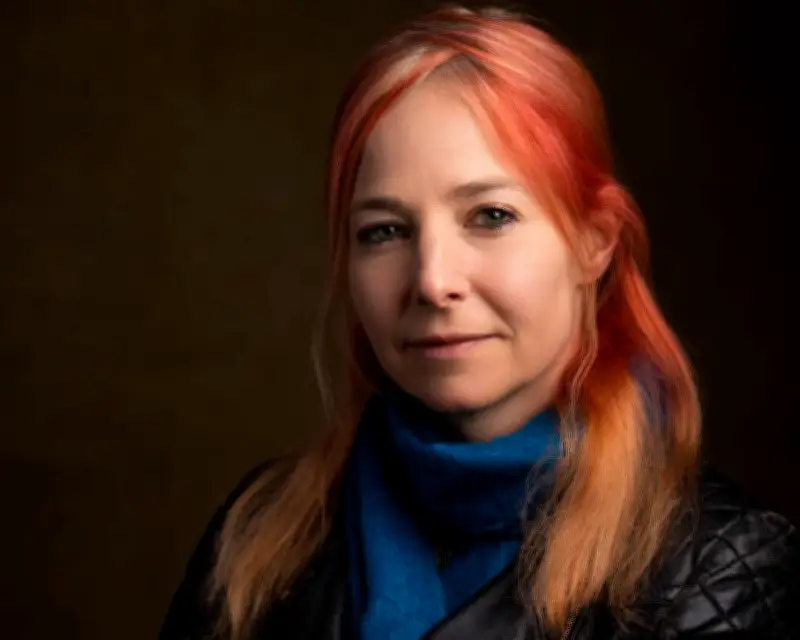
Alice Roberts, the TV presenter and author, has revealed how reading Richard Dawkins's The Blind Watchmaker led her to leave the Anglican faith she had been brought up in. In an interview, she explained that biological diversity could be entirely explained through natural processes, with no need for a divine creator. She became a humanist, although she did not know the word for it at the time.
Early Reading and Favourite Books
Roberts's earliest reading memory is from The Village with Three Corners series by Sheila K McCullagh. She loved the colourful characters, such as Johnny Yellow Hat, and remembers reading with her Grandma in her garden, surrounded by bright begonias and busy lizzies.
Her favourite book growing up was Arnold Lobel's Frog and Toad stories. She enjoyed the humour and heart of the tales, where Toad would get himself into difficulties but Frog was always there as a caring and funny friend. She later read these stories to her own children and still revisits them.

Books That Changed Her Perspective
As a teenager, Roberts loved Alan Garner, Susan Cooper, and Rosemary Sutcliff, but the book that had a profound effect on her was Richard Dawkins's The Selfish Gene. Passionate about biology, she found that the gene's-eye view turned her understanding upside down and made evolution make sense. She went on to read all of Stephen Jay Gould's essays on evolutionary biology, and both authors inspired her.
Roberts never set out to be a writer. She wrote her first book as a handout to accompany her first television series, Don't Die Young on BBC Two. As a university academic, she wanted something more to go with the programmes. In her writing, she always returns to Gould's advice and example, which held that it was possible to communicate complex ideas without dumbing down, by providing enough steps and stripping away unnecessary jargon.
Later Discoveries and Current Reading
Roberts keeps coming back to Darwin's On the Origin of Species by Natural Selection, which is full of wonderful details and insights. She loves the way he takes readers on a journey from the known and familiar to the novel and strange.
She discovered George Eliot's Middlemarch later in life, having dismissed it as boring and banal based on her experience with the Brontë sisters and Jane Austen at school. It was Andrew Copson, chief executive of Humanists UK, who persuaded her to read it, and she was blown away by the complexity of the characters and the way it challenges prejudices.
For work, Roberts is reading Fritz Graf's Roman Festivals in the Greek East and Mary Beard, John North, and Simon Price's two-volume series on the Religions of Rome. For pleasure, she has recently finished Val McDermid's Queen Macbeth and Karen Hao's Empire of AI. She is also listening to Otto English's Notorious audiobook and reading Liu Cixin's The Three-Body Problem to her teenage son.
Her comfort read is The Little Book of Humanism, a book she helped to compile, full of everyday humanist wisdom. Her book The Goddess Queen is published on 1 September by Gallery UK.