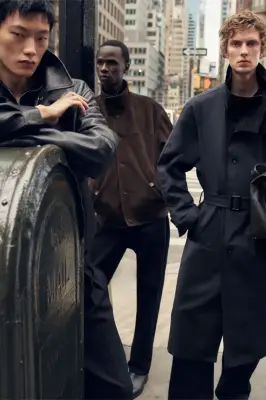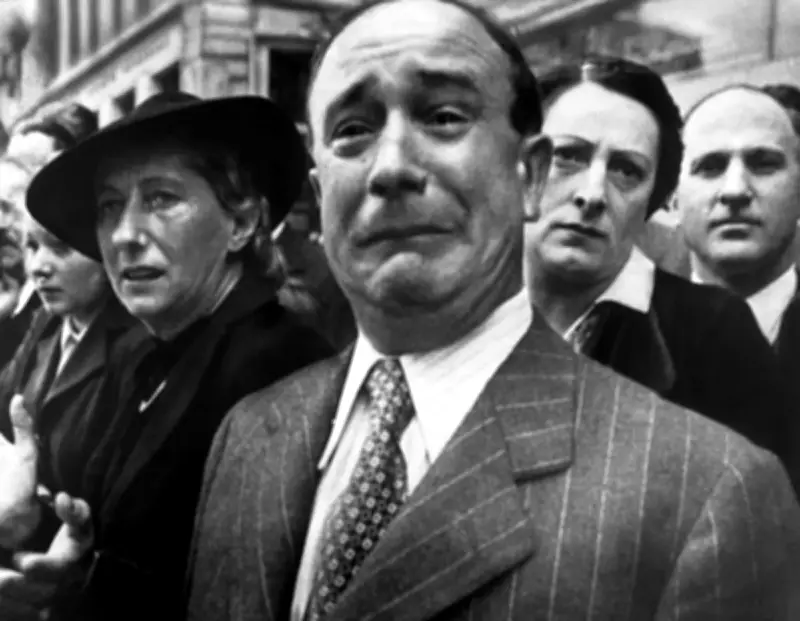
A collection of 39 groundbreaking photographs, introduced by author Luke Kennard, challenges long-held assumptions about how men behave, dress and project power. The images range from a body-building Arnold Schwarzenegger to a weeping Frenchman during the second world war, and include figures such as Marlon Brando, David Bowie and Billy Porter.
Kennard reflects on the enduring power of these images, noting that while men were traditionally depicted as acting and asserting dominance, turning the gaze onto masculinity itself can feel subversive. He observes that images of men crying, such as the weeping Frenchman and Paul Gascoigne's tears at the 1990 World Cup, remain remarkable even in the 21st century, despite a 2016 study finding that modern men cry in public more than twice as often as their fathers.
From Bodybuilders to Metrosexuals
The collection charts the evolution of male ideals, from Eugen Sandow, the father of modern bodybuilding, to Schwarzenegger and Hulk Hogan. Kennard notes the absence of the average male body type in media, which tends to present men as either waifs or muscle-men. He also highlights the rise of the metrosexual ideal, cemented by David Beckham's sarong at the 1998 World Cup, which he has stood by, saying in 2014: "Sarongs are great. I would still wear it now."
Challenging Masculinity Through Art
Many of the photographs offer alternative visions of masculinity. Depictions of queer masculinity, from Leigh Bowery's confrontational portraits to Rotimi Fani-Kayode's sculptural compositions of Black queer men, are presented as powerful counter-narratives. Sunil Gupta's Exiles series documents the underground culture of gay male life in India in the 1980s, before homosexuality was decriminalised there in 2018.
Other images capture moments of vulnerability and connection. A 1958 photograph of John F Kennedy with his baby daughter Caroline became a key part of his public image as a novel breed of male politician. A 1986 poster of a hunky man cradling a baby tapped into the archetype of the 'New Man' who rejected sexist ideas around domesticity, though the model later claimed to have leveraged the poster's fame to sleep with more than 3,000 women.
Violence, Power and Protest
The collection also addresses darker aspects of masculinity. Donna Ferrato's work documents the devastating impacts of domestic violence, with one image showing an eight-year-old boy shouting at his father as he is arrested. Photographs of Vladimir Putin on horseback and Teddy Roosevelt on a horse are examined as carefully crafted images of power, with Ruth Ben-Ghiat, author of a book on strongmen, noting that "the use of masculinity as an authoritarian tool is deadly serious."
Some images have become symbols of resistance. Wolfgang Tillmans' photograph of two men kissing at a club night called The Cock was slashed by a visitor when exhibited in Washington DC in 2007, and was widely posted as a defiant act of protest after the shooting at Orlando's gay nightclub Pulse in 2016. The collection also includes a 1970 public information poster of a pregnant man, dreamed up by ad company Cramer Saatchi, aimed at increasing the "sexual responsibility of the male."