A blood-stained, bullet-pierced World War One diary found on a rubbish tip in 1965 has finally been solved, revealing a tale of heroism, love and tragedy. The diary, discovered among household waste by 12-year-old Alan Southall in 1965 in Stourbridge, Worcestershire, had a final entry dated 10 August 1918, but little was known about the Australian soldier who wrote it.
Historian Unravels the Mystery
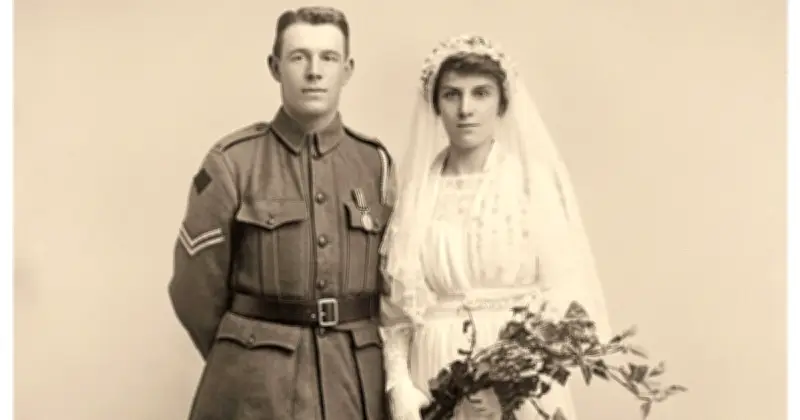
Finally, 108 years after it was written, historian Colin Reid has pieced together the inspiring life of author Corporal Claude Nuttall, who was once awarded the Military Medal by King George V for a daring rescue in No Man's Land. But the diary also reveals the tragedy of war, as the Battle of the Somme survivor, who wed his English sweetheart Violet in Worcestershire, died on 13 August 1918 - three days after the last entry.
Colin's book 'The Digger's Diary' - as Australian soldiers were nicknamed 'Diggers' like the English were 'Tommies' - tells the incredible story of Cpl Nuttall from the 23rd Australian Infantry Battalion. Married father-of-two Colin, 69, of Hartlepool, told the Express: "Two things have happened to bring this story to fruition - luck and chance."
"I was doing an exhibition for the Dudley Museum in 1996 about people from the Black Country in wartime, put out an appeal and was given all kinds of really interesting stuff relating to local soldiers. Then Alan brought in the diary and said 'I found this on the rubbish tip in Stourbridge when I was a kid'. Alan fascinated me with his story."
"And of course, there were the bloodstains and a bullet hole going through the pages. It was an enigma and I just thought 'I've got to find out what happened with this guy'."
From Melbourne to the Western Front
Cpl Nuttall was born in 1895 and attended Cheltenham State School in Melbourne, but in 1915 enlisted in the Australian Imperial Forces a few days after his twentieth birthday and was assigned to the 23rd Battalion. He embarked for Egypt on 27 September to reinforce his battalion that was fighting the Turks at Gallipoli. He later joined the 23rd at Tel-El-Kebir, Egypt, in January of 1916 and left for Marseilles in March 1916.
By 10 April 1916 they were occupying trenches in northern France, and in the battles of Pozieres - part of the disastrous Somme campaign - his battalion lost almost 90 per cent of its soldiers. But it was in August of 1916, aged 21, that he was awarded the Military Medal personally by King George V, when he and three pals volunteered to rescue two wounded soldiers at 4am who had fallen in No Man's Land. Four months later Claude himself was shot in the right leg in action and evacuated to Wordsley Hospital, near Stourbridge, Worcestershire, where he met 18-year-old local Violet Palfreyman.
Love and Tragedy in the Diary's Final Pages
From 1 January 1918 Claude kept the daily diary in a small green-covered book. In it he wrote of lectures and parades, and other military activities he was engaged in as a corporal, breakfasts of chips and bacon which he enjoyed, a visit to a cathedral one Sunday, playing billiards and attending films. After postings in the UK they married on 25 March 1918 in a small village church at Wordsley and spent a little more than thirty days together before Claude was ordered to re-join his battalion in France. The couple never saw each other again.
Frequent references in the diary are made to letters received from Australia and letters written and sent, particularly to Violet, his young wife. Claude wrote of the time a German shell landed two feet from him, but he was unhurt. He also described the day that Australia's General Monash arrived with two French generals to view captured German guns, and the occasion when some 'Yanks' came 'to observe to gain experience from our boys'.
Towards the last entries in the diary, Claude wrote of conditions in the dugout. Such as: "Stood to all night. Rained like the devil all the time. Our dugout got very wet. About 8 p.m. Fritz opened up a bombardment and dropped a shell into our trench wounding two and filled our dugout with mud and dirt. Letter from Vi."
The last entry was written on 10 August 1918 recounting some military successes: "Heavy bombardment by our guns. Push still in progress. Started letter to Vi. 11 ¼ inch gun captured by 31st Btn and train came back from forward. Packed up ready to move forward again. Prisoners still coming back. Wrote to Violet."
The next pages of the diary were blank. He was killed three days later after a sniper shot him while he was attacking a German machine-gun post during the Battle of Amiens. It is feared the blood stains and the bullet hole in the diary occurred when he was shot dead on 13 August 1918, only three months before an armistice was finally declared and fighting ceased.
A Lasting Legacy
Just prior to the signing of the armistice in Europe in 1918, a memorial service to remember the sacrifice that Claude made was held in his parish church, St Matthew's Church of England, Cheltenham, Melbourne. Colin said he traced Nuttall's story from Dudley to the battlefields of France and eventually to his hometown of Melbourne, uncovering a tale of "faith, love and unimaginable courage".
He told us: "I just felt this is actually a personal story… I couldn't help myself. Right from the very first moment that I held the diary, I had that real sense of connection with it. I was really hooked."
"There was a greater poignancy in something that actually has been created or treasured by somebody… something that kind of records a life."
"Writing the book has been a labour of love that began 30 years ago when I was manager at the former Dudley Museum and Art Gallery. When the diary was given to me for an exhibition on the Great War, it set me on a lifelong mission to discover Claude's fate."
It is thought when Violet died his diary may have accidentally been thrown out along with other family possessions and ended up on the rubbish tip to be found by chance by Alan. Colin's research has now been brought together in a new book, that will be launched at Stourbridge Library on 15 October, as part of Dudley History Festival. The diary is now with Claude's family in Australia. The Digger's Diary will also be launched at the ANZAC Memorial in Sydney during Remembrance Week.