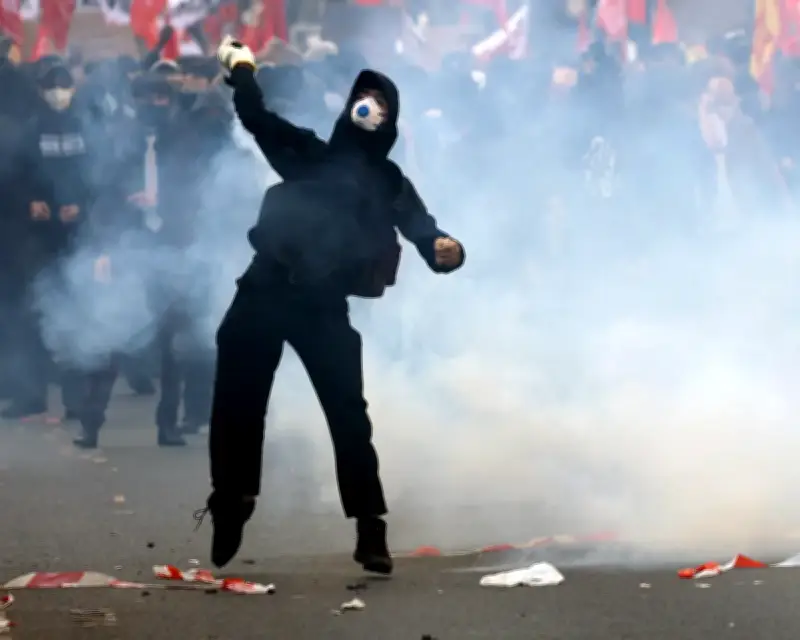
French high school students took to the streets on Tuesday in a nationwide day of protest over overcrowded classrooms, teacher shortages and dilapidated school buildings, with demonstrators and police clashing in Paris.
Reasonable demands
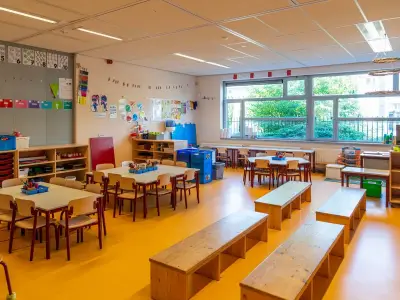
The protesters' demands include investment in crumbling schools, replacing absent teachers, reducing class sizes and overstuffed timetables, and bridging the inequality gap between schools in different areas. The protests, dubbed “l’acte III” (Act 3) or “la grande mobilisation” by demonstrators, were billed as the most dramatic day of action yet, with more school blockades and a march through central Paris in the afternoon.
More than 400 schools closed preventively, including the combined collège (for 11- to 15-year-olds) and lycée attended by the elder daughter of Helen Massy-Beresford, a British journalist living in Paris. At 11, her daughter is too young to be involved, and Massy-Beresford expressed relief after reports of fireworks, burning bins and smoke as students ran in through the gates one day last week.
Violence and injuries
While there have been some cases of violence from protesters, heavy-handed police methods have been severely criticised. In one incident, in Tours, a 16-year-old boy lost sight in his right eye, an injury the city’s prosecutor said was consistent with a rubber bullet. In a particularly dark turn on Monday, a lycée student lost his hand at a demonstration in Lens, northern France, in circumstances that are not yet entirely clear. A police investigation is under way.
As the protests have grown in scope, the French prime minister, Sébastien Lecornu, has promised the government will listen and try to meet the main demands – but that’s unlikely to mean suddenly freeing up billions to invest in schools that have gone underfunded for years, as videos posted online of rat-infested, flooded or crumbling classrooms testify.
Political tensions
The political debate surrounding the escalating social movement is angry and polarised, seen as a foretaste of how the country’s April 2027 presidential election is likely to play out. The high school movement comes at an already tense time, with France’s government once again trying to push through a budget full of spending cuts without a parliamentary majority.
Last year, to get the budget over the line, the government had to use special constitutional powers to bypass the need for a parliamentary vote. This year’s budget, due for a vote in November, includes pension and healthcare cuts aimed at helping to plug the seemingly bottomless budget deficit – and is likely to be just as problematic for the government.
The intensity of the protests has prompted a mudslinging match between two of the favourites for the first round of the presidential elections. Jean-Luc Mélenchon, the leader of France Unbowed, is vocally on the side of the protesters but rejects the narrative that his party stirred up the unrest. Meanwhile, Marine Le Pen, leader of the far-right National Rally, is using the protests to call for an anti-riot law.
Olivier Faure, the Socialist party leader, during a presidential primary debate among leftwing candidates, urged people not to fall into the classic rightwing trap of focusing on the violence while ignoring the cause of the protests. Faure made reference to the proverb of the wise man pointing at the moon and the fool looking at his finger: “look at the moon, not the finger,” he said.
Many of the lycéens protesting today will be voting for the first time next April. Even if Le Pen is now looking at the finger, she certainly shouldn’t be written off for next year’s election; her message seems to be resonating with a large number of French citizens and she is the clear favourite for the first round of the presidential elections. In 2017 and 2022, she was up against Emmanuel Macron, a centrist candidate who voters from across the spectrum could get behind to block her. As things stand, that may be harder for many in 2027. Le Pen’s opposition is fragmented, with several potential candidates still in the running on the left and centre right.
In Massy-Beresford’s north-east Paris neighbourhood, everything stayed quiet on Tuesday. But in the centre of the city, organisers say some 100,000 people turned out (the interior ministry estimated 56,000). Under a blazing early October sun, huge – and mainly calm – crowds gathered in Place de la République and marched to Place de la Nation to chant and wave placards. As the main crowd dispersed, some small groups clashed with police as the sun was setting.
For now, the movement’s momentum seems to be building, not receding. Some politicians are realising that, six months away from a fraught election, they should listen to their future voters.