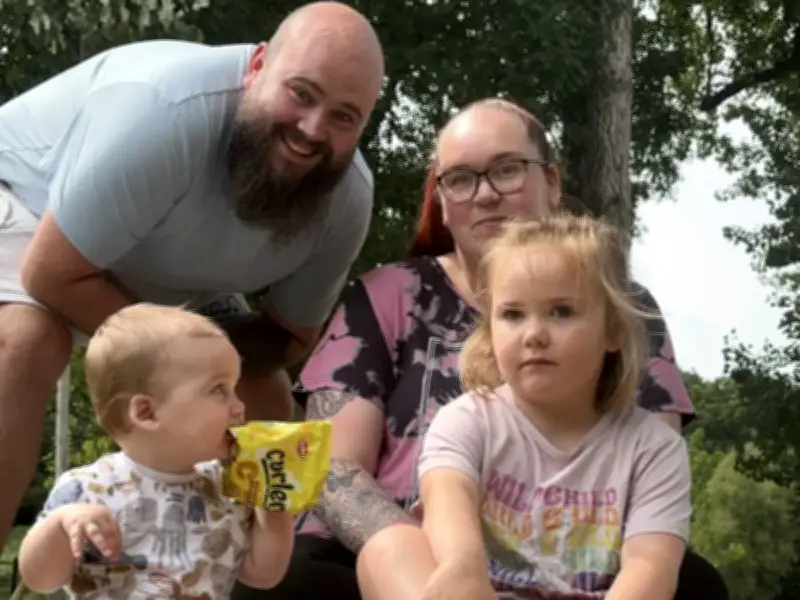
A mother from Bargoed, South Wales, says she is at “breaking point” after her six-year-old daughter was refused school transport and a specialist education place, leaving her missing classes when the family cannot safely get her to school.
Tyler Gapper says her daughter Sky has juvenile arthritis and autism with a demand avoidance profile, as well as limited mobility and little danger awareness. Sky can walk for only around six or seven minutes before complaining that her legs hurt, and needs a disability pram when out of the house, according to her mother.
Tyler, 30, claims the family has been refused transport to Sky's current school despite providing medical evidence, including a letter from an occupational therapist saying transport would benefit her. She says the decision means Sky can miss around eight out of 23 school days in September alone when her partner Evan, 32, is working day shifts and cannot safely take her.
Mother describes daily struggle
“If we can’t safely get her there, then she can’t go,” said Tyler. “She needs her disability pram as she has some muscle loss from her last arthritis flare.”
“In the month of September, it’s 23 school days she will miss. Eight, just because my partner is on day shifts and can’t get her there safely, but potentially more with hospital appointments.”
“She needs help with everything – every aspect of her day, [from] getting dressed and carrying her school bag, to putting on her coat and her shoes, and she needs supervision going up and down steps. Sky needs an adult to emotionally regulate her and she likes reassurance constantly.”
Tyler says she has also applied for a specialist resource base, where she believes Sky would receive more adult support and be better able to manage sensory demands and transitions. But the council has reportedly rejected the application, saying Sky's mainstream school can meet her needs.
School staff concerns
Tyler says this contradicts concerns raised by staff at Sky's current school, who she claims have told her they worry about having enough adult support to keep her safe. She said: “Anyone who has an autistic child knows what they’re like. The bus is every hour; if we missed that bus and had to wait an hour for the next one by a main road, it becomes a massive safety concern.”
“She swears, shouts, hits out, throws things, hurts herself and runs off. Sometimes, two teachers are having to deal with Sky out of class and they can’t do this forever.”
“They worry about keeping her safe. They’ve said she would be suited more to a specialist resource-based setting where there are fewer kids and more teachers.”
“They worry about having enough adult support that Sky requires. And they’ve had to make adjustments for Sky, which means the other children in her class have missed out. For example, in the summer they used to keep the doors open to the classroom that went out to the yard but now they can’t because Sky can’t be unsupervised and she’d be straight out there.”
Health and education challenges
Sky was diagnosed with juvenile arthritis and autism aged two. Her latest arthritis flare affected both ankles, her left knee, both hands, wrists and fingers. Tyler said Sky's medication stopped working, meaning she required blood tests, intravenous steroids and new medication before her symptoms eventually eased. She believes the flare has affected Sky's mobility and says her daughter has undergone hydrotherapy.
“She’s used a chair for around two years because she can’t walk too far and to keep her safe as she doesn’t have danger awareness. She’s autistic with a demand avoidance profile, which means every demand is a threat to her and she shuts down,” Tyler said.
“Her current school is amazing and they try their best, but there are 20-plus other children in the class who need their attention too.”
Despite her difficulties, Tyler says Sky is bright and has taught herself skills well beyond her years. “Sky's a funny little girl. She's strong-willed, always laughs at the most silly things, she loves music and actually makes her own music on GarageBand,” she added.
“Sky likes playing the piano and she loves numbers. She knows her times tables; she’s been able to read and spell since she was three, she likes learning, especially things that spark her interest, but she has to be regulated to be willing to learn.”
Tyler says Sky's school has made numerous adjustments to try to support her. “The school is incredible. The teachers and headteacher are the best about. They’ve made every adjustment they physically can; they’ve had the educational psychologist in to see Sky three times, they’ve adapted to a no-demand teaching approach and they’ve given her safe areas in the classrooms with things she likes, like the whiteboard,” she said.
“They do sensory circuit with her, and have sensory toys and quiet areas available too.”
Appeals and council response
The family has applied for transport to Sky's current school, but Tyler claims they were rejected on the basis that there was insufficient medical evidence. Tyler says she appealed the decision but says it was rejected again. She claims the council also cited the fact that the family had moved Sky out of her catchment area. Tyler says she made that decision because one local school had previously failed to meet Sky's needs, while the other was Welsh-medium and she believed Sky would struggle to communicate there.
The mum would prefer a taxi from their home to school with an adult accompanying Sky. Tyler added: “The fighting, nobody listening or helping me, having to gather evidence that my daughter needs more support and nobody taking it seriously – I’m exhausted.”
“I trust her teachers and headteacher. Even though they’re worried about keeping her safe, I know 100% they will try their hardest but every time my phone rings and it’s the school, my heart drops.”
“I feel like I’m fighting constantly. The system is broken; something needs to change and I can’t just be quiet and accept the bare minimum. It’s unfair. I’m doing the work of a parent, carer, receptionist, and advocate with no regular breaks or any help. I don’t get to clock in and out; it’s 24/7. What keeps me fighting is my daughter.”
“I have to keep going because she deserves an education, she deserves to be safe and regulated, she deserves the world and I’ll never give up. I want the council to see my daughter more than a number.”
“I want them to see she needs more support than mainstream can offer her. I want them to take me seriously. I want them to put more funds and resources into schools for SEN children, not just for my child but for every SEN child so other parents don’t have to fight.”
“We’re exhausted already without the extra fight. Sky isn’t learning to her full ability because she’s not in an environment where her emotional and sensory needs can be met.”
A spokesperson for Caerphilly County Borough Council said: “We are unable to comment on individual cases. However, decisions regarding specialist provision and home-to-school transport are made following careful consideration of the information available at the time and in accordance with the council’s relevant policies and procedures.”
“The parents have been advised of their right to appeal the decision. The appeals process provides an opportunity for requests to be reconsidered and for any additional supporting information to be submitted for review.”