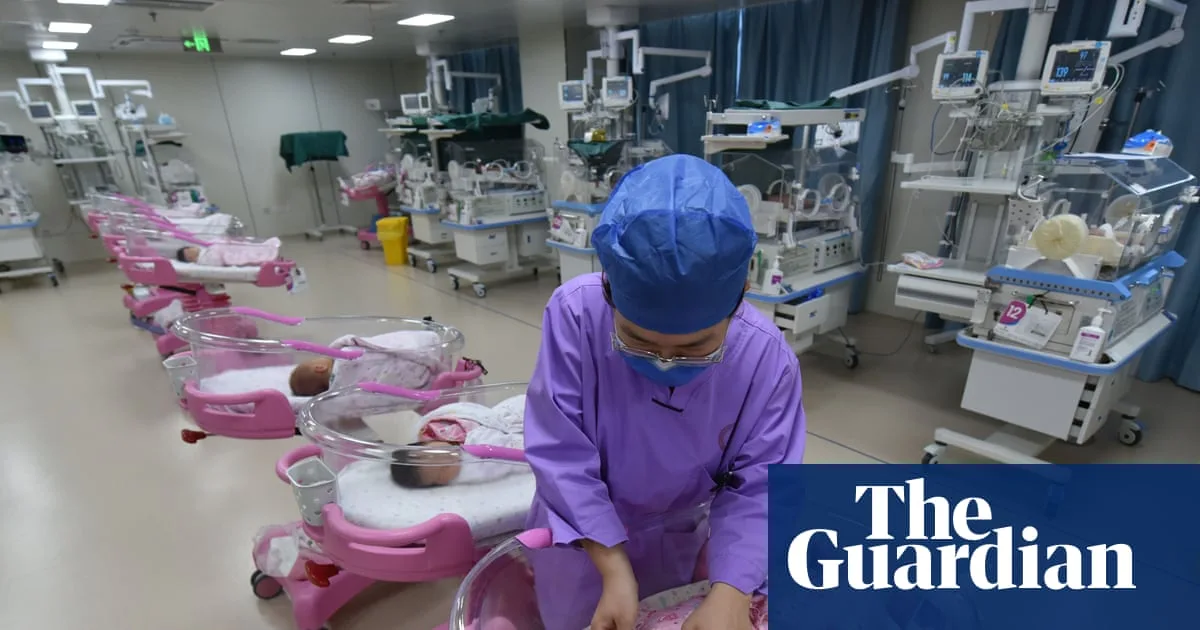
China's population declined for the fourth year in a row in 2025, with the birthrate plunging to a record low despite government efforts to encourage childbearing. Registered births fell to 7.92 million, down 17% from 9.54 million in 2024, according to the National Bureau of Statistics (NBS). The birth rate stood at 5.63 per 1,000 people, the lowest since records began in 1949.
The total population dropped by 3.39 million to 1.405 billion, a faster decline than in 2024. Deaths rose to 11.31 million from 10.93 million, pushing the death rate to 8.04 per 1,000, the highest since 1968. Demographer Yi Fuxian of the University of Wisconsin-Madison noted that births in 2025 were roughly equivalent to those in 1738, when China's population was only about 150 million.
The decline persists despite policies such as a 90 billion yuan (£9.65 billion) childcare subsidy programme for children under three and plans to expand health insurance to cover all childbirth-related expenses, including IVF. However, high costs remain a barrier. The average cost of raising a child to age 18 is 538,000 yuan, over 6.3 times GDP per capita, compared with 4.11 times in the US and 4.26 times in Japan, according to a Chinese thinktank.
Social factors also play a role. Decades of the one-child policy, lifted in 2017, have conditioned adults to favour single-child households and reduced the pool of childbearing-age individuals. Marriages, a leading indicator for births, fell by a fifth in 2024, though a policy change in May 2025 allowing couples to marry anywhere in the country led to a 22.5% rise in marriages in the third quarter.
China's population has been shrinking since 2022 and is ageing rapidly. Over-60s account for about 23% of the total, and by 2035, the number of people over 60 is expected to reach 400 million. Retirement ages have been raised, with men now retiring at 63 and women at 58. The demographic shift complicates Beijing's plans to boost domestic consumption and manage debt.