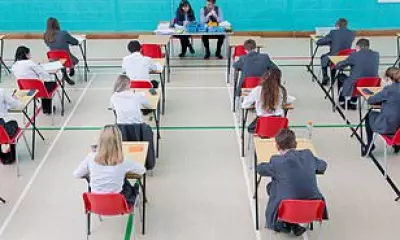
Distraught pupils have likened an A-level mathematics paper to a 'war crime', as over 19,000 individuals sign a petition demanding a review due to its excessive difficulty. The Pearson Edexcel Maths 1 paper, sat on Wednesday, faced widespread criticism after students claimed it was significantly harder than past papers and previous examinations, leaving them feeling 'overwhelmed' and 'uncertain'.
Petition Demands Fairness
A petition, launched in the days following the paper, has now garnered over 19,000 signatures and calls for grade boundaries to be adjusted accordingly to ensure fairness in marking. The petition, addressed to the examination body, states there is 'widespread concern among students, teachers, tutors and schools' that the test 'exceeded what many candidates reasonably anticipated based on the specification and past examination series'.
It emphasises: 'While it is normal for students to find examinations challenging, the scale and consistency of these concerns appears significant. Reports from candidates suggest that difficulty was not confined to a handful of demanding questions at the end of the paper, but was instead present throughout large portions of the assessment.'

The petition clarifies it was not created to 'avoid accountability for performance', nor is it an assertion that 'examinations should be made easier'. Rather, it states: 'It is a request that Pearson Edexcel examine whether the level of challenge presented by this paper was proportionate and whether grade boundaries should be adjusted accordingly to ensure fairness for all candidates.'
Student Reactions
According to the petition, pupils reported that the test 'required multiple layers of reasoning, extended algebraic manipulation, and unfamiliar approaches' that exceeded expectations based on previous exams. Reports indicate questions included trigonometric identities, solving a circular segment using the Newton-Raphson method, harmonic form and complex integrals.
In comments on the petition, students expressed their indignation at the intense difficulty. One described the exam as 'not accessible', while another labelled it 'atrocious'. Another commented: 'Walking out that exam hall, I couldn't feel any of my senses, couldn't see properly because of the tears rolling down my face, couldn't hear properly because of the trauma warping my hearing. All I could feel was sadness and rage.'
A parent named Karen said: 'My son has studied so hard for this exam and came home so deflated by the content and difficulty in the exam. This will have an impact on Uni offers.'
Regulator and Exam Board Respond
Ofqual, which oversees the regulation of examinations in England, said it was made aware of the concerns and will 'closely' monitor Pearson's approach to marking the exam. A spokesperson stated: 'Our priority is students and ensuring their grades are a reliable indication of what they know, understand and can do.'
Caroline Darrington, a spokeswoman for Pearson, assured that pupils will 'receive results that fairly reflect their performance'. She added: 'Every paper is developed with input from experienced senior examiners and rigorously checked to ensure it reflects the course and meets required standards. If a paper is found to be more difficult than previous years, grade boundaries will be set to reflect that. When setting grade boundaries, we review a range of evidence, including statistical data and expert judgment. This process ensures students receive results that fairly reflect their performance and are comparable across exam series.'