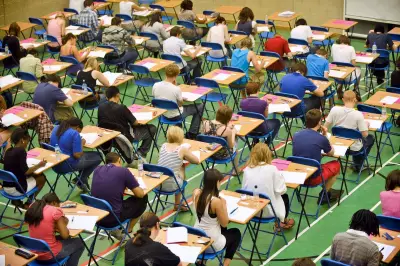
More than 15,000 individuals have signed a petition calling for a review into an A-Level mathematics examination, contending that it was considerably more challenging than previous papers. The petition, initiated on Wednesday, targets Pearson Edexcel's paper one exam, which students sat on the same day. Signatories assert that the test was substantially harder than any past papers, leaving them feeling overwhelmed and uncertain about their performance.
Petition Highlights Exam Difficulty
The Change.org petition details how the pure mathematics paper required multiple layers of reasoning, extended algebraic manipulation, and unfamiliar approaches. It argues that these elements disproportionately affected lower-achieving candidates, potentially undermining their grades. The petition states: 'Many students have dedicated countless hours over two years to preparing for these examinations. They have attended lessons, completed extensive independent study, worked through past papers, attended revision sessions, and made considerable personal sacrifices in pursuit of their academic goals. These students deserve confidence that their grades will reflect their mathematical ability rather than the unusual difficulty of a single examination paper.'
Ofqual Monitoring the Situation
England's exams regulator, Ofqual, has confirmed it is closely monitoring the marking of the exam. A spokesperson said: 'Our priority is students and ensuring their grades are a reliable indication of what they know, understand and can do.' The regulator is working with Pearson to ensure that grade boundaries reflect the difficulty of the paper if necessary.

Pearson's Response
Caroline Darrington, a spokesperson for Pearson, stated that the exam board is committed to ensuring a fair exam experience for all candidates. 'Every paper is developed with input from experienced senior examiners and rigorously checked to ensure it reflects the course and meets required standards,' she said. 'If a paper is found to be more difficult than previous years, grade boundaries will be set to reflect that. When setting grade boundaries, we review a range of evidence, including statistical data and expert judgment. This process ensures students receive results that fairly reflect their performance and are comparable across exam series.'
Broader Context of Exam Integrity
This controversy arises amid broader concerns about exam integrity. Ofqual recently issued a stark warning about the growing threat of pupils using high-tech smart devices to cheat in exams. Data from the watchdog reveals that cheating using mobile phones and smart devices has been the most common category of malpractice in every summer exam series since 2018. With over a million pupils sitting their GCSEs and A-levels this year, Sir Ian Bauckham, Ofqual's chief, has raised fresh concerns about gadgets such as smartwatches and glasses. Speaking on the regulator's new podcast series, 'Can I Just Qualify That?', Sir Ian stressed that 'mobile phones are not the only devices students can use to cheat. There are of course other devices, there are smart watches and smart all sorts of things. There might be smart spectacles next… that will play text across the inside of the lens that only the student can see.'