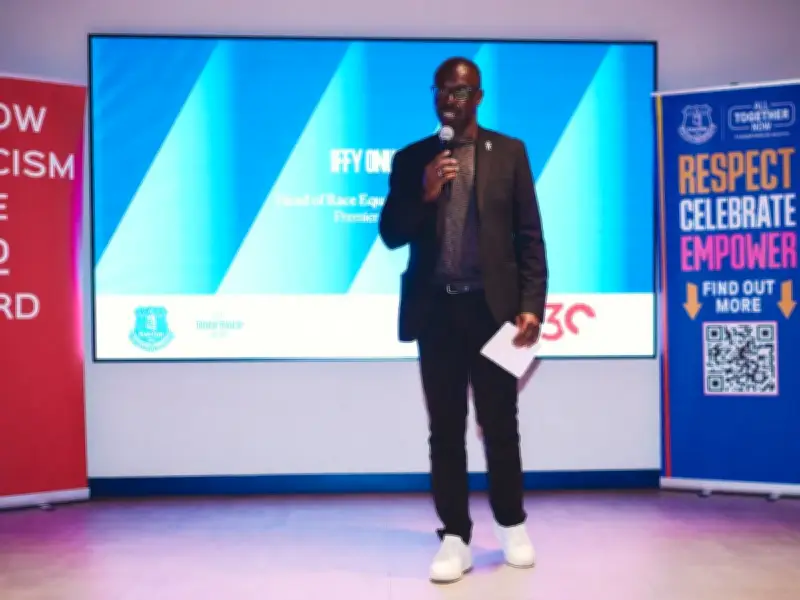
Iffy Onuora, the Premier League's first head of equality, diversity and inclusion, has praised Everton's transformation, having grown up watching the club when there were no black players in the team.
The 59-year-old, who attended the launch of an exhibition celebrating Everton's first 11 black players at Hill Dickinson Stadium during Black History Month, told the ECHO about his lifelong connection to the club.
A lifelong Blue with childhood memories
Onuora, who was born in Glasgow but moved to Merseyside as a child and attended Sacred Heart Catholic College in Crosby, recalled his early heroes: "My first Everton heroes were the likes of big Bob Latchford and Duncan McKenzie, all those guys. When I was still a kid, there was the 1980s team when we had the glory years under Howard (Kendall) with the likes of Peter Reid, Sharpy and Andy Gray."
He described sneaking into Goodison Park as a youngster: "I grew up watching from the terraces at Goodison Park when we were able to sneak in and catch a game. I was a little bit defiant, I was like: 'I'm going to watch the team, no matter what', but it was an uncomfortable time."
Although he had "a decent career" as a striker in the lower divisions, he admitted: "I wasn't quite good enough to play for the Blues which was always my dream. It still stays in your heart, half the family are all Blue and the other half, we don't talk about."
From Goodison to Hill Dickinson Stadium
Onuora, who never played at Goodison as an opposition player, praised Everton's new home: "I had so many great memories of Goodison from the 1980s, watching from the Gwladys Street. I'd hate the idea that it was bulldozed, so for me, it's great that it's still being used by Everton Women. Hill Dickinson Stadium, it's a magnificent though isn't it? We had to move and go on to the next level."
Working as a match delegate on weekends, he requested to officiate the first game at the stadium last season: "I asked for the first game at Hill Dickinson Stadium last season, I said: 'Please put me on that one', and have done a couple of matches since, but none yet so far this season."
Confronting racism and celebrating pioneers
Onuora detailed how conversations with former Manchester City player Alex Williams, who later received an MBE, opened his eyes to abuse at Goodison: "He told me about going in and working with Neville (Southall). Big Nev was a massive champion and supporter of him but unfortunately some members of the crowd would shout racist abuse towards Alex when he was warming up and working with Neville, who would defend him."
He highlighted allies including Peter Reid, Pat Nevin, and Seamus Coleman: "There were others among the Everton family who would always champion the cause... Gradually, there were enough important people at the club to make a difference."
Onuora paid tribute to Kevin Campbell, Everton's first black captain: "For me, 'Super Kev', Kevin Campbell was a big turning point with the impact that he had both on and off the pitch as club captain. He blazed a trail for the players that came afterwards... He had a lovely presence about him, and he was a real gentleman as well."
He noted the contrast with Liverpool's earlier black players: "I think by the time Daniel Amokachi signed for Everton (in 1994) there was a real clamour at that point. We'd all seen the impact that John Barnes had made at Liverpool... Everton remained, almost stubbornly, all white."
Onuora concluded with a warning about rising racism: "It's a sign of the times. We probably haven't recovered since the crash in 2008 and these things always seem to rear their head during economic downturns... We also have social media now. When we just had television, they probably wouldn't get the airtime."