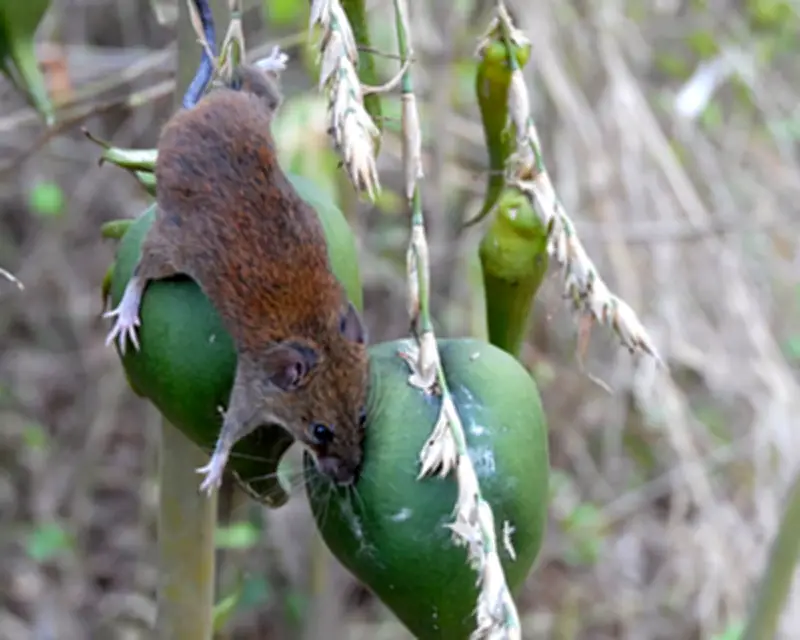
In the hills of Mizoram state in north-east India, the first sign of trouble for farmers is the arrival of swarms of stink bugs, known locally as thangnang. It heralds a predictable but devastating phenomenon: a rat boom that leads to famine. The mass flowering of bamboo species like Melocanna baccifera and Bambusa tulda occurs every few decades, producing vast quantities of seeds that trigger a surge in rodent populations. When the seeds are exhausted, the rats invade nearby farms, destroying crops.
Farmers Face Widespread Devastation
Maunsanga, a 62-year-old farmer in Mamit district, has cultivated his land for 40 years. He describes the current crisis as unprecedented: “I have been cultivating in this place for the last 40 years. Each year has had its own problems, but what I have noticed this year is that the damages are almost everywhere. No matter how alert we are even during night-time, there is nothing much that we can do about saving our crops.” His rice crop has been reduced from 30-40 bags to just three, insufficient even for his family.
According to the state agriculture department, more than 5,300 farmers have been affected across Mizoram. Rice has suffered the highest losses, but maize, ginger, pumpkin, and beans have also been damaged. In villages like Hriphaw, Mamte, and parts of Lunglei district, farmers report unusual rodent activity since late 2025 as bamboo flowering intensified.

The Science Behind the Cycle
Dr. Lalthanzami of the Forest Research Centre for Bamboo and Rattan explains the cycle: “The cycle usually happens every 48 to 50 years, depending on the bamboo species. The seeds become a major food source for rodents. Their breeding increases rapidly during this period and once the bamboo seeds are depleted, the rodents spread into nearby farms.” The mass flowering events are known as mautam (for Melocanna baccifera) and thingtam (for Bambusa tulda), with an 18-year gap between them and 30 years until the next mautam.
Beyond crop losses, the die-off of bamboo after flowering poses environmental risks. Dr. R Zoramthanga of Pachhunga University College in Aizawl warns: “Bamboo plays a major role in stabilising soil in these hill regions. Once flowering is completed, the bamboo dries and dies. This increases the risk of soil erosion and slope instability, especially during monsoon months.” He adds that heavy rodent feeding on bamboo seeds may hinder natural regeneration, forcing birds, insects, and small mammals to adapt or relocate. “It is not just a farming issue,” he says. “It is an ecosystem shift.”
Traditional and Government Responses
Farmers have tried various methods to protect their crops. C. Lalhriliana, a farmer in Lunglei district, describes nightly vigils: “You hear movement in the grass before you see anything. Sometimes there are so many that you cannot stop them. By morning, large sections of the fields are destroyed.” In Mamte, farmer Chungtea attempted early planting after warnings from neighbours: “I planted early thinking we could avoid the worst period. But the rats arrived before harvest. We lost almost everything.”
The state government has launched rodent control operations, distributing chemicals like zinc phosphide and bromadiolone, along with awareness campaigns. Hmangaihchhunga, a district agricultural officer in Lunglei, says: “We are trying to control the rodent population quickly before further crop losses happen. Field teams are visiting villages regularly and monitoring affected areas.” The government is also assessing crop losses for compensation and seed assistance.
However, some communities refuse chemical use due to contamination fears. Vanlalruata, a village council member in Hriphaw, explains: “Our water sources are very close to the fields. People are worried that poison could enter streams used for drinking water and fishing.” Instead, many rely on traditional bamboo traps like vaithang and chepthang, set along field edges and footpaths. Lalhriliana notes: “We catch many rats every night. Sometimes dozens. But the numbers are still very high.”

Historical Pattern and Need for Preparedness
The thingtam cycle has been documented in Mizoram for generations, with similar outbreaks during the 1958-60 famine that had lasting political and social impacts. Prof. Lalrinmawia, a historian at Mizoram University, says: “People know bamboo flowering can lead to rodent outbreaks. But long-term planning and preparedness have remained inconsistent. Many times the response begins only after the damage has already started.”
Researchers note limited evidence on whether climate variability affects the intensity of ecological impacts. Dr. Lalthanzami states: “The flowering itself is a natural biological cycle. But changing rainfall patterns and environmental stress may influence how ecosystems respond.” Calls have been made for monitoring bamboo flowering, better grain storage, and alternative cropping systems. “We need preparation, instead of an emergency response every few decades,” he says.
For now, farmers face an uncertain future. Maunsaga sums up the despair: “We know this will happen again. But knowing is not enough. Each time, we start from the same place.”