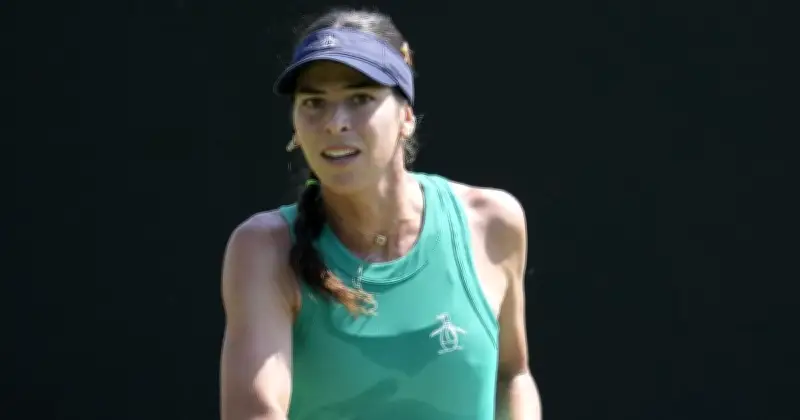
Two-time Wimbledon quarter-finalist Ajla Tomljanovic has launched a scathing attack on doping protocols and the International Tennis Integrity Agency (ITIA) following Marketa Vondrousova's four-year suspension for refusing a doping test. Tomljanovic described the system as 'awful' and accused doping officers of being 'cocky' and 'out to get' players.
Vondrousova's Four-Year Ban
Marketa Vondrousova, the 2023 Wimbledon champion, was handed a four-year ban on Monday after she refused to provide a sample when a doping control officer arrived at her home in December 2024. The Czech star cited stress, poor mental health, and safety concerns as reasons for her refusal, but an independent tribunal found 'no compelling justification' for her actions. Her suspension runs until June 21, 2030.
The ITIA has defended the severity of the punishment, stating that harsh penalties are necessary to prevent athletes from evading tests by refusing altogether. The case has ignited a row within the tennis community, with Tomljanovic leading the criticism.
Tomljanovic's Personal Experience
Speaking to reporters in Eastbourne shortly after the ban was announced, Tomljanovic shared her own frustrating encounters with doping officials. The Australian, currently ranked world No. 98, revealed that officers have tested her outside her designated one-hour time slot, which she finds intrusive and intimidating.
'They have come outside of my slot, never at night, but they have,' Tomljanovic said. 'I'm very lucky where I live. I have a really nice lady, and she's always in my slot. The funny thing is, the guy or woman, I don't know who it was, but they probably were busy. It's in their control. They don't have to test you outside of your slot. I've learned that. I've spoken to these people.'
She added, 'Once they have your slot, if they don't make it, they can just test you the next day. Them coming outside of your slot is just what they've decided to do that day. No one told them you have to come. So that's just to me, to do that at night. I mean, I wouldn't be comfortable if I'm living alone and someone comes at eight or whenever. Overall, I can count on one hand experiences, good experiences with these people. I think they're always out to get you. They're not very nice.'
Criticism of the Whereabouts App
Tomljanovic also criticized the whereabouts app that players must use to report their location for testing. She claimed the app frequently malfunctions, yet players can face suspension if they accumulate three whereabouts failures in a year.
'I can tell you the app doesn't work half the time. But then if you miss a test, you get a fail, three fails, and you're done. So it's like, how do we depend on an app that malfunctions all the time? It doesn't add up,' she said. 'I'm all for a clean sport, don't get me wrong. But it has to make sense.'
She recalled how early in her career, she missed a filing deadline because no one explained the rules. 'Ten years later, they finally send this thing to all the young players that have to come on it. “Okay, let's do orientation, we'll show you”. Ten years it took them. And I was two fails for a month, and I was living at my door. We shouldn't be living like this.'
Inconsistent Rulings and 'Cocky' ITIA
Tomljanovic expressed frustration over what she perceives as inconsistent rulings in doping cases. 'I mean, you look at a lot of different cases. The rulings are, what does someone get four years and someone else gets two weeks in the off-season? I don't know, I'm just asking. Four years and a month – it's a big difference,' she said.
She also accused the ITIA of being 'cocky' and 'out to get' players, even those who have done nothing wrong. 'I just think that the whole ITIA, they're so cocky. They're almost out to get you, even if you are doing nothing wrong. The rules don't make sense,' she added.
ITIA Response
In response to Tomljanovic's comments, an ITIA spokesperson defended the testing procedures. 'This case – unfortunate as it is for the individual – should make it clear that players can and will be tested outside of their allocated hour. Everyone wants a clean sport and to achieve this we need to have a strong testing programme which must be unpredictable,' the spokesperson said.
'We know this can be challenging for players. Having someone in your home or hotel room to watch you pee is stressful. We believe most of our testers deal with this in a respectful way, but they too have a challenging and not always pleasant job. We would encourage any player who has questions about the process, or issues with a tester to talk to us. We will always listen to any concerns or feedback.'
The ITIA also noted that anti-doping rules cover multiple sports and are applied fairly based on facts and evidence. They regularly hold sessions to explain the rules and help players navigate the system.
Tomljanovic's Near-Refusal and Ongoing Fear
Tomljanovic admitted she has come close to refusing a test herself. She recalled an incident during the US Open where testers arrived outside her slot. 'I was once. They came, I was in New York for the Open just two, three days out of the start. And I had a really early practice because I wanted to get on the stadium. And my car was at 7am and I put my slot at 5am just to be sure. I was a bit late for my car. So I exit my door at 7.05 and they're like walking to my door, the two people. And I go, “You're outside of my slot”. And they're like, “Doesn't matter. Sorry, like we have to”,' she recalled.
She stood her ground and eventually had a tester follow her for the day, allowing her to maintain her practice schedule. 'Obviously, I would. I'm too nervous. Like that was also in the morning. Like I'm too nervous. Obviously, I don't want to make trouble. So I probably would obey. But I don't know what she was feeling, the post she'd made about mental health and all that. Like that's all valid. Maybe she didn't think, you know, it would be consequences would be that harsh. I also actually didn't know that if you refuse a test outside of a slot, it's a four-year ban. So I've never gotten close to refusing, but I've complained,' she said.
Tomljanovic also described a tense encounter after a match at the US Open where a tester accused her of delaying on purpose. 'I usually know the people, and I didn't know this girl. And I was like, listen, I don't have time to spite you. I just lost in the quarters. I want to be out of here. But just the way she came at me, and I went back in there. She apologised right away. The nerve to even speak to an athlete that way shows me how much power they feel that they have,' she said.
She concluded by expressing hope for Vondrousova's appeal and calling for systemic change. 'I hope she appeals. I hope it gets better, but it's never good when the first ruling is a four-year ban. It's kind of a disgrace what's happened to Marketa. It's really sad that we're part of a sport where I think the treatment isn't equal. Equality is what we strive for. It's just insane,' Tomljanovic said.