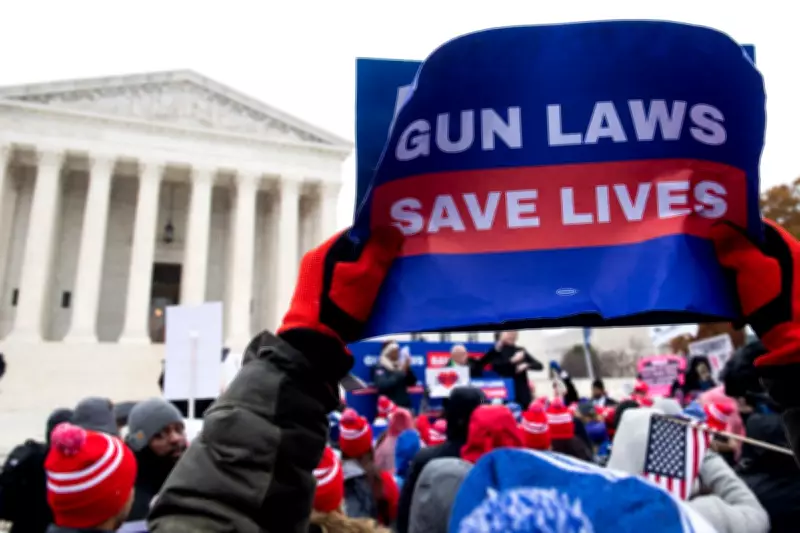
Supreme Court Upholds Federal Ban on Firearm Ownership for Nonviolent Felons
The United States Supreme Court has firmly declined to expand constitutional gun rights further, rejecting a significant challenge to longstanding federal legislation that prohibits individuals with serious criminal convictions—including nonviolent felons—from legally owning firearms. This decision represents a notable moment in the nation's complex legal landscape surrounding the Second Amendment, particularly as the court continues to navigate numerous firearms-related cases during its current term.
Case Background and Judicial Ruling
The justices opted not to review an appeal from Melynda Vincent, a Utah resident and single mother, who sought to overturn lower court rulings that affirmed the constitutionality of the gun restriction. Vincent's legal battle stemmed from her 2008 felony conviction for bank fraud, involving the cashing of a fraudulent cheque valued at approximately $500. Following this conviction, she was permanently barred from firearm ownership under the Gun Control Act of 1968, a provision that has been rigorously enforced for decades.
Vincent argued that this prohibition infringed upon her Second Amendment right to "keep and bear arms," but both the lower courts and now the Supreme Court have consistently rejected this assertion. The court's refusal to hear the case effectively upholds the existing legal framework, maintaining that nonviolent felons do not possess an automatic right to own guns under current federal law.

Political and Administrative Context
Notably, the Trump administration had previously urged the Supreme Court to dismiss this specific challenge, highlighting a broader political divide on gun policy. Justice Department lawyers emphasized that the administration had already taken administrative steps to grant the US Attorney General, Pam Bondi, the authority to restore gun rights to nonviolent felons who meet stringent eligibility criteria. This move reflects ongoing efforts to balance public safety concerns with individual rights, though the court's decision suggests a preference for legislative and executive action over judicial intervention in this particular area.
The court's conservative majority, which stands at 6-3, has historically adopted an expansive interpretation of Second Amendment protections, as evidenced by landmark rulings in 2008, 2010, and most recently in 2022. However, this case demonstrates that even a conservative-leaning court is willing to uphold certain restrictions, particularly those with deep historical roots and clear public safety implications.
Legal Precedents and Future Implications
The Supreme Court's 2022 precedent in New York State Rifle & Pistol Association v. Bruen has been a pivotal reference point in recent firearms litigation. That decision, driven by the court's six conservative justices with dissents from the three liberals, established a new legal test requiring that gun restrictions must be "consistent with this nation's historical tradition of firearm regulation" rather than merely serving an important government interest. Challengers to the nonviolent felon ban, including Vincent, cited the Bruen ruling in their appeals, arguing that historical traditions do not support such broad prohibitions.
Despite this, the court has shown a nuanced approach. In 2024, it ruled 8-1 that a federal law prohibiting individuals under domestic violence restraining orders from possessing guns satisfied the stringent Bruen test. Currently, the court is considering two additional Second Amendment cases this term, including one involving a Hawaii law restricting handguns on private property and another defending a federal ban on gun ownership for users of illegal drugs. These cases will further shape the legal boundaries of gun rights in America.

National Debate and Public Safety Concerns
This ruling occurs against a backdrop of intense national debate over how to address persistent firearms violence, including frequent mass shootings and everyday gun-related incidents. While the Supreme Court has broadened gun rights in several key decisions, it has also demonstrated a willingness to uphold specific restrictions deemed necessary for public safety. The prohibition on nonviolent felons owning firearms is one such measure, rooted in the Gun Control Act of 1968 and reinforced by decades of judicial interpretation.
As the legal and political battles over the Second Amendment continue, this decision underscores the complex interplay between individual liberties, historical legal traditions, and contemporary public safety needs. The Supreme Court's refusal to expand gun rights for nonviolent felons may signal a cautious approach to further judicial expansion, leaving room for legislative and executive branches to craft targeted policies in this divisive area.