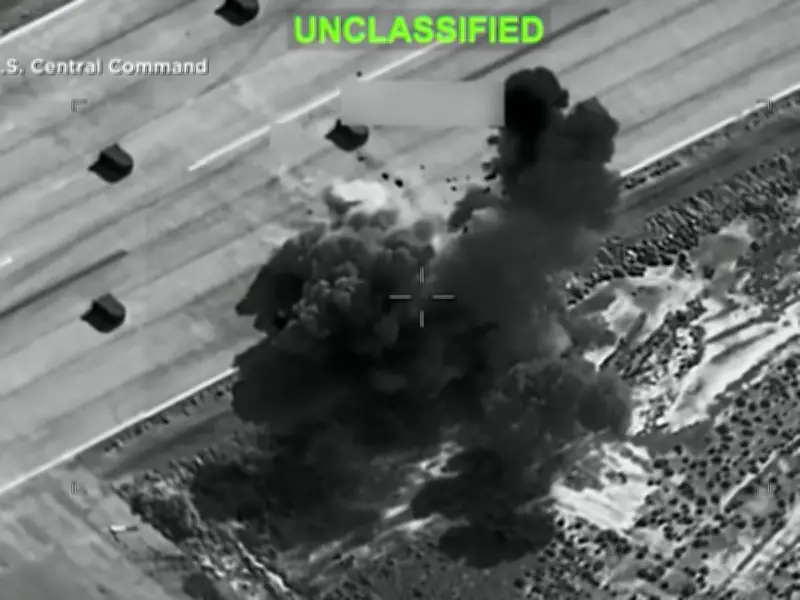
Tehran's missile teams launched a wave of retaliatory strikes against US forces and several Middle Eastern countries on Thursday, just hours after American warplanes targeted more than 90 sites within Iran. Air defence systems sounded around US military bases across the region as Iranian missiles targeted locations in Jordan, Iraq, Bahrain, and Kuwait. Jordan's air defences shot down five Iranian missiles, marking a significant escalation in the conflict and a direct response to two nights of US strikes on Iranian territory.
Retaliatory Strikes Across the Region
Reports emerged of Iranian missiles targeting US Navy ships in the Strait of Hormuz, as near all-out war appeared to break out following US President Donald Trump's declaration that the ceasefire was "over." Israeli forces were placed on high alert for potential Iranian attacks, with emergency ministerial meetings convened to address the crisis. The US strikes had hit Iranian military posts along the country's southern coastline, as well as military sites, bridges, airstrips, and even the perimeter of a nuclear facility.
Iran's Islamic Revolutionary Guard Corps (IRGC) confirmed it launched retaliatory strikes on US military bases in Kuwait and Bahrain overnight, calling them the "first phase of the punitive response against the American treaty-breakers." Iranian parliamentary speaker Mohammad Bagher Ghalibaf, also the country's chief negotiator with the US, stated: "America still hasn't learned that bullying and breaking promises are no longer cost-free." He added: "Let me put it plainly: if you strike, you'll get hit," and warned that the Strait of Hormuz would only open under Iranian arrangements, not "American threats."
Nuclear Plant Under Threat
Iranian air defence systems around the Bushehr Nuclear Power Plant, 600 miles south of Tehran, sounded warnings of a possible US missile attack, and explosions were heard in the area. Sources indicated that US forces had launched Tomahawk cruise missiles at the air defences surrounding the atomic complex. Iran's medium-range ballistic missiles targeted the US Ali Al Salem airbase in Kuwait, where US and UK RAF personnel are stationed, and Jordan's Muwaffaq Salti air base. It is also believed Iranian missiles were aimed at a US base in Erbil, northern Iraq, where several hundred UK armed forces personnel are based.
Trump's Rhetoric and Escalation
US President Donald Trump, speaking on Air Force One, claimed that Iran had made overtures to the US, saying: "They called a little while ago. They want to make a deal so badly." When asked about the 90 Iranian sites targeted on his orders, he stated: "It was really retribution." In an outburst at the NATO conference in Turkey, Trump branded Tehran's regime "scum" and declared the ceasefire with Iran was "over." Among the targets in the renewed US attack were several bridges within Iran, including the Aq Qala Bridge, a rail link in the north that carries trade to and from Russia.
Casualties and Regional Impact
Iran's Ministry of Health reported that 14 people have been killed during this latest round of fighting. Hossein Kermanpour, head of public relations at the ministry, said US attacks targeting five provinces in Iran over July 8 and 9 have also injured 78 people, of whom 47 remain in hospital. The mayhem unfolded as crowds of thousands marked the week-long funeral of slain Supreme Leader Ayatollah Ali Khamenei across Iraq and Iran. Sources told the Daily Mirror it is possible the pro-Iranian Islamic Resistance in Iraq has risen up to support Tehran's IRGC.