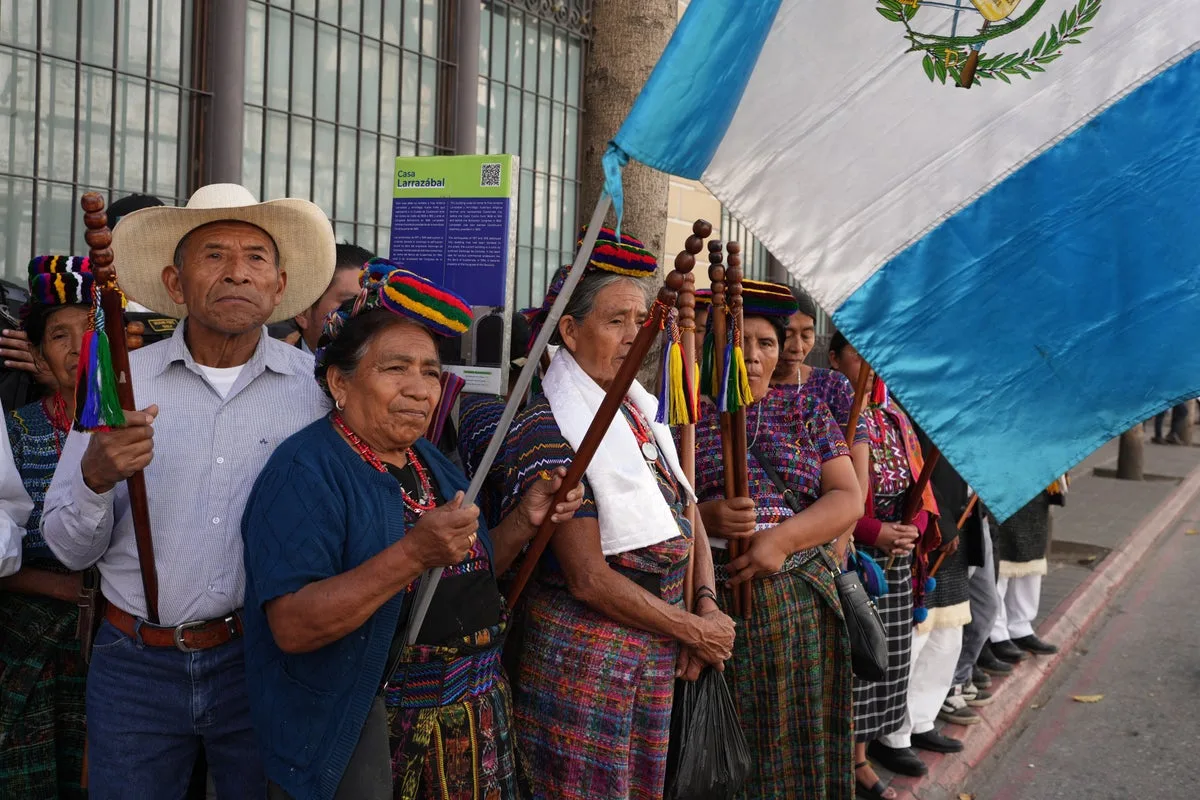
Guatemala's freshly constituted Constitutional Court confronts a formidable challenge to reclaim public trust following a period where its rulings were widely perceived as shielding influential elites. Experts emphasized on Thursday that the nation's highest judicial body must actively work to regain credibility among Guatemalans who have grown disillusioned with a justice system seemingly skewed toward serving narrow interests.
New Composition and Historical Context
Elected through a five-year cycle involving multiple state institutions, Guatemala's Constitutional Court will see four of its ten magistrates, including alternates, retained from the outgoing bench. The previous court's decisions in highly contentious cases drew sharp criticism for allegedly protecting individuals connected to drug trafficking networks, human rights violations, and corruption scandals.
Carlos Luna Villacorta, a former alternate magistrate on the court, articulated the core mission: "What it has to do is recover the concept of a legal and technical court and not issue decisions tailored for anyone. It must inspire more confidence above all with its most controversial decisions."
Recent Appointments and Structural Role
The court's formation concluded on Wednesday when President Bernardo Arévalo announced his selections: Gladys Annabella Morfín, a former solicitor general, as principal magistrate, and María Magdalena Jocholá, a Kaqchikel Maya lawyer and academic specializing in Indigenous issues, as her alternate. These appointments join others chosen by the Supreme Court of Justice, Congress, the University of San Carlos, and the national bar association, each selecting one magistrate and an alternate.
Notably, four of the five principal magistrates in the new court will be women, with the full bench scheduled to be seated in April. The Constitutional Court occupies a pivotal position in Guatemala's legal framework, serving as the ultimate judicial authority whose rulings are final and unappealable. Alternates participate when a magistrate faces conflicts or when constitutional questions require a full panel of seven magistrates.
Controversial Legacy and Democratic Safeguards
Historically, the Constitutional Court has been central to Guatemala's anti-corruption struggles, adjudicating high-profile cases concerning international anti-corruption commissions and the legal status of former presidents accused of graft. In 2019, when then-President Jimmy Morales terminated the mandate of the International Commission Against Impunity in Guatemala (CICIG), the court acted as a crucial democratic check, declaring his move unconstitutional.
However, the court's trajectory shifted following the election of new magistrates in 2021. A stark example occurred in April 2024, when it upheld the release from prison of former President Otto Pérez Molina (2012-2015), who had been convicted in two separate corruption cases. This ruling exacerbated public skepticism about the court's independence.
Analyst Perspectives and Future Expectations
Political analyst Renzo Rosal described the new court as appearing "relatively balanced," noting its conservative lean while acknowledging its constitutional mandate. "The court leans conservative, but nothing else can be expected of the Constitutional Court, since its essence is applying the Constitution," Rosal stated. "What we need is a group of magistrates who must stabilize the court and allow it to be an institution that halts the mistrust of justice, that serves the people and not the spurious spaces like now."
Experts concur that while the new composition suggests improved balance, the court's forthcoming decisions will ultimately validate or undermine this perception. The overarching task involves demonstrating judicial integrity, particularly in sensitive cases, to counteract years of eroded public confidence and reaffirm the court's role as a guardian of constitutional order rather than a protector of privileged interests.






