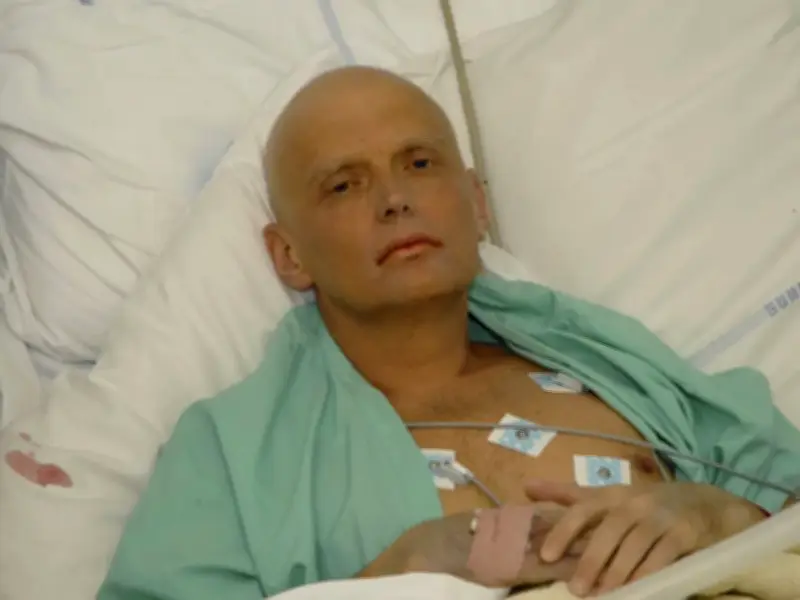
Twenty years after the haunting image of Alexander Litvinenko as he lay dying in a London hospital bed - the victim of radioactive polonium-210 poisoning - was beamed around the world, his family still live in fear.
A former Russian spy who defected to the UK and worked with MI6, Alexander was 44 when he died on November 23, 2006, after two ex-Russian intelligence agents - Andrey Lugovoy and Dmitry Kovton - poisoned his green tea when they met at Mayfair's Millennium Hotel.
British investigations concluded that Vladimir Putin "probably" approved his murder. And his wife, Marina Litvinenko, says seven years later, in 2013 - on the night that oligarch Boris Berezovsky was found dead on the bathroom floor of his ex-wife's Berkshire mansion, with a ligature around his neck - her home was also burgled.
Family Still Living in Fear
Her husband Alexander, who she called Sasha, had been given orders to kill Mr Berezovsky - by then an outspoken critic of Putin - before fleeing Russia, but refused. And the oligarch funded the Litvinenko's life when they arrived in London.
A 2014 inquest recorded an open verdict on his death, saying there was insufficient evidence to prove beyond reasonable doubt whether it was suicide or unlawful killing. But Marina says: "He [Mr Berezovsky] died apparently by suicide, but we know better than that, don't we? And my home was burgled. They took some possessions. That scared me. It sent shivers down my spine.
"Surely, it wasn't a coincidence. I sat by the broken glass of the window all night until I could phone for it to be repaired in the morning."
A Life of Fear and Resistance
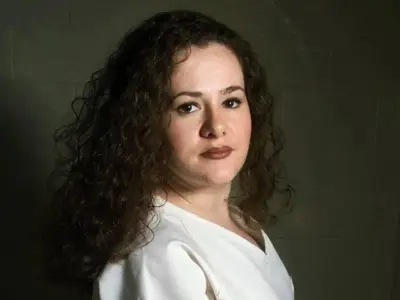
Former ballroom dancer-turned activist and public speaker, Marina, 64, who has written a book to mark the 20th anniversary of Sasha's death, was born opposite the Kremlin in 1962 and met him at her 31st birthday drinks party. Both married before, she says they hit it off instantly, adding: "The birthday gift I didn't expect."
Four months later, she was pregnant and in June 1994 the couple's son, Anatoly, was born. An agent for the Russian intelligence service, the FSB, in 1998 Sasha was one of several whistleblowers to expose details of criminality and corruption within the Russian security services.
His life under threat, the family were given political asylum in London in 2000. Describing her life, Marina says: "It was like the plot of a Hollywood film. Nobody could believe our escape from Russia was real. I never expected our life would be even more turbulent once we got to London."
Litvinenko worked with MI6 and Spanish intelligence agencies, sharing information on the Russian mafia in Europe and its deep integration within the Russian state. In 2006, Sasha, who was British nationalised, was investigating the murder of Russian journalist Anna Politkovskaya, another prominent Kremlin critic when, on November 1, he met his killers, who spiked his tea with Polonium-210, which is 250 billion times more toxic than hydrogen cyanide.
Of his death in London's University College Hospital, Marina says: "It was devastating losing the man I loved. It was frightening and surreal. But I had no choice but to keep going for Anatoly. Then I had to keep going to get justice."
Refusing to Let Fear Win
Marina, who lives in London with Anatoly, now 32, continues: "For a long time he wouldn't talk about it, or even look at pictures of his father. I became Sasha's widow. It's one of the reasons I wanted to write my book - to tell my own story. I'm not just Sasha's widow, I am Marina Litvinenko."
After Sasha's death, Marina was offered some protection, but did not want to go into hiding, like former Russian double agent Sergei Skripal and his daughter Yulia, who in March 2018 were poisoned and nearly killed with the Russian nerve agent Novichok in Salisbury.
Marina, who does not have contact with them, says: "I was so grateful I had some kind of support and protection, but it was not protection like that of Sergei and Yulia Skripal. We don't know where they are. For me, I don't want Putin to win. Putin himself lives in an underground bunker. He is a small frightened man. He doesn't have fresh air or freedom, and that is his cage, his punishment."
But there is no ignoring Putin's ongoing threat to her. Marina says: "Many people have fled Russia. My story is not the only one. Russia is a mafia state. Putin never changed from being bad. He just became worse. And yet we still agree to his demands."
But Marina refuses to let fear stop her from speaking out. She continues: "I've always had something else to think about, other than fear. I had my son - his schooling, his needs. Then I campaigned for Sasha's killers to be brought to justice."
Keeping His Memory Alive
So shocking was Sasha's story, that it has also been told on stage and screen - most notably in A Very Expensive Poison, performed in 2019 at London's Old Vic, and in 2022's ITV drama Litvinenko, with Sasha played by David Tennant.
Marina was in the audience for the play, and consulted on the TV show. She says: "I welcome all adaptations, because it allows another chance to tell our story. I was in the audience for the play and very nervous, but MyAnna Buring, who played me and is a good friend of mine, is a brilliant actress. And I think David Tennant did a wonderful job."
In the 2000s, Marina found love again with Alexei, a Russian chemist based in Berlin, but he died from cancer in 2018. She says: "It was devastating losing someone again." Currently single, her ambition now is to start a group of women activists.
And she's in touch with Russian journalist and activist Zhanna Nemtsova, whose father - prominent opposition leader Boris Nemtsov - was assassinated directly outside the Kremlin walls in 2015. She says: "It's long been an idea of mine to make women's voices stronger - particularly when women need to stand up and talk, because of what happened to their relatives."
Meanwhile, she wants to keep Sasha's memory alive. She says: "He was kind, and brave. I would like him to be remembered in history for being a man who changed Russia for the better. With more people like him, maybe one day Russia will be a better country to live in, and to be friends with.
"People ask me how I carried on [after his death]. But I learned to let go of any hate in my heart. I carry on with love. With love for Sasha, with love for my son, with love for myself. I am happy and lucky to be alive."
Now, sharing photos of her life with Sasha in happier times, she admits that only one image - that of him dying in his hospital bed - remains synonymous with Sasha. Marina says: "That picture was splashed across the front pages of newspapers in almost every corner of the world."
But she sees the image differently to other people, saying: "I see our life together unfold into thousands of tiny moments. I see our first date and later Sasha's two left feet as I taught him ballroom dancing. I see him slipping a wedding ring onto my finger with a smile. I see his overwhelming joy as he squinted up at the labour ward with binoculars while I held our baby up to the window."
But she also recognises the impact this harrowing image still has. She says: "You see a murder victim staring into the camera's lens, someone using his last days, hours, minutes – and even breaths – to force the man who ordered his execution to look him square in the eyes, a final act of defiance.
"That man was Vladimir Putin, and I am in no doubt that he has seen the same photograph that you have, that it would have travelled all the way from that central London hospital room to his desk in the Kremlin."