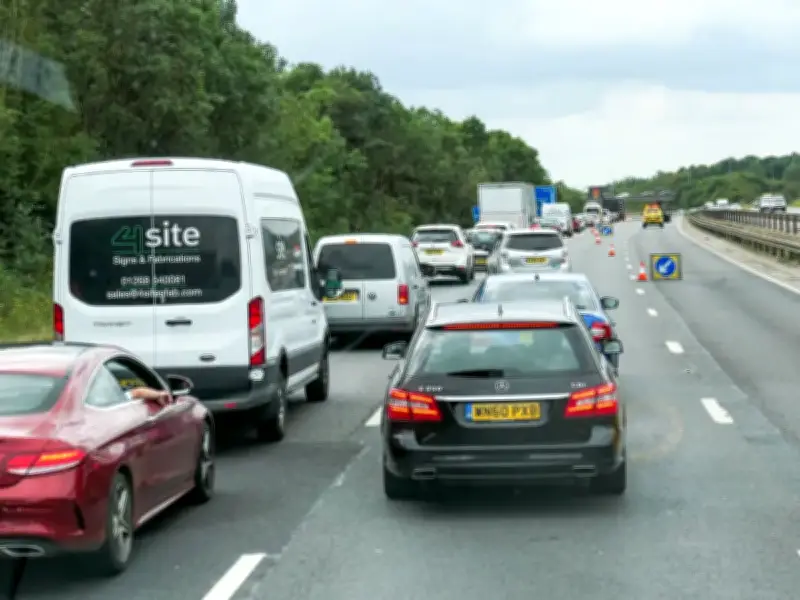
Police have issued clear guidance on how and when to merge lanes when two lanes become one on UK roads. The correct method is called "zip-merging" — and doing it wrong can lead to a £100 fine and three points on your licence.
Virtually all drivers on UK roads will have had to navigate this situation. And they will undoubtedly have seen a long line of single-file traffic in the left-hand lane while the right-hand lane remains empty. Many will also have been angered by drivers in the right-hand lane zooming past the queuing traffic until the merging point. Many will consider this "jumping the queue" — and one driver was even filmed seemingly getting so angry about this exact situation that he crashed his car into the one in front.
But just because you're angry doesn't make you right. The most common scenarios in which you will need to merge lanes are either where there is a permanent lane-merger in place or when there are roadworks (for example, on a motorway) resulting in the closure of one of the lanes.
What is the correct way to merge lanes?
The correct method of merging in a situation where two lanes become one at a certain point is called "zip-merging". It means that instead of moving into one lane as soon as a lane closure is announced, drivers should merge one at a time at the point of the lane closure. It's called zip-merging because it is like the teeth of a zipper coming together and it is said to significantly reduce congestion.
The police, Highway Code, RAC and National Highways are all agreed on this. Avon and Somerset Police said the method "helps make full use of the available road space" and added: "Problems tend to arise when drivers are unwilling to allow others to safely merge, or when motorists change lanes aggressively, without adequate observation, signalling or consideration for other road users."
National Highways gave similar advice and said: "By keeping both lanes in use until the merge point, congestion is minimised and journey reliability is improved."
What the Highway Code says
Highway Code rule 134 addresses lane-merging by saying: "You should follow the signs and road markings and get into the lane as directed. In congested road conditions do not change lanes unnecessarily. Merging in turn is recommended but only if safe and appropriate when vehicles are travelling at a very low speed, e.g. when approaching road works or a road traffic incident."
The RAC agreed. It says: "When motorists encounter a lane closure on a motorway or dual carriageway, the majority of drivers follow the etiquette of moving over early, but this creates one long, slow line of traffic and a near-empty outside lane."
"While motorists on the inside lane might think they’re doing the right thing, it can be more beneficial to continue using the open lane until the last minute, utilising all of the available road and then ‘merging in turn’ at the point at which the road narrows to a single lane."
"However, many drivers find it annoying to watch fellow motorists using the outside lane as they sit stationary on the inside. But if we remove good old-fashioned British queuing etiquette from the equation taking all emotion out of the scenario, the plain and simple fact is that two lanes of slow moving traffic are better than one. So if cars use all of the space available to them on both lanes, it should result in the line of congestion disappearing, or at the very least reducing."
Fines for incorrect lane merging
While you won't be fined for queuing on the left too early (and definitely not for using the empty lane right up until the merger point), there are circumstances in which incorrectly using merger lanes could result in a driving conviction, fine and points on your licence.
If, for example, you try to prevent someone using the emptier lane to pass queuing traffic, you could find yourself prosecuted for careless driving, or worse. The fixed penalty for careless driving is now £100 with 3 points on the driver’s licence. National Highways said: "Dangerous, careless or inconsiderate driving can occur if a driver forces their way into traffic, deliberately obstructs other vehicles, or carries out manoeuvres which create a risk of collision."
If you do find yourself being obstructed by someone who doesn't understand the correct way to use lane mergers, don't react angrily. If you have a dashcam, you can upload the footage to Operation Snap, a UK police initiative that allows members of the public to upload video evidence of suspected driving offences.