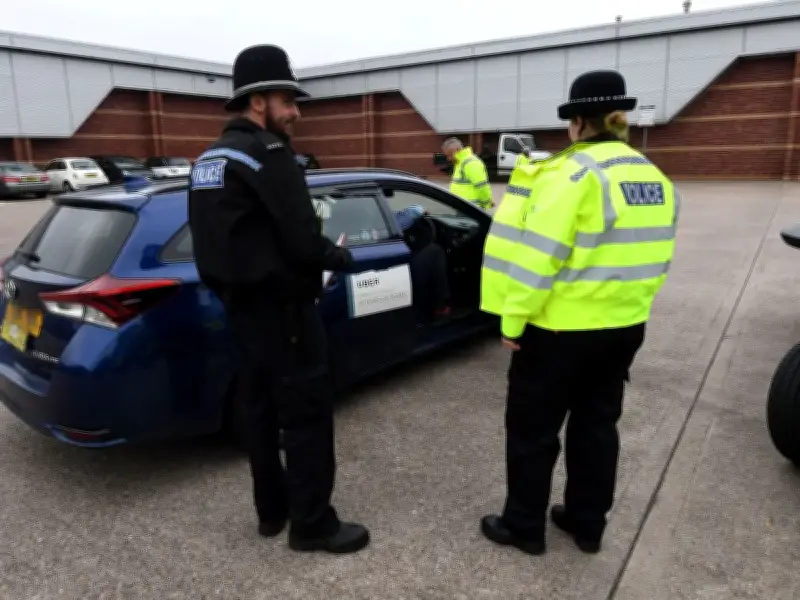
Police across the UK are pulling over drivers for roadside eye tests, and those who fail a 20-metre number plate check can have their driving licence revoked on the spot and face a £1,000 fine, according to former police officer Rav Wilding speaking on BBC Morning Live.
Mr Wilding confirmed officers are carrying out vision checks during traffic stops, explaining that a failed test could lead to immediate licence revocation. He told presenters Gethin Jones and Helen Skelton: "This is really important. We're talking about something that's currently happening in Chester. It's called Operation Insight, but it's happening around the UK as well with other forces where they're stopping vehicles and requiring a roadside eye test to make sure that drivers are up to the required standard, legal standard to drive a car on the roads."
What the roadside test involves
Mr Wilding outlined the test's content and what motorists must do to pass. He said: "It is something that I think we should be aware of because there are a lot of drivers that are below the minimum standard and you might not know what the standard actually is. And the test really quite simply is reading a normal car license plate from 20m away.
"That is the same as five parked cars together. If you're in a street, you're outside your home, you're walking along the foot path and you just want to count and see how far away that distance will be, it's actually, quite, it is quite far. When I did my motorcycle test, I'd already had my car licence for many, many years."
He added: "I had to redo the eyesight test as part of it like everyone would. Even though I've got 2020 vision, I thought, 'Wow, actually that's a harder test than I thought it was going to be.' So, it's worth just having a go if you're walking along the street just to see if you can read that license plate from 20m away."
Consequences of failing the check
When host Gethin asked what drivers should do if they have concerns about their eyesight, Mr Wilding warned: "What you don't want to happen is you be pulled over by police to do the test and fail because if you do, you can actually have your license revoked. It can be taken away on the spot. If you were to then try and continue to drive, that is an offence in itself because you currently don't have a licence, and you actually have to reapply to get your licence back via the DVLA, and you'd have to have proof of having an eyesight test that meets the required standards.
"So, you don't want that to happen. If you've got any doubts, I would say it's best to have an eyesight test. Now, lots of people don't have them as regularly as you know we would like to have. So, if you're over the age of 60 in England, Wales, and Northern Ireland, you can get them free. Scotland, they are free. Over 60 with certain medical conditions. You can also get them free."
He continued: "So if you have something like glaucoma, you may be able to get a free eye test. It's worth checking where you are because you could be entitled. Over the age of 70, you need to declare you are fit to drive to reapply for your licence every 3 years via the DVLA. Now, if you have to declare a medical condition that affects your eyesight, you do have to support that with documentation that shows that you have met the required eyesight standards. So you have to have a test there as well."
Planned changes for older drivers
Under a new Department for Transport (DfT) Road Safety Strategy plan, motorists aged 70 and above will no longer be permitted to depend on self-declaration when renewing their driving licence every three years. Instead, they will be required to undergo mandatory vision testing - officials have consulted on this proposal but the findings have not yet been made public.
The proposals stipulate that older motorists will need their eyesight formally assessed every three years as part of the renewal procedure. The DfT consultation period - which ran from 7 January 2026 to 11 May 2026 - has now concluded, and the government is presently reviewing the responses alongside organisations such as The College of Optometrists and the Association of Optometrists.
In addition to the strategy, police forces throughout the UK continue operating the Is Your Vision Roadworthy? campaign, carrying out 20-metre number plate checks. Under Cassie's Law, motorists who fail a roadside examination can have their licence withdrawn immediately if judged to be unsafe.
Mr Wilding added: "If you fail it, you could get three points on your licence. You could get up to a £1,000 fine. But let's not forget what is far far more serious is the potential danger to yourself, to your passengers, and other road users and pedestrians. That is a much bigger concern that should make people think, do you know what? Let's just make sure my eyes are up to that standard that they should be."