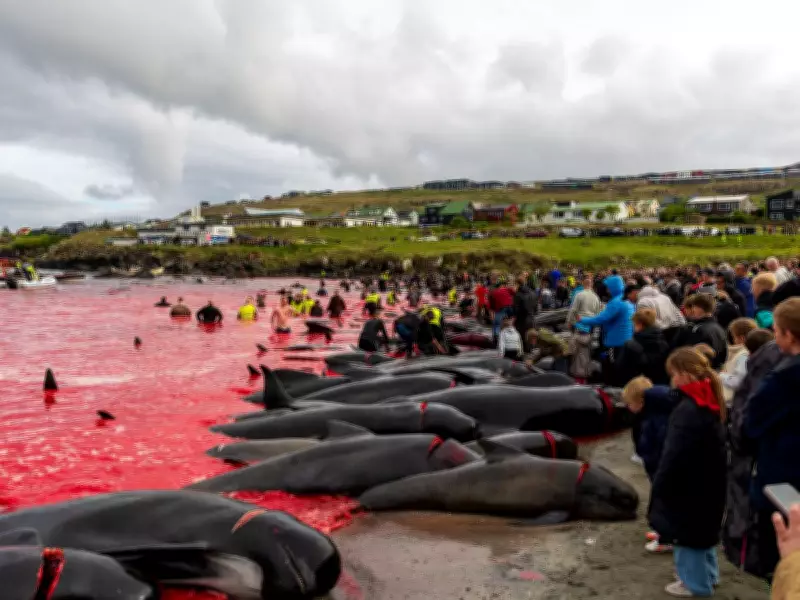
Children watched on as the macabre ritual took place again. Hundreds of incredible whales have once again been slaughtered in the Faroe Islands as the barbaric historical tradition continues. The sea turns red as the creatures' carcasses lay on the beach, hours after they were knifed with young children in the large crowd seen watching from the shore. The inhumane butchering is known as a 'grindadrap' - a Viking cultural practice that sees pilot whales and dolphins driven into shallow waters to their deaths.
After boats bring the pods to within reach, the terrified animals are then beached before fisherman pull out blades and knife them until they are dead. The Faroese claim the culling, which includes juveniles and unborn animals, is sustainable and regulated by law, but campaign groups want the cruel hunts banned.
The horrific killing took place just over 200 miles north of Scotland, in the bay of Hvalvik on Streymoy Island. It is understood to be the second 'grind' of 2026. Sea Shepherd's Campaign Director Valentina Crast was present at the first last month, one of around 10 per year with more than a thousand whales wiped out.

Participants killed more than 125 pilot whales and several dolphins near the village of Sándavágur on Vágar island in the first week of May. Telling of what she witnessed, the activist said: "Every pod killed in a grind contains pregnant females and young juveniles. In almost any other hunting community, these animals would be protected. Pregnant females, unborn young, newborns, and small juveniles would not be considered legitimate targets. But in the Faroese grind, they are driven and killed indiscriminately."
In years gone by, Charity Sea Shepherd documented the killings. In September 2018, the group offered the Faroe Islands €1m for 10 consecutive years in exchange for stopping the whale hunts. A spokesman for the campaign group previously said: "Over the course of the lengthy drive more and more members of the public and tourists could be seen stopping along the coastline to watch the family of pilot whales struggle and resist. As is often the case, the grind was swiftly becoming a social event with parents laughing and chatting as children played on the killing beach."
"The level of excitement was clearly growing as anticipation of the brutality came closer, epitomising the social aspect of the grind was the sight of a youth group - possibly a guides or scout group - sat eagerly watching and waiting. Grind participants ran cheering into the pod to start attaching ropes and pulling individuals out to begin slaughtering. Though, as usual, the 'humane' process of killing the pilot whales was far from it, with multiple unsuccessful attempts to paralyse them with the lance were observed on a number of the pod."
"Having previously observed other pilot whale drives our crew noted that this pod had clearly been worn out or resigned to their fate as little to no cries were heard from the pod. Children were playing with fins, kicking and punching the bodies, walking on them and worryingly seen running around the dock carrying the traditional knives that are used as part of the grindadrap."