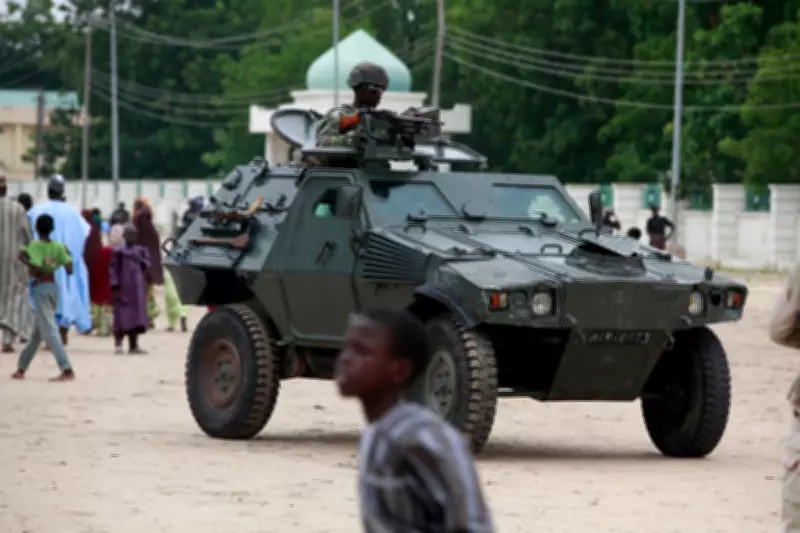
In a tragic incident highlighting Nigeria's ongoing security challenges, an army general and multiple soldiers have been killed during an assault on a military base in the country's northeast. The attack occurred early Thursday in Benisheikh, Borno State, according to official statements from Nigerian authorities.
Details of the Deadly Assault
Army spokesman Michael Onoja confirmed that the attack was successfully repelled by Nigerian forces, but not before claiming significant casualties. While Onoja did not specify the exact number of soldiers killed, he described the assailants as "terrorists" - the military's standard term for Islamic militant groups operating in the region.
Presidential Response and Tribute
President Bola Tinubu personally confirmed the death of Brigadier General Oseni Omoh Braimah in the attack. In an official statement, Tinubu extended his condolences to the families of the fallen soldiers, describing them as "gallant soldiers who made the ultimate sacrifice in the defense of our country."

The President characterized the insurgents' counterattack as "a sign of desperation" and vowed that "their sacrifices will not be in vain." He emphasized that "our resolve to defeat terrorism and all forms of violence across Nigeria is stronger than ever" due to the courage and dedication of frontline troops.
Military Analysis of the Situation
Onoja provided further context about the attack, stating: "This attack is a clear indication of the desperation of terrorist elements who, having suffered significant losses in recent operations, continue to resort to futile and ill-fated offensives against well-defended military positions."
He added regretfully that "the encounter resulted in the loss of a few brave and gallant soldiers who paid the supreme price in the line of duty."
Broader Security Crisis Context
Nigeria, Africa's most populous nation, continues to battle a complex and multifaceted security crisis, particularly in its northern regions. The country faces a decadelong insurgency alongside numerous armed groups engaged in kidnapping for ransom operations.
Among the most prominent militant organizations are Boko Haram and its breakaway faction, the Islamic State West Africa Province (ISWAP), which maintains affiliation with the Islamic State group. Additionally, the IS-linked Lakurawa group operates in northwestern communities bordering Niger Republic.
Regional Security Developments
The security situation has deteriorated recently with the involvement of militants from neighboring Sahel regions. Notably, Jama'at Nusrat al-Islam wal-Muslimin (JNIM) claimed its first attack on Nigerian soil last year, expanding the geographical scope of the conflict.
Earlier this year, the United States deployed 200 troops and drones to Nigeria as part of a new security partnership. While American forces will not engage in direct combat operations and Nigerian forces retain complete command authority, this deployment represents significant international support for Nigeria's counterterrorism efforts.
This security cooperation agreement followed allegations by former U.S. President Donald Trump that Christians were being specifically targeted in Nigeria's security crisis. The U.S. military launched strikes against Islamic State forces on December 26 as part of these operations.
Human Cost and Analytical Perspectives
According to United Nations data, several thousand people have been killed in Nigeria's ongoing conflicts. Security analysts and observers have expressed concern that the Nigerian government is not implementing sufficient measures to protect its citizens from the escalating violence.
The attack in Benisheikh represents another tragic chapter in Nigeria's prolonged struggle against militant groups, highlighting both the bravery of military personnel and the persistent challenges facing Africa's most populous nation in securing its territory and protecting its citizens from extremist violence.