Britain's Counter-Terrorism Programme Under Fire for Threat Assessment Priorities
Britain's troubled Prevent counter-terrorism programme faces renewed accusations of complacency regarding the threat posed by increasingly confident Islamic extremists. This criticism emerges despite official security assessments identifying Islamist terrorism as the nation's most significant volume threat.
Diverging Threat Assessments and Referral Patterns
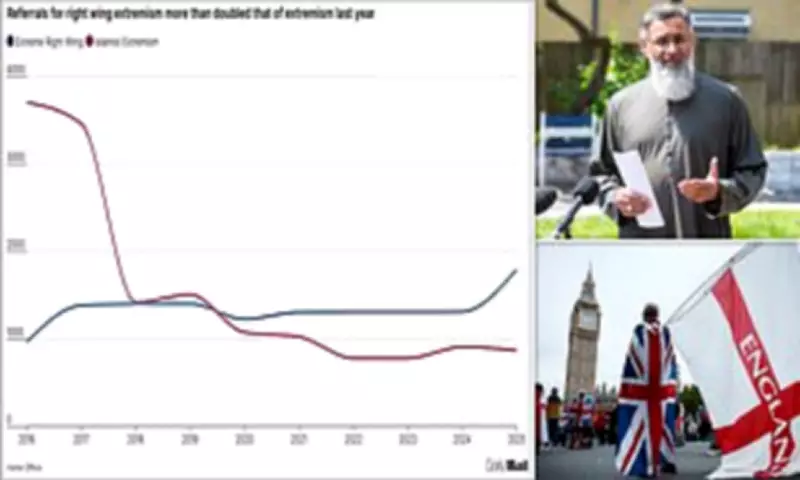
Current data reveals a concerning discrepancy between identified threats and programme focus. While MI5 maintains that Islamist terrorism, driven by perceived grievances against Western nations, represents the most substantial danger to UK security, Prevent's referral statistics tell a different story.
Extreme Right-wing behaviour has become the primary reason for individuals being placed on Prevent's radar, with approximately four people daily referred for displaying such views. This figure represents twice the average referral rate for Islamist extremism concerns.

The Home Office defines Islamist terrorism as the threat or use of violence as a means to establish a strict interpretation of an Islamic society, including the adoption of Sharia law. Security experts note that some adherents consider violence a religious duty rather than merely a strategic tool.
Conversely, Extreme Right-wing ideologies encompass cultural nationalism, white nationalism, and white supremacism, with official guidance acknowledging their use of violence to advance objectives.
Expert Concerns and Programme Performance
Dr Paul Stott, head of security and extremism at the Policy Exchange think tank, emphasised the continuing danger: The greatest threat to the UK, in terms of terrorism and terrorist attacks, clearly comes from Islamist terrorism. Islamist actors have been rampant on our streets since 7/7, and those movements appear ever more confident. If Prevent is not laser focused on this it will fail.
Annually, approximately 7,000 individuals undergo initial Prevent assessment, typically referred by teachers and social workers fulfilling their legal duty to identify potential extremism risks. Police evaluate each referral, with those deemed at genuine radicalisation risk progressing to Channel, a voluntary mentoring programme offering educational and career guidance.
Statistical Trends and Programme Shortcomings
Government data for the year ending March 2025 reveals significant trends:
- Extreme Right-wing behaviours constituted 21% of all identified referrals, increasing from 19% the previous year
- Islamist extremism referrals declined from 13% to 10% of total cases
- Among nearly 1,500 Channel referrals, 42% concerned Extreme Right-wing views compared to just 15% for Islamist extremism
- Left-wing organisations represented minimal concern, with only 21 Prevent referrals recorded
A Home Office spokesperson cautioned against judging ideological threats solely through referral statistics, stating: We must direct people away from the dangerous path of radicalisation – whether it be Islamist ideology, extreme Right-wing or those seeking mass violence.
Historical Failures and Programme Evolution
Established following the 2005 London bombings that claimed 52 lives, Prevent has faced substantial criticism for missing Islamist terror sympathisers, including individuals connected to notorious hate preacher Anjem Choudary. The programme also failed to adequately address cases like Southport murderer Axel Rudakubana, referred three times before his 2024 knife attacks, and neo-Nazi campaigner Alex Davies, who established the proscribed National Action group.
Three years ago, a damning Home Office-commissioned review accused Prevent of applying double standards to Islamist and far-Right threats, scrutinising Right-wing material that fell well below extremism thresholds. The 188-page report warned of a loss of focus as the programme became distracted by far-Right cases rather than concentrating on Islamist threats.

Controversial Classifications and Recent Developments
Prevent has faced additional controversy for its classification methods. Beloved television comedies including Yes Minister and The Thick Of It were marked as potential white nationalist texts, while the 1955 war film The Dam Busters was identified as a possible extremism indicator. Training documents last year listed viewing Western culture as under threat from mass migration and a lack of integration as a terrorist ideology.
Following the 2023 Shawcross Report, a second review from the Independent Commission on UK Counter-Terrorism Law, Policy and Practice recommended a refocused strategy with localised approaches and clearer terrorism definitions to ensure legal proportionality.
Political figures have recently highlighted concerns about Islamic extremism responses. Reform's Robert Jenrick suggested police had lost their nerve in a battle for Britain's soul, while Shadow Home Secretary Chris Philp identified a systemic problem with confronting Islamic extremism following incidents like the banning of Israeli football fans from Birmingham.
These developments follow recent security incidents including an Iranian-backed sleeper cell allegedly claiming responsibility for an antisemitic ambulance firebombing outside a north London synagogue, highlighting the continuing complexity of Britain's counter-terrorism landscape.