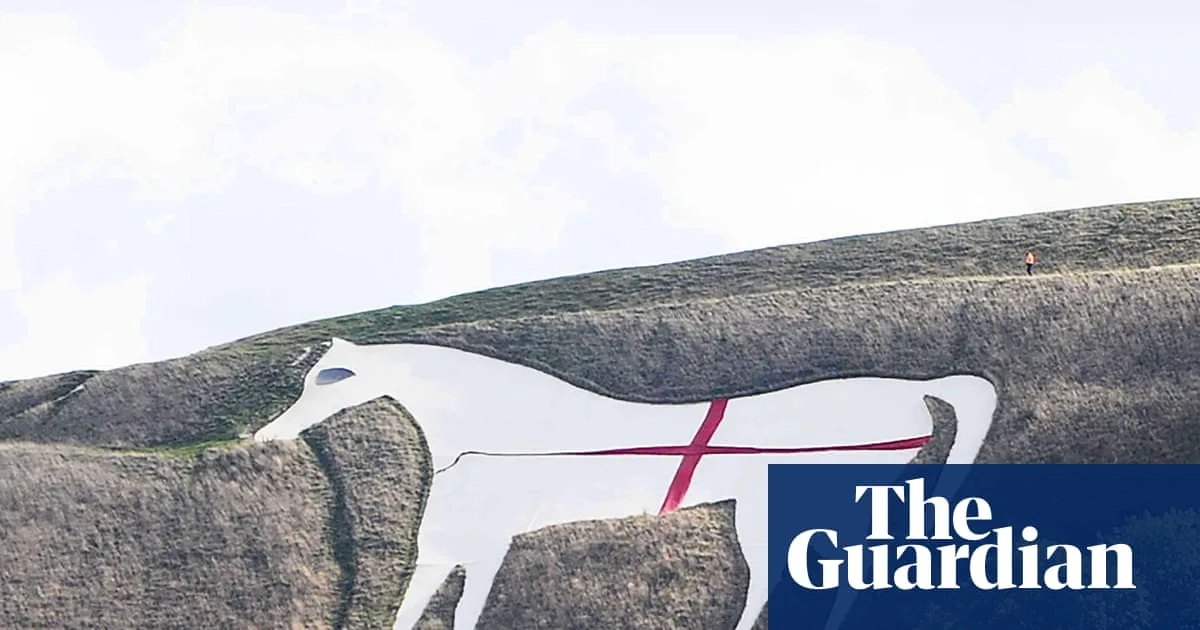
Wiltshire police have confirmed that no criminal investigation will be launched after red fabric was pinned across the Westbury white horse to form a St George's cross. The 53-metre chalk figure, cut into a hillside about 350 years ago, is a scheduled monument protected by legislation that makes damage a criminal offence.
English Heritage, which manages the site, said the fabric has been removed and an assessment is under way to determine whether the landmark has been damaged, for instance by pegs used to attach the material. A spokesperson said: 'We're now assessing whether any damage has been caused to this much-loved historic landmark.'
The incident comes amid a wider trend of union jacks and St George's crosses appearing on lamp-posts, motorway bridges, mini-roundabouts and traffic signs, following an online campaign. Some view the displays as patriotic, while others link them to xenophobia or racism. Anti-extremist groups Hope Not Hate and Stand Up to Racism claim the campaign has been organised by far-right figures.

Wiltshire police stated: 'We are aware of red material being pinned across the Westbury white horse to form the St George's cross. No criminal offences are thought to have been committed and we are not investigating it.'
The Westbury white horse, also known as the Bratton white horse, is believed to have been created in the late 1600s, possibly to commemorate the Battle of Ethandun in AD878. It sits on Bratton Camp, an Iron Age fort built over 2,000 years ago, with evidence of a Stone Age long barrow also found nearby.
The landmark has undergone several restoration efforts, including a major clean-and-repair project in 2023 involving conservationists abseiling down its near-vertical face. The horse was originally scoured to keep it white, with the last recorded scouring in 1853. It was covered in white-painted concrete in the 1950s, replaced in 1993, and has since been cleaned and repainted using specialist steam cleaning and environmentally friendly paint.