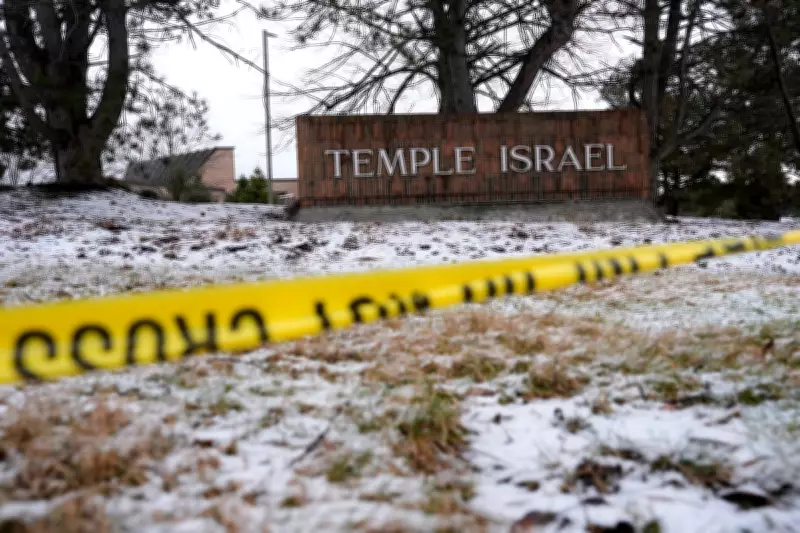
The Israeli military has made a startling claim regarding a recent attack on a synagogue in Michigan, asserting that the brother of the assailant was a commander within the Hezbollah militant group. This revelation adds a complex international dimension to the ongoing investigation into the violent incident that targeted a Jewish community near Detroit.
Details of the Allegations and Attack
According to statements released on Sunday, Israeli officials allege that Ibrahim Ghazali, who was killed in an Israeli airstrike in Lebanon on March 5, served as a Hezbollah commander responsible for managing weapons for a unit that launched rockets at Israel. This airstrike occurred just one week before authorities report that his brother, Ayman Mohamad Ghazali, drove his car into Temple Israel, a major Reform synagogue outside Detroit, in a deadly attack.
FBI Investigation and Response
The FBI's Detroit office, which is leading the investigation into the synagogue assault, has declined to comment on the Israeli military's claims about Ibrahim Ghazali. In an email on Sunday, FBI spokesman Jordan Hall emphasized respect for the ongoing investigation, stating, "Out of respect for the ongoing investigation, we will continue to refrain from commenting on its substance." The Associated Press noted that it was unable to immediately verify the assertion that Ibrahim Ghazali was a militant, highlighting the need for further corroboration.

A Lebanese official, speaking anonymously due to restrictions on public discussion of the airstrike, confirmed Ibrahim Ghazali's death to the AP. The official disclosed that Ghazali's children, Ali and Fatima, and his brother, Kassim, were also killed in the strike that targeted their home shortly after sunset. Authorities have indicated that Ayman Ghazali, aged 41, carried out the synagogue attack after learning about the deaths of his four family members in the Israeli operation.
Context of Regional Violence
This incident unfolds against a backdrop of escalating tensions in the Middle East. Israel has intensified its attacks on Hezbollah, an Iranian-backed militant group based in Lebanon, as conflict with Iran has spread violence across the region. The war has heightened security concerns globally, with potential repercussions felt as far as the United States.
Synagogue Attack Timeline and Aftermath
On Thursday, prior to the attack, Ayman Ghazali reportedly waited in his car outside Temple Israel for approximately two hours. Authorities state that he was armed with a rifle, commercial-grade fireworks, and jugs of liquid believed to be gasoline. He then crashed his vehicle into the building, which was occupied by dozens of children at the time.
According to Jennifer Runyan, the special agent in charge of the FBI's Detroit field office, Ghazali began firing his gun through the windshield, engaging in an exchange of fire with an armed security guard. After becoming trapped in his vehicle and the engine catching fire, Ghazali fatally shot himself. Fortunately, no staff or children inside the synagogue were injured, a outcome likely attributed to enhanced security measures implemented in recent months.
The FBI has described the assault on one of the nation's largest Reform synagogues as an act of violence targeting the Jewish community. However, officials have clarified that there is insufficient evidence at this stage to classify it definitively as an act of terrorism, underscoring the complexity of the investigation.
Background of the Attacker
Records from the Department of Homeland Security reveal that Ayman Ghazali entered the United States in 2011 on an immediate relative visa as the spouse of a U.S. citizen. He was granted U.S. citizenship in 2016. At the time of the attack, he resided in a single-story brick home in the Detroit suburb of Dearborn Heights, located about 38 miles (61 kilometers) south of the synagogue.

Broader Implications and Related Incidents
The attack on the Michigan synagogue coincided with another violent event in the United States. On the same day, a former Army National Guard member, who had previously served prison time for attempting to aid the Islamic State, opened fire in a classroom at Old Dominion University in Virginia, resulting in one death and two injuries. These parallel incidents highlight ongoing security challenges and the potential for extremist influences to manifest in domestic settings.
As investigations continue, the claims by Israel's military introduce a geopolitical layer to the tragedy, raising questions about international connections and motivations behind the attack. The FBI's cautious approach reflects the sensitivity and scope of the probe, which seeks to unravel the full story behind this alarming act of violence.