Father Triumphs in Legal Battle Over Filming of Cyclist Incident
A father who was ordered to pay compensation to a cyclist for filming him as he knocked over his young daughter has finally won his legal battle after a lengthy appeal process. The case, which has sparked widespread debate about freedom of expression and public safety, reached a conclusion in a Belgian court this week.
The Christmas Day Incident in Baraque Michel
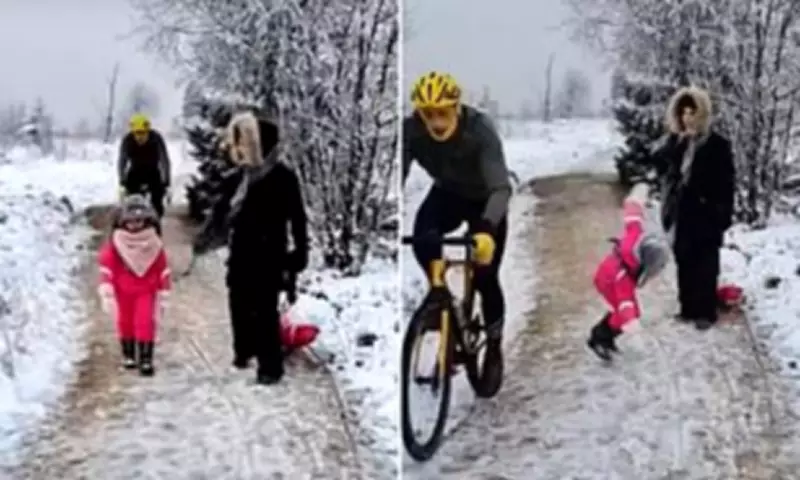
The footage was filmed and posted to social media by five-year-old Neia's father, Patrick Mpasa, during their family walk in a nature reserve in Baraque Michel, Belgium, on Christmas Day in 2020. In the video, the young girl is seen walking by her mother's side on a snow-covered path as the cyclist approaches from behind.
Just as he rides alongside the girl, he extends his knee out, hitting the little girl and knocking her to the ground before continuing on his way without stopping. The furious father chased after the man and managed to make him stop, but the cyclist showed no remorse and did not apologise for the incident.

Initial Legal Proceedings and Controversial Rulings
The cyclist, who was only identified as Jacques D and is president of a local cycling club, was originally taken to court in Verviers for kneeing the little girl. During a court hearing on February 3, 2021, the cyclist claimed that the incident happened because he had tried to keep his balance when his rear wheel slid on the snowy path.
However, the prosecution argued his statement seemed very unlikely, suggesting he was simply annoyed by people on the path and gave the child what they described as a "knee punch" out of sheer annoyance. The local cycling association described the man's behaviour as "unacceptable."
Despite this, the judge opted for lenient treatment, arguing that the man had no intention of harming the girl, the incident was minor, and he had already been criticised on social media. The cyclist received a suspended sentence and was ordered to pay the girl's family a symbolic €1 in compensation.
Defamation Lawsuit and Appeal Process
Almost a year after the incident, the cyclist went back to court to sue Mr Mpasa for defamation, claiming the backlash from the video resulted in him feeling so threatened by the public that he was scared to leave his own house. In April 2023, the child's father was ordered to pay the cyclist 4,500 euros in compensation.
But now, after a lengthy appeal, a court in Liege has overturned the original decision in favour of Jacques D. Lawyer Jacques Englebert, who represented Mr Mpasa, explained the court's reasoning: "In essence, the court said that posting the video was a freedom of expression and it was not a crime, so the original ruling was overturned."
The court determined that by uploading the clip, the father had contributed to the public debate on cyclists and pedestrians, and this was not an issue that warranted compensation. The cyclist had argued that by uploading the video, he had been identified, with initial reports incorrectly stating he was between forty and fifty years old when he was in fact well over sixty.
Court's Final Decision and Legal Implications
Following the court ruling on Thursday, the cyclist was also ordered to pay 2,040 euros in court costs. His lawyer, Phillippe Culot, declined to comment on the decision. Mr Englebert added: "Uploading the video did not identify him or his address. He says he was insulted as a result, but has not been able to provide any evidence of this."
The family had always maintained that the incident was not an accident, as the man did not stop to check if the girl was okay and carried on cycling down the path. Mr Mpasa had previously stated: "A lot of people tell me that I should have hit him, but I don't agree and, in any case, I was in front of my children, which would have made things even worse for them. I also don't want a witch hunt, I just want him to apologise."
This case highlights the complex intersection between freedom of expression, public safety concerns, and the legal ramifications of sharing content on social media platforms. The court's decision establishes an important precedent regarding the rights of individuals to document and share incidents of public concern without facing defamation claims.