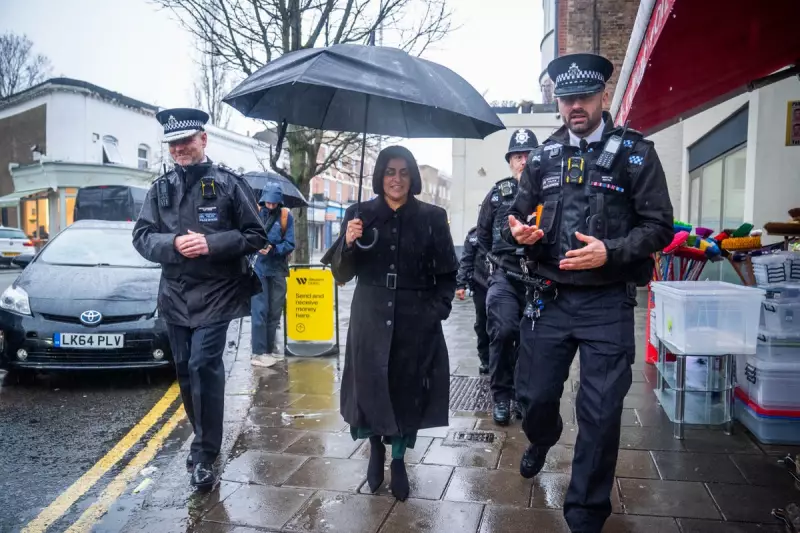
The Home Secretary has unveiled a comprehensive package of reforms designed to modernise what she describes as Britain's "broken" policing system, with artificial intelligence and live facial recognition technology at the heart of the transformation.
£140 Million Tech Investment to Free Up Police Time
Shabana Mahmood is investing £140 million to roll out advanced technology across police forces in England and Wales. Officials estimate this investment will free up approximately six million hours of police time each year, which is equivalent to the annual workload of 3,000 full-time officers.
This represents the most significant overhaul of policing methods in two centuries, moving away from what the Home Secretary called an "outdated" model designed for a different era.

How AI Will Transform Police Work
The artificial intelligence technology will be deployed to perform multiple functions that currently consume substantial police resources:
- Rapid analysis of CCTV footage, doorbell camera recordings, and mobile phone evidence
- Detection of deepfakes and manipulated digital content
- Accelerated digital forensics investigations
- Streamlined administrative tasks including form completion, document redaction, and transcription services
"Criminals are operating in increasingly sophisticated ways," Ms Mahmood stated. "However, some police forces are still fighting crime with analogue methods. We will roll out state of the art tech to get more officers on the streets and put rapists and murderers behind bars."
Expansion of Facial Recognition Capabilities
The government plans to significantly expand the use of live facial recognition technology, increasing the number of mobile facial recognition vans from ten to fifty. These vehicles will be deployed across the country to help identify and apprehend wanted criminals more efficiently.
Comprehensive Structural Reforms
Alongside the technological upgrades, the Home Secretary announced sweeping structural changes to policing in England and Wales:
- Creation of a National Police Service: An FBI-style national agency will be established to tackle terrorism, fraud, and serious organised crime more effectively.
- Force Consolidation: A "significant reduction" in the number of police forces, potentially merging the current 43 forces into as few as 12 larger regional organisations.
- Neighbourhood Policing Teams: Every council ward will receive dedicated neighbourhood policing teams to address what officials describe as an "epidemic" of everyday crime.
- Licence to Practice: All police officers will be required to obtain and regularly renew a mandatory "licence to practice" to maintain their operational status.
- Enhanced Accountability: The Home Secretary will receive new powers to dismiss chief constables and drive up standards in underperforming forces.
Police Leadership Response
Police chiefs have welcomed the proposed reforms as "long overdue." Gavin Stephens, chairman of the National Police Chiefs' Council, told journalists that the current system suffers from having "too many chiefs" and requires substantial modernisation.
The announcement represents the most comprehensive restructuring of policing in England and Wales since the establishment of modern police forces nearly two centuries ago, combining technological innovation with organisational reform to address contemporary crime challenges.