On February 10, 1986, a monumental legal proceeding unfolded in Palermo, Sicily, known as the maxiprocesso. This unprecedented trial targeted the very heart of organised crime on the island, bringing hundreds of alleged Mafia members before the court.
A Courtroom Fortress: The Stage for Historic Justice
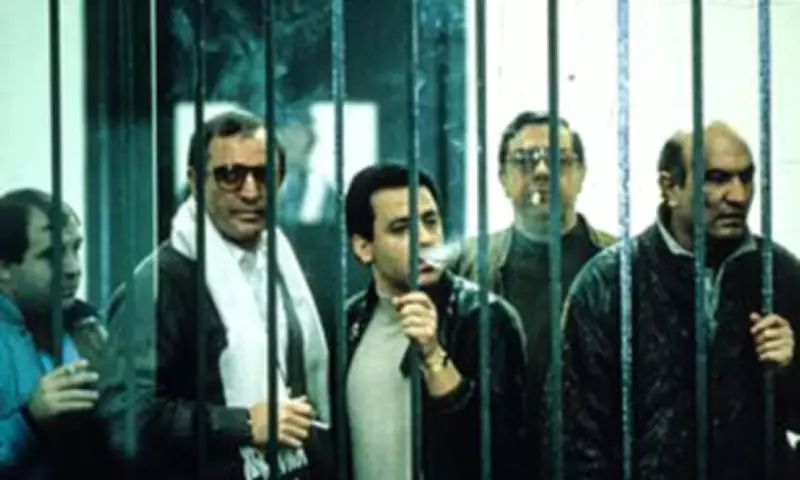
The defendants were transported to a specially constructed courtroom via underground tunnels, a security measure of immense scale. The courtroom itself was built like a concrete bunker, designed to withstand any potential attack. Once inside, the accused were confined within steel cages, a stark visual representation of their alleged crimes coming home to roost.
Outside the fortified courthouse, the scene was one of extreme military preparedness. Two tanks stood guard, flanked by several armoured vehicles. Authorities had drafted in no fewer than 3,000 extra police officers to maintain order and security, underscoring the perceived threat posed by the defendants and their associates.

Defiance in the Dock: The Faces of Power
Within their cages, the defendants presented a study in contrasting attitudes. Some appeared bored or dismissive of the proceedings, while others wore expressions of outright defiance. Their attire varied just as widely; some were dressed casually in tracksuits and trainers, while others wore sharp, expensive suits. These were the men who, for decades, had wielded immense power, not just over Palermo, but over much of Sicily and, through corruption, significant parts of Italy itself. For years, challenging them seemed an impossibility.
A Mother's Courage and a Nation's Conscience
Amidst this intimidating atmosphere, one brave woman directly addressed the assembled defendants. Her name was Vita Rognetta, and the Mafia had murdered her only son. With nothing left to lose, she taunted them from the stand, saying, ‘Come and kill me too, if you want to. I have no one left.’ Her raw defiance became a powerful symbol of resistance.
Ultimately, enough witnesses found the courage to testify. The judge remained unbowed, and the trial concluded with a landmark verdict: 323 defendants were sentenced to jail, with their combined prison terms totalling centuries. It was a decisive, if incomplete, victory for the Italian state.
The Lonely Voice of Leonardo Sciascia
Another figure felt a profound sense of vindication that day: the Sicilian novelist and essayist Leonardo Sciascia. For decades, Sciascia had been a solitary, obsessive, and erudite voice warning about the Mafia's corrosive influence. He described how they corrupted the entire country with what he termed ‘the whole mosaic of evil’.
Despite being deeply respected as a writer, his political warnings were often ignored. When an interviewer once asked him how it felt to be the conscience of a nation, he replied simply, ‘Bad. And alone.’ The maxi trial represented a moment where his long-held convictions were finally being acted upon in a court of law.
A Biography That Unlocks Modern Italian History
Now, prize-winning writer Caroline Moorehead, who was present at the 1986 trial, has published a vivid and compelling biography of Sciascia. Her work is so astute and broad-ranging that it effectively serves as a modern history of Italy, with the Mafia's shadow at its very centre. Moorehead traces the origins of the Mafia to Sicily's brutal history of colonisation, plunder, and enslavement by powers ranging from the Carthaginians to the Arabs.
She shockingly notes that under Arab rule, ‘Christians had been forced to wear pictures of pigs on their shoulders; Jews those of monkeys’. This legacy of oppression and humiliation fostered a fiercely insular society. The impoverished Sicilian people, ignored except as a source of revenue by brutal overlords, turned inwards to family and clan—il sangue mio (my blood)—as the only entities they could trust.

The Birth of a Monster from Poverty and Distrust
Even after reunification with Italy in the 1860s, Sicily faced rebellion and was bombarded by the Italian navy, killing hundreds. The so-called Italian liberators derided Sicilians as ‘self-centred and dirty’ and ‘more like Africans than Europeans’. This cycle of violence and prejudice only deepened the island's Sicilianismo—a close-knit, suspicious cultural identity. From this cauldron of relentless poverty and oppression, the monster of the Mafia was born. As V.S. Naipaul grimly observed, ‘Hate oppression, but fear the oppressed.’
Sciascia's World and the Mafia's Evolution
Leonardo Sciascia was born into this world in 1921 in the village of Racalmuto. During the Second World War, he witnessed American soldiers distributing aid, which the Mafia swiftly took control of. By the 1950s, the organisation had entrenched itself in the heroin trade, using ingenious methods like smuggling drugs inside wax oranges ‘the exact size and weight of real oranges’.
More money led to more ferocious violence and deeper corruption, ensnaring policemen, lawyers, and even clergy. Moorehead recounts horrifying acts, such as a Mafia boss murdering an 11-year-old shepherd boy who witnessed a crime, and others beheading a dog belonging to an undertaker who refused extortion payments. These stories starkly counter any romanticised view of the Mafia.
The Power of the Pen Against Corruption
In 1961, Sciascia published the first true ‘Mafia novel’, The Day Of The Owl. It was no simple thriller. His fictional world featured solitary, pessimistic figures battling a corruption that seeped into every corridor of Italian power. As Moorehead notes, it is a world where ‘reality is ambiguous, elusive, priests rapacious and ungodly, and the investigators themselves often meet death rather than solve crimes’.
Sciascia often felt his writing changed nothing, but he confessed, ‘I write, I console myself, I feel happy.’ As Italy globalised, so did the Mafia, building vast criminal empires. The 1980s saw staggering violence in Palermo, with 1,000 people murdered between 1980 and 1982 alone. In recent decades, their operations have expanded to include people smuggling alongside drugs, prostitution, and extortion.
Sicily: A Land of Beauty and Inescapable Melancholy
The island of Sicily itself emerges as a central character in this story. Moorehead captures its ‘splendour and pomp, its harsh climate, the arrogance and melancholy of its people’. It is a place of profound contradiction, where every Sicilian seems to long for escape yet feels irrevocably tied to their homeland.
Sciascia embodied this conflict. He loved escaping to Paris, a city he saw as a beacon of light, reason, and intellectual vivacity—the antithesis of crime-cursed Sicily. Yet, he could never truly leave. He wrote, ‘I hate Sicily, and am condemned to love her.’ In a bleak joke, he once said he hoped to die elsewhere, but he did not. He passed away in Palermo in 1989, aged 68, and is buried in his native Racalmuto, forever part of the land he both criticised and cherished.