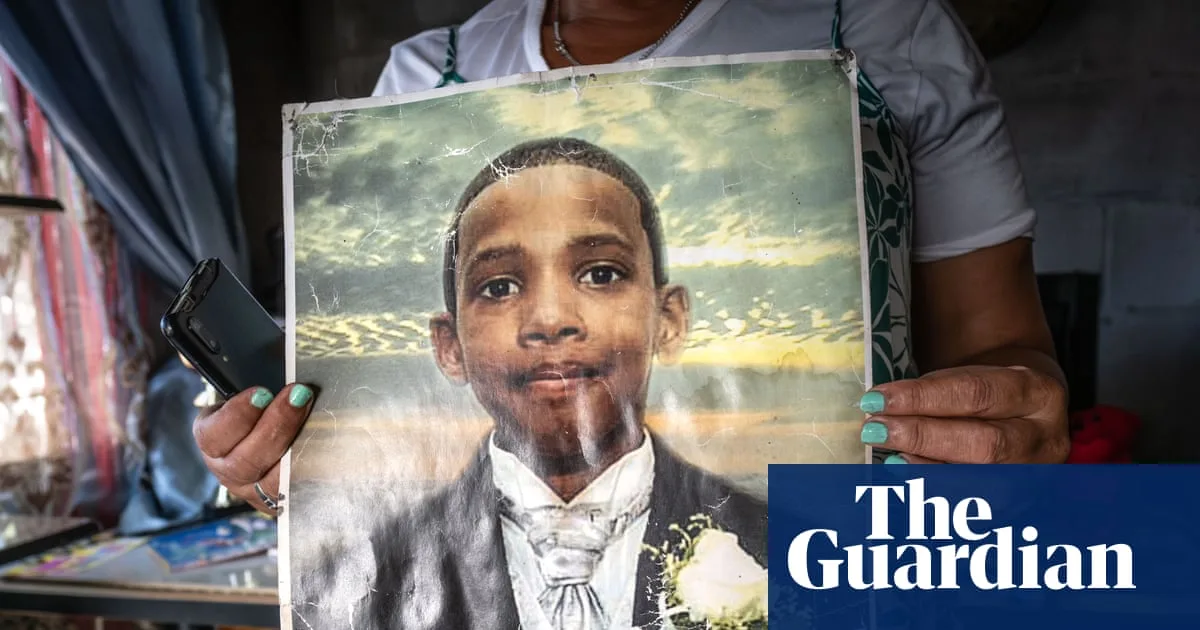
In 2015, Deniël de Bruyn moved nearly 300 miles to Cape Town to live with relatives and overcome a drug problem. Nine months later, he was shot dead in the township of Wesbank, in what gangsters claimed was a case of mistaken identity, according to his cousin Lindy Jacobs. The shooting was witnessed by Jacobs's 12-year-old son Zunadin. 'My son's life was never, never ever the same again,' she said. In 2018, gangsters tried to kill Zunadin; two months later, he was dead. Jacobs is now raising her 12-year-old grandson Noah, whose father was another casualty of gang violence.
The Cape Flats townships, where Black, Coloured and Indian South Africans were forcibly relocated by the apartheid regime in the 1960s and 70s, are full of such stories. Yet many residents remain committed to their communities. After the man who allegedly killed her son was himself killed by a rival gang, Jacobs refused to celebrate. 'I said to myself, ‘He is also somebody’s child,’' she said. She now runs home gardening workshops and football training for children, leading the local chapter of Balls Not Guns, a collective of women's volunteer groups promoting sport.
'I always remember light, light, light in this darkness,' Jacobs said. 'Because if there’s nobody that is trying to light, what is going to happen with our youth?' Last year, there were more than 1,037 gang-related murders in the wider Western Cape province, 16% higher than in 2024. The splintering of gangs has escalated turf wars over drug-selling territories and extortion, trapping ordinary people in the crossfire. In response, President Cyril Ramaphosa announced on 12 February that the military would be deployed to combat gangs.

Many community members are sceptical, noting that when the army was sent into the Cape Flats in 2019, gangsters merely laid low before returning. 'They’re going to instil fear, it’s going to happen for a short while … and then what?' said Gloria Veale, an activist who runs Balls Not Guns. Acting police minister Firoz Cachalia acknowledged those concerns but said the action was necessary 'in order to save lives and restore some calm.' He added that the army would support police, not replace them, and that 'this is not a magic bullet … What these communities need … is development.'
Gangs proliferated in Cape Town during apartheid, when the forced removal of about 150,000 people to the Cape Flats ruptured families and communities. Ben de Vos, a criminologist running an NGO in Mitchells Plain, listed the problems: 'The spatial inequalities, the congested communities, the unemployment, which is sky-high. The drug economy gives an alternative economy.' South Africa's unemployment rate exceeds 40%; non-white South Africans, who make up most township populations, are least likely to have jobs. Local experts also expressed concern about the growing recruitment of children by gangs, including those left without state support after being excluded from school.
'The whole of government has failed to come up with a youth intervention strategy,' said Martin Makasi, chair of the Nyanga community police forum. Irvin Kinnes, an associate professor in criminology at the University of Cape Town, said corruption from police to the top of government fuels gang crime: 'The violence on the Cape Flats is a symptom of the bigger problem of corruption, in a system of accumulation that’s not working for people.' The Global Initiative Against Transnational Organized Crime found in 2019 that Cape Town’s 13 largest gangs had a membership of about 72,000.