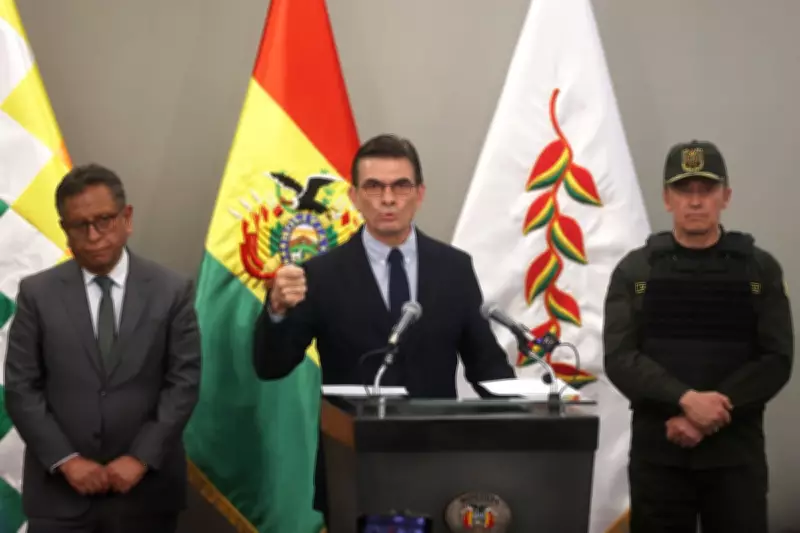
Bolivian President Rodrigo Paz has publicly confirmed the arrest of Sebastián Marset, an alleged Uruguayan drug kingpin, during a press conference held in La Paz on 13 March 2026. This significant law enforcement operation marks the culmination of an international manhunt for one of South America's most notorious criminals.
End of a Criminal Empire
The arrest signals the dramatic downfall of Marset, who had styled himself as the 'King of the South' – a title he reportedly stamped on bricks of cocaine. Bolivian Interior Minister Marco Antonio Oviedo announced that Marset is already being extradited to the United States, where he faces serious charges of money laundering through American financial institutions.
International Crimes and Connections
Marset, aged 34, stands accused of orchestrating the trafficking of tonnes of cocaine from South America to European markets, including Belgium, the Netherlands, and Germany. Furthermore, he is alleged to have ordered the assassination of Paraguayan prosecutor Marcelo Pecci, who was shot dead while honeymooning on a Colombian beach in 2022. Colombian President Gustavo Petro has publicly implicated Marset in this murder.

His criminal career has deep international roots. Initially arrested for drug trafficking in 2013, Marset spent years in Uruguayan prisons, where he allegedly forged connections with Brazil's powerful Primeiro Comando da Capital (PCC) organised crime group and Italy's 'Ndrangheta mafia. Upon his release in 2019, he relocated to Paraguay using a counterfeit Bolivian passport under the alias Gabriel de Souza Beuner.
A Life on the Run
Marset's evasion of justice has been marked by bold moves and narrow escapes. In 2021, he was detained in Dubai while travelling on a fake Paraguayan passport, only to be released days later after Uruguayan authorities issued him a legitimate document – a scandal that led to multiple official resignations in Uruguay.
By 2022, he had moved to Bolivia, now operating under a Brazilian passport as Luis Paulo Amorim Santos. There, he lived conspicuously, purchasing a second-division football team and inserting himself into its starting lineup, with matches broadcast on local television. When Bolivian authorities raided his Santa Cruz de la Sierra mansion in July 2023, he had already vanished, apparently forewarned.
During his subsequent fugitive period, Marset taunted authorities through periodic video postings and even arranged a helicopter transport for a Uruguayan television presenter to interview him at his hideout. Ultimately, Bolivian police captured him in the same city where he had previously eluded them.
Geopolitical Implications
This arrest represents a notable shift in international law enforcement cooperation. Under President Paz's centrist government, Bolivia has re-engaged with United States authorities, contrasting sharply with the policies of his leftwing predecessor Evo Morales, who expelled both the US ambassador and the Drug Enforcement Administration nearly two decades ago.
Marset's criminal network exploited Bolivia's strategic position as both a cocaine producer and a key transit hub for Peruvian cocaine. His operations demonstrate the complex, transnational nature of modern drug trafficking, involving multiple countries across South America and Europe.