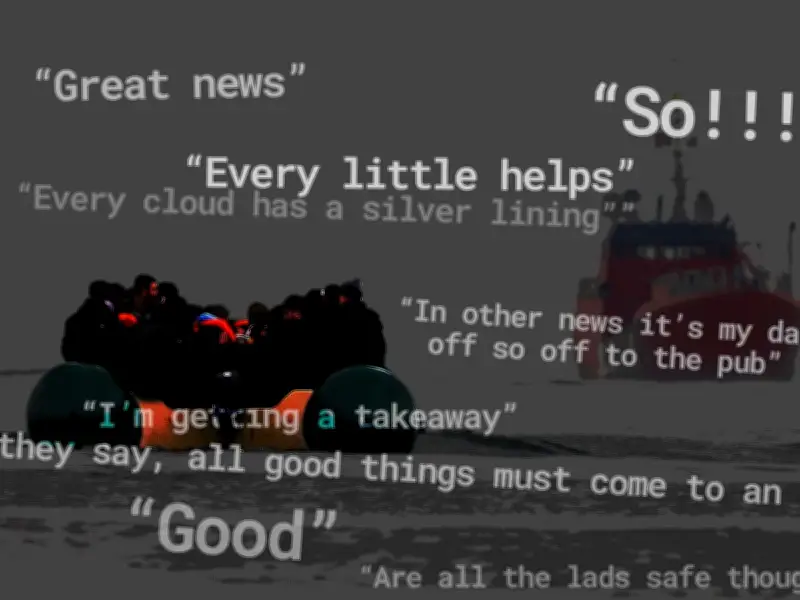
Hundreds of social media profiles responded with laughter and celebratory comments last week to the news that two women and a child had died attempting to cross the English Channel in a small boat. The comments, posted under the Manchester Evening News' Facebook page, included remarks such as "Depends on how you look at it" and "Every cloud has a silver lining."
Disturbing comments under tragic news
Jean Morrell, Nic Lecher, Luke Alan and Kaze Sukimo all wrote "Great news," while Andrew Booth and Joe Dilks both commented "Every little helps." John Murrow wrote "Oh well never mind," and Marcus Arrowsmith asked "Can someone explain why this is devastating?" Tracey Earp added "In other news it's my day off so off to pub."
Other comments included "Ah man only 3?" from Al Mi, "Good 3 less" from David Henry, "Shame it wasn't more" from Peter Lilac, and "Fish food" from Aaron Jardine. Some accounts shared memes, including the catchphrase 'oh dear, how sad, never mind' from the 1970s sitcom It Ain't Half Hot Mum. Others made references to 'bacon' and 'ham', which could be interpreted as Islamophobic in the circumstances.
Victims and context
The three people who lost their lives were among 102 asylum seekers on a boat that needed rescuing off the coast of Bleriot Plage, near Calais, last Monday (September 28). A medical team was scrambled to the boat by helicopter to try to save their lives. French authorities said the child, aged just 10, and the two women in their 30s were 'likely crushed' to death.
Dr Rebecca Whittington, online safety editor at Reach PLC, which owns the Manchester Evening News, described the comments as 'depressing' but 'predictable'. She said: "I think I said out loud to myself 'what kind of humans are we? What kind of people are we becoming?'."
Fake profiles and divisive tactics
Dr Whittington noticed a trend on closer inspection of the accounts. While some appeared to be held by real people, with real profile pictures and ordinary-looking social media history, others did not. "Some of them look like real profiles," she said. "One was a dad standing with his kids. You think, where is his connection for his own kids, and the child that died at sea in a situation that nobody chose to be in? But a lot of the profiles are faceless. Half of them don't look real. If you didn't dig into the accounts on this post, didn't go to look at them and see who is putting these comments celebrating the death of two women and a child - which is an obscene thing to do - you would assume they are people from Manchester, Manchester Evening News readers."
She added: "They could be your neighbours. That would be a really depressing take away and it could make you feel upset. But I do think these are not all real people. They are making divisive comments. Unfortunately we've seen a rise in that kind of account on social media across the board."
Dr Whittington says people may be more likely to believe comments left by 'bots' have been made by real people when they are posted underneath verified news stories. It's something designed to make users 'feel depressed about society', she says, but it also opens up a space for real people to join in and post their own hateful remarks.
Normalisation of extreme rhetoric
The campaign group Hope Not Hate says the comments are another example of how 'extreme rhetoric' has become normalised online in recent years. A spokesperson said: "The radical right ecosystem - made up of politicians, media outlets, think tanks and organised groups - has become increasingly confrontational in recent years, pushing the Overton window significantly further to the right. As a result, extreme rhetoric has become normalised across mainstream discourse, including at the highest levels. The inadequate response from both government regulators and tech platforms has also played a major role. Platforms such as X have not only failed to tackle hate speech effectively but have also helped amplify content that drives engagement and profit. Together, these factors have created an environment in which people feel increasingly emboldened to express hatred online, including in response to the most tragic circumstances."
Under the Online Safety Act, which came into force last year, social media platforms have a duty to remove illegal content, which can include hate speech and content provoking violence. Ofcom has the power to fine platforms which do not comply with the law up to 10 per cent of their worldwide revenue or £18m - whichever is greater. The act targets criminal content, but does not prevent adults from seeking out legal content and does not restrict people posting legal content. Social media platforms also have their own community guidelines designed to protect users.
Meta, which owns Facebook and Instagram, says it removes 'content that could contribute to a risk of harm to the physical security of persons', while threatening content is not allowed. In its community guidelines, the company says it 'protects refugees, migrants, immigrants and asylum seekers from the most severe attacks', but it does allow 'commentary on and criticism of immigration policies'.
Past incidents and glimmer of hope
It's not the first time the Manchester Evening News' social media pages have been peppered with cruel comments responding to the loss of life in the English Channel. Last September, the Manchester Evening News reported on a similar incident, which saw two children and one adult die while attempting to make the crossing. More than 8,000 comments were posted on the Manchester Evening News' Facebook page at the time. Hatred flowed on the screen until the thread was ultimately closed.
In last week's instance, there was a glimmer of hope. Dr Whittington noted that far more users argued back against the worst comments this time, something she described as 'refreshing'. She said: "I think some people on that thread that are making celebratory remarks will be real people. They will have felt that they can say these things because other people are saying them. But you see in the comments that people are also saying 'what's funny about this? Why are you laughing?' You have to take some hope from that, definitely."
While 427 accounts had responded to the Facebook post with a 'laughing' emoji as of Monday afternoon (October 5), they were well outnumbered by more than 3,100 who responded with a 'sad' emoji. Amy Blades commented: "Imagine laughing at this, wild world we live in." Becky McCallum wrote: "Most people are saddened by lose of life especially when a child is involved. No negative comments please." Tara Humphries commented: "I don’t want to start some big thing here, but off the assumption this is true, whatever you may think of migrants, they’re still people, human beings, and I more so think the tragic thing here is people revelling in the deaths of these human beings. It doesn’t matter who it is, death is not something that should be revelled in, or worse, wishing more of it. That’s not what being human is."
Dr Whittington feels those who take a different view may have to keep pushing back. She added: "Some people would argue it's freedom of speech, and nobody is saying anything illegal. They are saying things that are obscene and offensive, but they are not illegal things to say. I don't know where we really go from here. You just have to keep calling it out if you don't think it's right for people to behave in that way. Maybe people have to stand up and say it's not right to say that, and actually show that there's a group of people - a strong section of people - that doesn't celebrate people's tragic deaths."