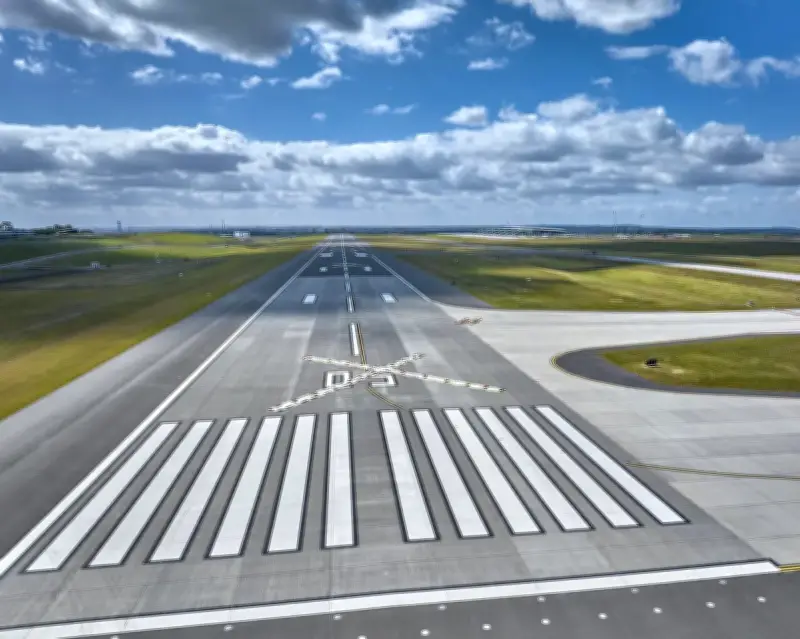
This Sunday, the first commercial flight will depart from Western Sydney international airport, marking the start of operations at Sydney's second airport. The airport, which promises to relieve congestion at Kingsford Smith and provide more competition, is set to serve up to 10 million passengers a year.
The opening draws comparisons with Melbourne's Avalon airport, which began passenger flights more than two decades ago as that city's second commercial airport. Both airports share comparable footprints, are roughly 60km from their respective city centres, and had their first flights operated by Jetstar.
Different Approaches to Passenger Services
Despite the similarities, officials from both airports are keen to highlight their differences. Avalon's chief executive officer, Ari Suss, says examining the similarities and differences between Avalon and Western Sydney is "not really comparing apples with apples". A WSI spokesperson says "conceptually, the two are chalk and cheese".
In 2015, the entity that runs Avalon airport said it "maintains the passion to make Avalon airport the nation's leading secondary airport". Asked if this is still the ambition, or if he expects WSI to overtake Avalon in this respect, Suss says: "I'm concentrated on Avalon."
Avalon, built in 1952 primarily as a military airfield, has never really taken off as a major passenger alternative to Tullamarine. In contrast, seven airlines are already signed up to operate flights out of Western Sydney, including Singapore Airlines, Air New Zealand and Qatar Airways.
Capacity and Expansion Plans
Suss says Avalon has the capacity to handle 1.2 million passengers a year. "It's up and down," he says. The airport resumed international flights earlier this year after a six-year break precipitated by the pandemic, with Bali as its only international route. Altogether, there are about 55-60 commercial flights a week, including 35 return flights to Sydney and services to Brisbane, Adelaide and the Gold Coast.
In contrast, federal transport minister Catherine King has said WSI will serve up to 10 million passengers annually, with "scalable expansion" to meet future demand. The airport plans to serve up to 80 million passengers a year by 2060, which a spokesperson says is "a larger capacity than Dubai, Hong Kong and New York's JFK today".
The WSI spokesperson acknowledges the airport will "launch with a modest volume of services, relative to its future capacity" but says it has been "built for long-term growth and will serve Sydney's growing population for the next century".
Operational Advantages and Challenges
Western Sydney has an advantage as a secondary airport because Kingsford Smith is subject to strict movement limits of 80 takeoffs and landings – known as slots – in any one hour, alongside an 11pm-6am curfew. WSI, in contrast, is approved to run 24 hours a day. Melbourne's Tullamarine is not as restricted, giving it greater capacity for flights and room to expand, which Suss says makes competing with the bigger airport for passengers more difficult for Avalon than likely for WSI.
For now, Kingsford Smith has the advantage of a quick rail link into the city's CBD, with promised rail links for the western airport not due to come online until 2027 or 2028. Neither of Melbourne's airports has such supporting rail infrastructure.
Associate Prof Chrystal Zhang, an aviation expert at RMIT University, says WSI will have to show there is the passenger demand and connecting flights to keep the airlines using its runways. "That would be an ongoing challenge," she says.
Freight and Long-term Viability
Suss says Avalon "of course" wants to grow its passenger services, but it has other things on the agenda. Linfox, which effectively bought the airport from the commonwealth in 1997 with a 99-year lease, runs the site more as a logistics operation than a passenger hub. "We have different advantages," Suss says. "We've got opportunities that are uniquely ours and that's what we're pursuing."
Avalon handles a large amount of freight and recently opened an industrial precinct whose tenants include the Cotton On Group, Australia Post and defence giant Lockheed Martin. It is a portal for Australian food and pharmaceutical exports and e-commerce deliveries from cut-price online retailers Shein and Temu. WSI also has freight ambitions: its 24-hour cargo precinct opened in July, with Qantas Freight and Dnata among its clients, and plans to "ultimately cater for up to 1.8m tonnes of air cargo annually".
Prof Rico Merkert, an aviation expert from the University of Sydney, says WSI may need 10 years before it becomes commercially viable and may require financial support from the government to sustain it until then. WSI would not say whether it expected to take a decade to become commercially viable. On the other hand, Merkert says, the fact that Avalon is privately owned by Linfox means it may not matter whether or not the airport is profitable on its own. The airport has strategic value because it is a linchpin of the company's broader logistics operations. "If [Avalon] airport doesn't break even it doesn't really matter so much as long as the rest of the organisation benefits financially from that activity," Merkert says. "That's the difference here." Suss says the company does not comment on profits publicly, but is "certainly very happy with its growth".