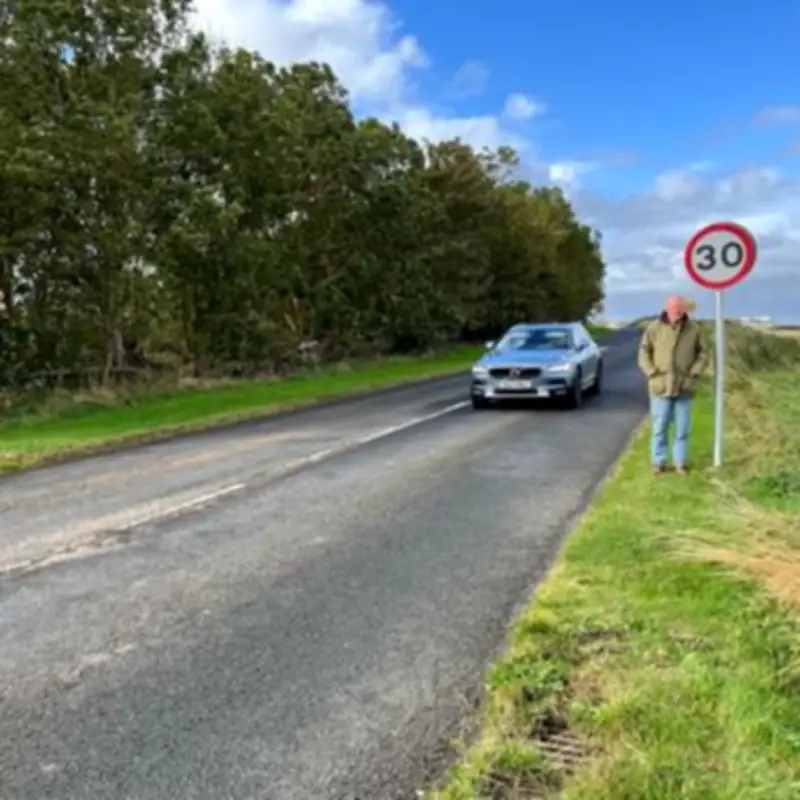
Three potential options to upgrade a notorious crash blackspot in Northumberland have been unveiled, following a series of collisions at Swinhoe Crossroads in recent years. The junction has been the subject of long-standing safety concerns due to extremely poor visibility, which has been exacerbated by the rising number of visitors to the Northumberland Coast.
Campaign for Safety Improvements
Local campaigner John Rhind gathered over 1,000 signatures calling for improvements, prompting Northumberland County Council to commit £1.4 million to a safety scheme. While initial plans suggested a roundabout, the council is now consulting residents on three distinct options.
Option 1: Realigned Crossroads
This option retains the existing crossroads layout but improves visibility and road geometry. It is the lowest cost and has a reduced visual impact, though some crossing and design constraints would remain.

Option 2: Compact Roundabout
The compact roundabout would replace the crossroads with a clear junction priority. However, it costs more, has a greater impact on the landscape, and requires additional infrastructure such as street lights.
Option 3: Staggered Junction
The staggered junction offers a strong technical performance with improved sightlines and layout. It has the largest footprint, highest cost, and greater impact on surrounding land and heritage assets.
Community Response
Coun Guy Renner-Thompson, representing the Bamburgh ward, said: "The consultation is still going. I would encourage people to take part. The council is committed to improving road safety at Swinhoe because of the number of accidents. There is £1.4 million in the budget for the project."
Campaigner John Rhind added: "There are advantages and disadvantages in each proposal as well as factors such as the ease and speed of implementation and the extent of disruption during construction. Those who regularly negotiate this junction are the best judge of which option would make them feel safest; not the environmentalists and archaeologists who have to take a narrow view of the issues in accordance with the criteria of their specialism."
Rhind continued: "This is the public's opportunity to ensure that the redesigned junction at Swinhoe will be made as safe as it can be. Whatever their preference, even if they are content with the current design, I hope they will express it. The risk is that a poor or lukewarm public response may allow the county council to decide in favour of the cheapest and not the safest option."
He noted that nearly three years have passed since the "Safety at Swinhoe" petition was launched. "Hopefully, and at long last, we will soon see an end to nearly one hundred years since the then Belford Rural District Council failed to grasp the nettle in 1928 and decided instead to paint the first of many white lines on the roads at Swinhoe."