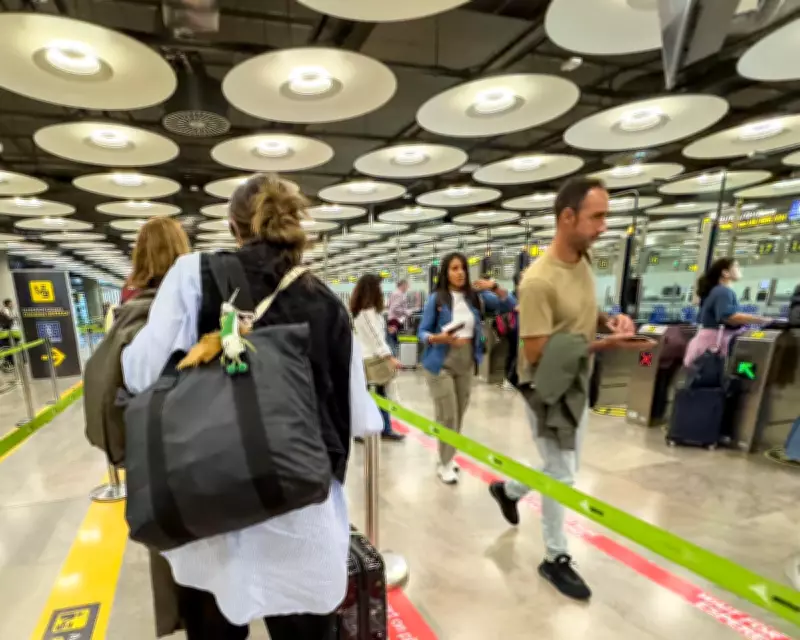
Summer Travel Disruption Fears Over New Biometric Checks at European Borders
Travel industry leaders have urgently called on the European Commission to instruct all border authorities to suspend the new Entry-Exit System (EES) if necessary, as fears escalate over significant summer travel disruption. European airports have issued stark warnings of a potentially disastrous experience for passengers, with enormous queues anticipated unless biometric controls for foreign visitors are substantially relaxed.
Widespread Delays and Divergent Application
Most British holidaymakers travelling to Europe will now be required to undergo fingerprinting, photographic capture, and registration. UK firms have reported a wide divergence in how these new rules have been applied since the scheme's soft launch in October. This staggered implementation has already resulted in extensive queues at several European airports, despite provisions allowing border officers to relax the stringent requirements.
Currently, member states are only obligated to register a minimum of 35% of travellers. However, in theory, all passengers are due to complete the full EES registration process starting from the 10th of April. Border authorities retain the power to reduce the number or extent of checks—or even stand down the system entirely—to prevent significant operational disruption and the formation of large passenger queues.

Infrastructure Readiness and Current Challenges
Many border crossings had the necessary EES infrastructure operational well before last October's launch, including locations on British soil such as Eurotunnel in Folkestone and Eurostar's London St Pancras International station. Nevertheless, the majority of visitors to the 29 countries implementing EES will likely register their details at border control upon arrival at airports.
The trade body Airports Council International (ACI) Europe has reported that the system is already causing delays of up to three hours, with airports in Spain, Portugal, France, and Italy among the worst affected. Olivier Jankovec, the Director General of ACI Europe, expressed grave concerns: "The chronic understaffing of border control guards was an issue before—and the rollout of EES makes it worse. We're routinely seeing, with only up to 35% of people coming into Schengen being registered, queues of up to two hours. It's not sustainable and we fear it is only going to get worse."
Projected Summer Crisis and Industry Appeals
Jankovec highlighted specific worries for the peak summer months: "We're especially concerned for July and August, when we have double the traffic. We could see queues of up to five hours, and that is making us very nervous: it creates a disastrous passenger experience and a safety hazard, as well as possible missed connecting flights."
The UK travel association Abta has urged the EU to ensure all member states and border authorities have instructed staff on the ground to utilise contingency measures to avoid prolonged delays at passport control. Mark Tanzer, Abta's Chief Executive, has written to EU Commissioner for Migration, Magnus Brunner, requesting a continuous review of the system and advocating for additional border guards during the busiest periods.
Tanzer stated: "The ambition of a project like EES means it was never going to go completely smoothly, and we were prepared for that. However, what is frustrating is that border authorities have it within their power to ease queues and deal with issues as they arise—but that doesn't seem to be happening across the board."
Contingency Measures and Technical Issues
Last week, a European Commission spokesperson indicated that contingency measures would be available for at least 90 days from the April deadline, hinting at a possible further six-week extension to cover the summer season. However, Jankovec noted that airports had "not received formal notification that the ability to suspend EES will be extended, nor the conditions required."

He revealed that queues at Lisbon airport had reached seven hours just before the New Year, prompting Portuguese authorities to suspend the system temporarily. Many self-service kiosks for EES have not functioned reliably, and no state, except Sweden, has permitted the use of a pre-registration app for travellers.
Jankovec emphasised the need for a coordinated solution: "We can do a Band-Aid for the summer but we need all these things to be addressed, under a coordinated European approach."
UK-Specific Preparations and Rollout Status
In the United Kingdom, Eurotunnel reported that it had begun a phased rollout of EES for coach passengers and lorry drivers smoothly and was "fully prepared", but had not yet commenced registering tourist vehicles, awaiting a definitive date from French authorities.
Eurostar, which has invested heavily in new kiosks at St Pancras, has yet to activate them. The company confirmed that EES checks are currently being completed manually by border officers, with plans to introduce kiosk-based processing once the final software and implementation dates are confirmed by the French interior ministry.