Major UK airlines including Ryanair, easyJet, and TUI have reinforced bans on power banks in checked baggage after terrifying footage showed a lithium battery fire erupting in an aircraft cabin. The bans come as UK authorities reported 643 incidents of lithium batteries improperly packed in hold luggage last year, nearly double the 2024 figure.
Footage Shows Power Bank Fire on Air China Flight
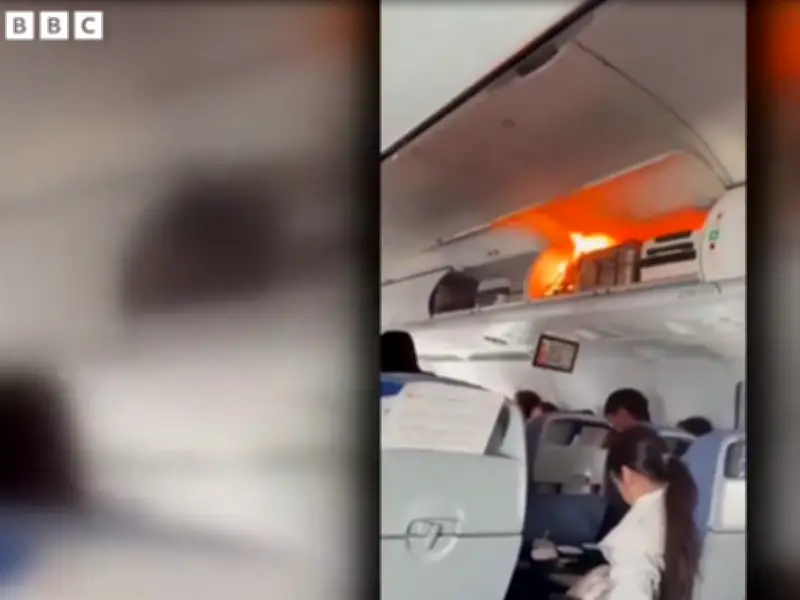
BBC News broadcast footage of a power bank fire breaking out in the overhead locker of an Air China flight in October 2024. The cause is believed to be a lithium battery. Speaking on BBC Breakfast, correspondent Katy Austin described it as a 'terrifying situation', stating: 'Flames broke out in the overhead baggage compartment. They can store a lot of energy in a small space, but if they overheat or are defective, this video shows just how quickly a fire can start.'
Lithium batteries are found in laptops, vapes, phones, and power banks. When faulty, they can cause aggressive, self-fueling fires that are difficult to extinguish. Austin warned: 'The fires can be quite ferocious and you can’t put these fires out in the way you can with a normal fire.'
Rising Incidents of Lithium Battery Malfunctions
According to the Civil Aviation Authority (CAA), reports of overheating or malfunctioning passenger devices nearly doubled in 2025 compared to 2024, exceeding 200 incidents. Cases of lithium battery-powered devices being incorrectly packed in hold luggage rose 91% over the same period. Most incidents occurred in the cabin where crew could intervene, but the fear is that hold fires could go undetected until too late.
CAA director of aviation safety Giancarlo Buono said: 'Pack right for a safe flight, and that means don’t put your batteries in your checked bag. Take them into the cabin with you. This simple tip will make your flight safer for you, and the other passengers you’re flying with.' A passenger survey indicated that 36% are unaware of the dangers of packing batteries in checked baggage.
Airline Rules: Power Banks Banned in Hold Luggage
easyJet requires all lithium-ion batteries, spare batteries, and power banks to be carried in cabin hand luggage only. Power banks below 100Wh (approximately 27,000mAh) are permitted without approval; those between 100-160Wh need airline authorization. Batteries in portable electronic devices must be carried as carry-on. If packed in checked baggage, devices must be fully switched off (not sleep or hibernation mode) and protected from damage. easyJet allows up to 15 portable electronic devices per passenger.
Ryanair permits up to 15 personal electronic devices including power banks. Spare lithium batteries must be individually protected to prevent short circuits—by original packaging, taped terminals, or separate plastic bags—and transported in carry-on baggage only. Passengers may carry up to 20 spare batteries under 100Wh each. Power banks must not exceed 100Wh and cannot be used to charge devices during taxi, take-off, or landing. They must be stored in cabin baggage under the seat, not in overhead lockers. Batteries over 100Wh are forbidden in cabin and hold.
TUI prohibits loose lithium batteries, power banks, or spare batteries in checked baggage. They must be kept in hand luggage with terminals protected. Power banks typically must not exceed 100Wh. Devices should not be recharged on board. TUI fly mandates all power banks in hand luggage, never in checked baggage, and restricts capacity to 100Wh. In-flight usage for charging is not allowed, and power banks should be stored in seat pockets or under seats, not overhead bins.
Safety Advice for Passengers
Passengers are advised to take items like mobile phones, vapes, and power banks on board, never charge power banks during a flight, and turn off laptops completely if placed in check-in bags. Power banks are considered the 'number one safety risk to aircraft' due to their potential to cause fast-spreading fires.