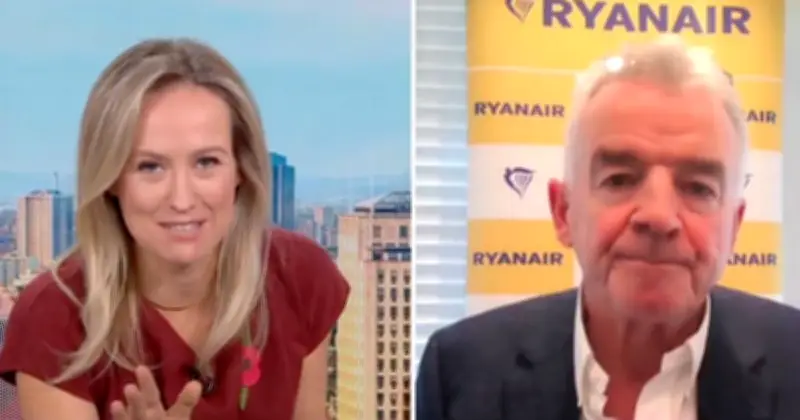
Ryanair chief executive Michael O'Leary has called for passengers to be restricted to just two alcoholic drinks before boarding a flight, insisting they should show their boarding passes when buying alcohol at airport bars.
Speaking to Sky News presenter Sophy Ridge on Monday morning, Mr O'Leary was asked how many drinks he thinks are acceptable for passengers to have before getting on a plane. He replied: "I think it should be limited to two."
Proposal to cap airport drinking
Explaining his proposal, he said: "We're not trying to block everybody from drinking but you should show your boarding pass and that should limit you to two alcoholic drinks at whatever time of the day it is. And after two, have a cup of tea, have a cup of coffee."
Mr O'Leary said that airport drinking is contributing to a growing problem of disruptive behaviour on flights, particularly when passengers are left waiting for hours because of delays. He said: "We should limit people to two alcoholic drinks at an airport, that's enough. When you have flight delays as we had during the summer, people are drinking too much at the airports. The airports don't care, they're happy to sell you the drink because they know then they'll pass the problem on to the airlines."
Rise in in-flight misbehaviour
He added: "We have real problems, all of the airlines are facing real challenges with a dramatic growth in misbehaviour in passengers on board aircraft - a combination of alcohol and drugs I'm sorry to say - and they expect the airlines to police it. It's too late once they're up in the air."
Mr O'Leary also said the airline has been forced to divert on average about one or two aircraft a week this year, which comes to about 100 diversions. He said: "Think of the number of passengers whose holidays and travel plans have been disrupted because some idiot can't control themselves or won't behave properly."
Comparison with smoking ban
The airline chief also questioned why smoking was banned on aircraft while intoxicated passengers were still allowed to board. He said: "I go back 20 years ago, we used to allow passengers to smoke on board aircraft. Now if somebody lit up on board an aircraft, it would be an international incident, you'd be arrested. Why do we allow drunk people to get on board aircraft?"
Mr O'Leary dismissed suggestions that airlines should simply identify intoxicated passengers at the boarding gate, arguing that it is not always easy to recognise someone who had been drinking unless they're visibly staggering over.
Criticism of authorities
He also criticised the response from authorities and urged them to do more. The Ryanair CEO claimed: "It is not acceptable that we tolerate this misbehaviour and the authorities will not take any action. I divert an aircraft to an airport and the local police just want him or her back on the aircraft and send them back to the UK again."
He urged: "We need to be much more serious about this safety and we need to tackle this - limit the drinks at airports. It's a sensible thing to do. My view is two will do."
Being drunk on a plane is a criminal offence and can be punished by a fine of up to £5,000 and two years' imprisonment.
This is not the first time Mr O'Leary has called for a two-drink limit at airports. In 2024, he said aeroplane passengers should be restricted to two drinks at airports and he also spoke of the issue in May. He told The Times earlier this year: "I fail to understand why anybody in airport bars is serving people at five or six o'clock in the morning. Who needs to be drinking beer at that time? There should be no alcohol served at airports outside [those] licensing hours."
He added: "We are reasonably responsible, but the ones who are not responsible, the ones who are profiteering off it, are the airports who have these bars open at five or six o'clock in the morning and during delays are quite happy to send these people as much alcohol as they want because they know they're going to export the problem to the airlines."