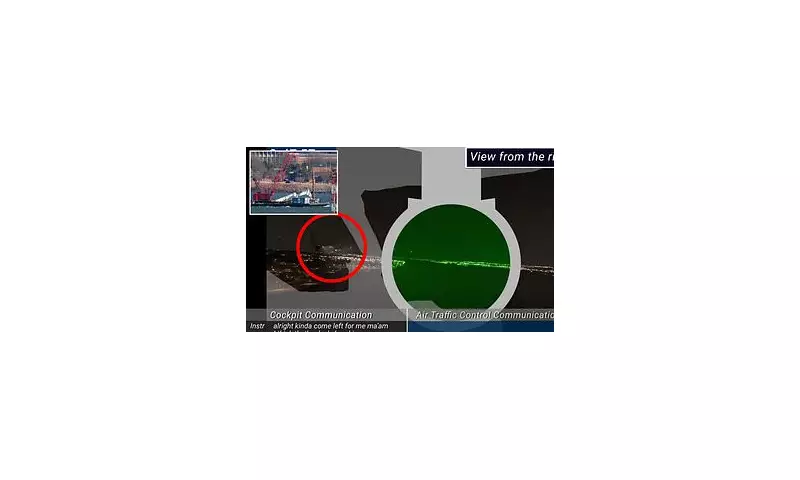
A harrowing video animation has been released, depicting the terrifying final moments before an American Airlines passenger jet collided with a military Black Hawk helicopter in a catastrophic mid-air crash that claimed 67 lives. The National Transportation Safety Board (NTSB) shared the visual simulation on Tuesday, publishing its comprehensive findings into the disaster just two days before its one-year anniversary.
A Tragedy Over the Nation's Capital
The fatal incident occurred on January 29, 2025, over Ronald Reagan National Airport in Washington DC. This devastating event stands as the deadliest commercial aviation accident on American soil in nearly a quarter of a century. The collision killed all 64 passengers and crew aboard the American Airlines regional jet, along with all three soldiers on the U.S. Army Black Hawk helicopter.
The Cockpit Perspective
The newly released animation provides a chilling pilots-eye view from inside the American Airlines cockpit in the moments leading to impact. The simulation specifically shows the perspective from the right-seat position, where First Officer Sam Lilley was seated. Investigators noted that Lilley had the most advantageous position to potentially spot the approaching helicopter, even though Captain Jonathan Campos was the pilot flying the aircraft at the time.

The visual reveals the challenging conditions the crew faced: dark night skies, reliance on night-vision technology for landing, and the confusing glare of bright city lights from Washington DC below. Crucially, the animation highlights significant grey 'masked' areas representing cockpit structural blind spots that obstructed the pilots' external view. The helicopter appears abruptly to the left of the plane's windshield, striking the jet in a flash and leaving the pilots with absolutely no time to execute an evasive manoeuvre.
Systemic Failures, Not Individual Blame
In its detailed findings presented this week, the NTSB presented evidence that while 'individual errors' contributed to the tragedy, board members emphatically stressed that 'no singular person is to blame for this - these were systemic issues across multiple organizations.' The investigation points to a confluence of critical failures.
The year-long probe identified several primary factors: a poorly designed helicopter flight path near the airport; the Black Hawk flying approximately 78 feet higher than its assigned altitude; and the Army's decision to deactivate a key anti-collision system known as Automatic Dependent Surveillance-Broadcast (ADS-B) on the helicopter. Testimony confirmed the Army was following an existing FAA memorandum that permitted turning this safety system off.
Air Traffic Control Lapses
Further compounding the disaster, the NTSB found that air traffic controllers failed to provide adequate warning to the American Airlines pilots about helicopter traffic in their airspace. Audio evidence from the cockpit confirmed that 'no safety alerts' were given to the flight crew. Investigators also uncovered 'major discrepancies' in the altitude readouts on the helicopter's instruments, which may have led its crew to believe they were flying at a lower, safer altitude over the Potomac River than they actually were.
Emotional Hearings and Calls for Change
The release of the animation during Tuesday's NTSB hearing proved deeply distressing. ABC reported that several groups of grieving family members were escorted from the room in tears as the video played. Board member Todd Inman acknowledged the profound pain of the victims' families present, warning that presenting the findings 'will not be an easy day.'
NTSB Chair Jennifer Homendy stated in her opening remarks that the agency 'left no stone unturned' in its quest for answers. 'We asked the hard, uncomfortable questions that ruffled feathers and we got to the truth,' she asserted. Homendy elaborated on the investigation's philosophy, noting a common tendency to focus on human error after such disasters. 'However, human error in complex systems like our modern aviation system and the National Airspace System isn’t a cause. It’s a consequence,' she explained.

A Legacy of Safety Reforms
In the wake of the crash, immediate changes were enacted. The Federal Aviation Administration (FAA) implemented measures to prevent helicopters and planes from sharing the same airspace above Ronald Reagan Airport. Last week, the NTSB made these changes permanent and is expected to recommend further actions, including permanently restricting helicopter access to that specific airspace.
Board member Michael Graham reflected on the profound impact of the event: 'We mourn the loss of 67 lives nearly one year ago from an accident in a tragedy that never, ever should have happened.' He emphasised that the hearings aim not to assign blame, but to ensure 'those systems that failed to protect 67 people on January 29, 2025 never fail again.'
This sentiment was echoed by Rachel Feres, who lost her cousin Peter Livingston, his wife, and their two young daughters in the crash. Speaking at the hearing, she expressed a desperate hope for clarity and urgent reform: 'I hope that we see a clear path through the recommendations they offer to ensure that this never happens again. That nobody else has to wake up to hear that an entire branch of their family tree is gone.'