

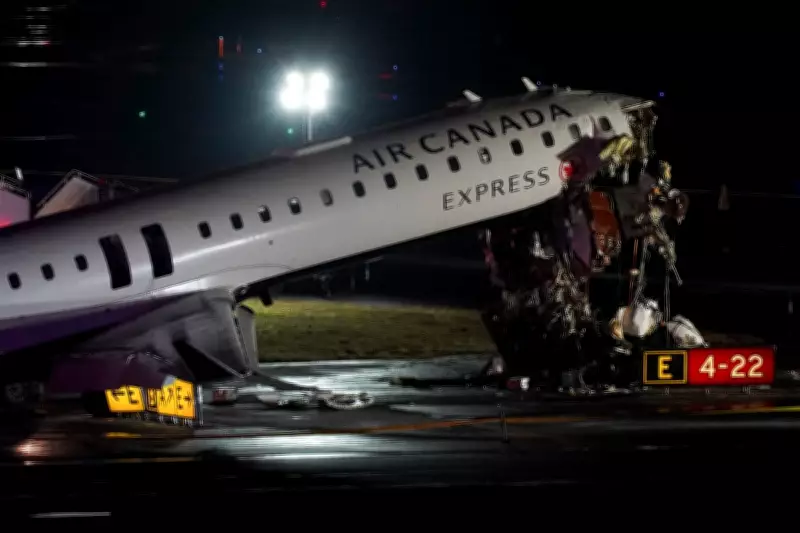
The aviation industry faces renewed scrutiny after a fatal collision involving an Air Canada Express regional jet at New York's LaGuardia airport. Two pilots lost their lives when the aircraft struck a fire truck during landing on Sunday evening, an incident captured on air traffic control audio.
Ongoing Safety Concerns in US Aviation
This tragedy occurs amidst persistent concerns about aviation safety in the United States. While the Federal Aviation Administration (FAA) reported a decrease in runway incursions—with 97 recorded in January this year compared to 133 during the same period last year—the need for comprehensive safety measures remains urgent.
In response to broader safety issues, a bipartisan group of US House lawmakers proposed legislation last month addressing 50 aviation safety recommendations. These measures followed a year-long investigation into the January 2025 collision between an American Airlines regional jet and a US Army Black Hawk helicopter, which resulted in 67 fatalities near Ronald Reagan Washington National Airport.

Recent Deadly Aviation Disasters Worldwide
The Air Canada incident adds to a sobering list of fatal crashes in recent years that have claimed hundreds of lives across multiple continents.
2025: Multiple Tragedies
In June 2025, hundreds perished when an Air India flight to London crashed minutes after taking off from Ahmedabad, India. This became the world's worst aviation disaster in a decade, killing all but one of the 242 people on board plus 19 others on the ground.
Later that year, a UPS cargo plane crashed shortly after takeoff from Louisville, Kentucky, killing seven people and injuring 11 on the ground.
2024: International Disasters
South Korea experienced its deadliest air disaster on December 29, 2024, when Jeju Air flight 7C2216 crashed at Muan International Airport, killing all 175 passengers and four of six crew members.
On Christmas Day 2024, Azerbaijan Airlines flight J2-8243 crashed after being diverted from Russia to Kazakhstan, resulting in 38 fatalities. Azerbaijan's President Ilham Aliyev stated the plane was damaged by accidental ground fire in Russia, though Moscow has not confirmed this claim.
Earlier that year, a Japan Airlines Airbus A350 collided with a Coast Guard aircraft on the runway at Tokyo's Haneda airport. While all 379 passengers and crew aboard the JAL plane escaped the burning aircraft, five of six crew members on the smaller plane perished.
Earlier Years: Significant Crashes
In 2022, a China Eastern Airlines Boeing 737-800 crashed into mountainous terrain in Guangxi, China, killing all 132 people on board in the country's deadliest aviation disaster in 28 years.
The year 2020 saw Iran's Revolutionary Guards shoot down a Ukraine International Airlines Boeing 737-800 shortly after takeoff from Tehran, killing all 176 passengers and crew. Iran's civil aviation authority blamed misaligned radar and operator error.
In 2019, an Ethiopian Airlines Boeing 737-MAX 8 crashed minutes after takeoff from Addis Ababa, killing all 157 people on board. This tragedy led to the global grounding of the Boeing 737 MAX fleet over safety concerns.
The previous year, a Lion Air Boeing 737 MAX crashed into the Java Sea shortly after departing Jakarta, Indonesia, claiming all 189 lives on board.
2014: Malaysian Airlines Disasters
Two Malaysian Airlines tragedies occurred in 2014. Flight MH17 was shot down over eastern Ukraine during conflict between pro-Russian separatists and Ukrainian forces, killing all 298 passengers and crew. Earlier that year, Flight MH370 disappeared en route from Kuala Lumpur to Beijing, with the Boeing 777 and its 239 passengers never found.
These incidents collectively highlight the ongoing challenges in aviation safety and the critical need for continued vigilance, improved protocols, and international cooperation to prevent future tragedies.






