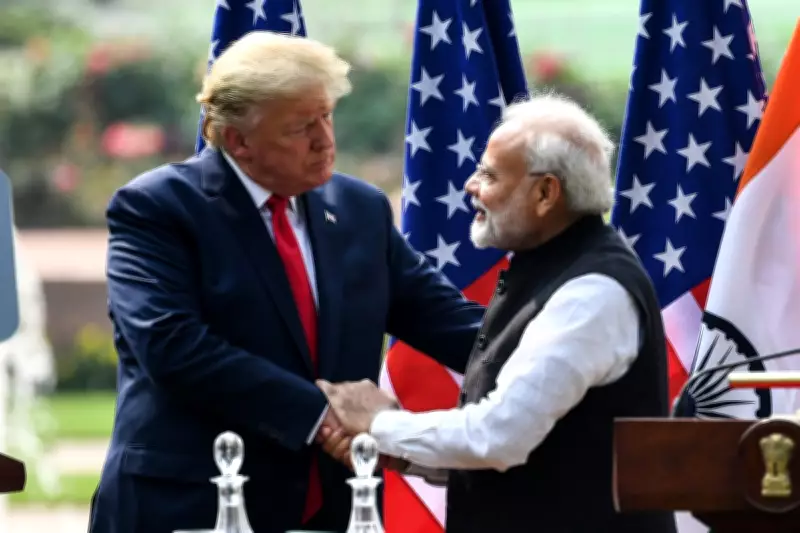
Former US President Donald Trump has declared a significant trade agreement with India, yet crucial specifics remain shrouded in uncertainty as official documentation fails to materialise. The announcement, made via social media and brief remarks, suggests a resolution to long-standing economic disputes but leaves analysts questioning whether this constitutes a binding deal or merely a preliminary framework.
Tariff Reductions and Energy Commitments
The most concrete element to emerge from Trump's statements involves a reduction in US import tariffs on Indian goods. Trump asserted that Washington would immediately lower reciprocal tariffs from 25 percent to 18 percent. Furthermore, he claimed this move was contingent upon India halting purchases of Russian oil, with the punitive 25 percent levy imposed last year being lifted as a result.
Indian exports to the US had been facing a 50 percent tariff rate since August, when Trump imposed additional duties over India's continued acquisition of Russian crude. A White House official confirmed that the rollback of this punitive measure depends on India fully ceasing, not merely reducing, its imports of Russian oil. Trump emphasised this point on Truth Social, stating, "He agreed to stop buying Russian Oil and to buy much more from the United States and, potentially, Venezuela. This will help END THE WAR in Ukraine."

India's Notable Silence on Russian Oil
India's import of discounted Russian crude since the Ukraine war began has been a persistent friction point with Washington, with the Trump administration accusing Delhi of indirectly financing Moscow's military efforts. Despite not being a historic major buyer, India became one of Russia's top customers post-sanctions, capitalising on discounted supplies.
Prime Minister Narendra Modi and his officials have remained conspicuously silent on whether India has agreed to halt Russian oil purchases. In his public response, Modi focused exclusively on the tariff reduction, expressing delight that "Made in India" products would benefit from the lower 18 percent rate and praising Trump's leadership as vital for global stability.
The Kremlin downplayed the US claims, with spokesman Dmitry Peskov stating Moscow had received no official communication from India regarding halted purchases and reaffirming Russia's commitment to deepening its strategic partnership with Delhi.
Analyst Skepticism and Strategic Realities
Michael Kugelman, senior fellow for South Asia at the Atlantic Council, expressed doubt about India halting Russian oil imports, calling it "hard to believe" given the economic, diplomatic, and strategic ties between Delhi and Moscow. He noted that India has reduced Russian oil imports since new US sanctions in November, which, combined with a recent US-India natural gas deal and increased US oil imports, likely helped facilitate negotiations.
Ambiguous 'Buy American' Targets
Trump made a bold assertion that Modi committed to "BUY AMERICAN," claiming India would spend over $500 billion on US goods, including energy. However, he provided no elaboration, and Indian officials made no public mention of this figure.
Analysts view this target with considerable scepticism. Evan Feigenbaum of the Carnegie Endowment for International Peace described it as "kind of a stretch," highlighting India's economic constraints and the absence of clear timelines or sectoral details. Ajay Srivastava, founder of the Global Trade Research Initiative, suggested the $500 billion figure is likely a "long-term aspirational number rather than a near-term commitment."
Agricultural Sector Liberalisation
An Indian government official indicated that Delhi agreed to purchase oil, defence equipment, and aircraft from the US while partially opening its closely guarded agriculture sector. Agriculture had been a major sticking point during the year-long negotiations, as even limited liberalisation could expose Indian farmers to intense competition from heavily subsidised and mechanised US producers.

Small and marginal farmers, who constitute the majority of India's agricultural workforce, have long opposed such openings, fearing domestic livelihoods would be undermined. Experts remain doubtful that India could remove all barriers to US imports, particularly in sensitive areas like dairy, where introducing American products could provoke consumer backlash and threaten approximately 70 million livelihoods.
The absence of a full agreement text, joint statement, or detailed fact sheet leaves many questions unanswered. Observers caution that without these documents, the announced deal may represent a framework for future negotiations rather than a conclusive trade pact, with the fine print and implementation details yet to be determined.