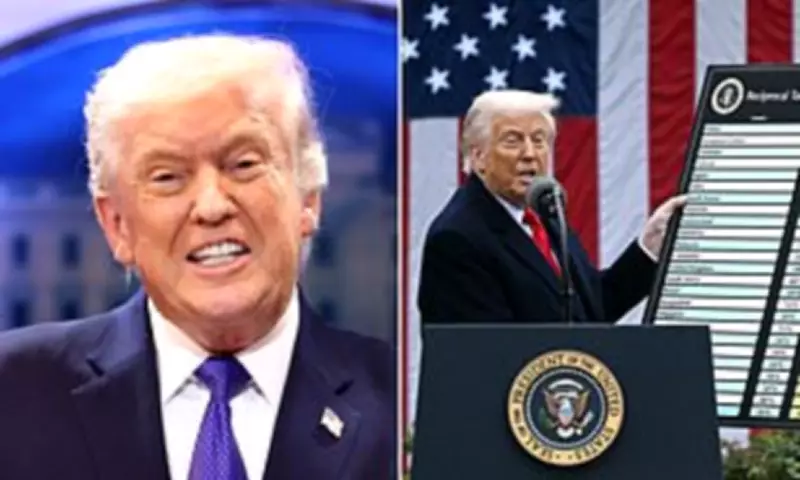
President Donald Trump has declared his intention to increase tariffs on imports from every country to 15 per cent, responding angrily to what he termed a "ridiculous" defeat at the US Supreme Court. The announcement came after the court ruled against his signature tariff program, prompting immediate action from the White House.
Immediate Tariff Increase and Legal Framework
On Saturday, Trump stated he would elevate the temporary 10 per cent tariff, imposed following the court's decision, to a maximum of 15 per cent. This move utilizes Section 122 of the Trade Act of 1974, marking the first invocation of this provision. The law permits tariffs of up to 15 per cent for a duration of 150 days without congressional approval, though legal challenges are anticipated.
The new tariffs are scheduled to take effect on February 24 at 12.01am EST. However, exemptions apply to a broad range of goods, including energy products, natural resources, fertilizers, pharmaceuticals, select electronics, certain vehicles, specific aerospace products, informational materials, and accompanied baggage. Food items such as beef and tomatoes are also excluded to mitigate impacts on average consumers.

Trump's Fiery Response to Supreme Court Ruling
In a post on Truth Social, Trump lambasted the Supreme Court's decision as "ridiculous" and "extraordinarily anti-American." He asserted that the ruling was poorly written and claimed it allowed him to "destroy the country" but not impose tariffs. "I'm allowed to destroy the country, but I can't charge them a little fee," he complained during a press conference.
The president accused some conservative justices of being "swayed by foreign interests" and lacking loyalty, contrasting them with appointees from Democratic administrations. He expressed shame over the court's lack of courage, stating, "The Supreme Court's ruling on tariffs is deeply disappointing and I'm ashamed of certain members of the Court."
Supreme Court Decision and Its Implications
The Supreme Court, with a 6-3 conservative majority, ruled 6-3 against Trump's previous tariff legislation, deeming it unlawful. Conservative justices Amy Coney Barrett and Neil Gorsuch joined Chief Justice John Roberts and the three liberal justices in the majority, while Justice Brett Kavanaugh, a Trump appointee, dissented.
The court did not prohibit tariffs outright but determined that Trump had employed incorrect legislation, based on an economic emergency law, to implement them. This decision places an estimated $175 billion in tariff revenue at risk, highlighting the significant economic stakes involved.
Background and Future Plans
This development follows Trump's "Liberation Day" on April 2, 2025, when he announced reciprocal tariffs globally, citing national emergency due to trade deficits and security threats. During the 150-day period, the Trump administration will work on issuing new and "legally permissible" tariffs, aiming to continue his "Make America Great Again" agenda.
Trump emphasized that the temporary hike is part of a broader strategy to address what he perceives as unfair trade practices by other nations. "During the next short number of months, the Trump Administration will determine and issue the new and legally permissible Tariffs, which will continue our extraordinarily successful process of Making America Great Again - GREATER THAN EVER BEFORE!!!" he wrote.