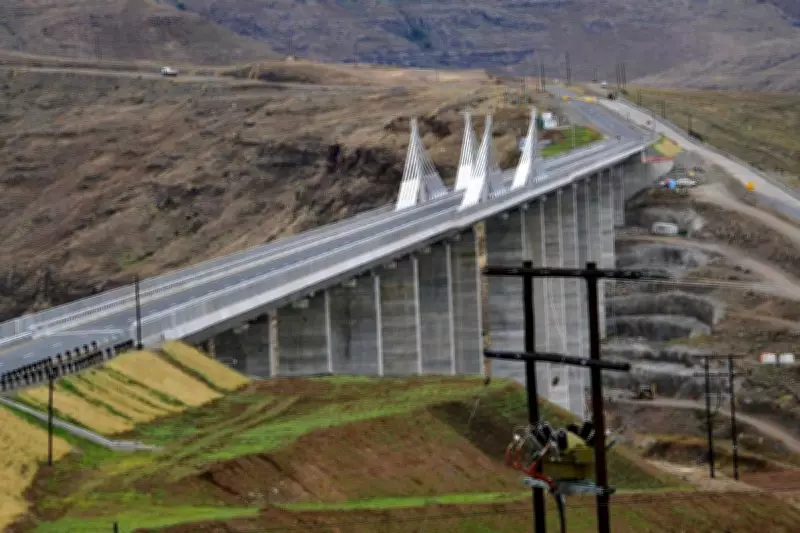
A newly constructed bridge in Lesotho is set to significantly enhance the country's capacity to export water to South Africa, with the potential to nearly double current volumes. This development underscores Lesotho's role as a vital water source for Gauteng, South Africa's most populous province, which includes Johannesburg. For every glass of water or shower taken in Gauteng, there is a 60% chance that the water originated from Lesotho.
Senqu Bridge: A Key Component of the Lesotho Highlands Water Project
The Senqu Bridge, measuring 825 meters (2,700 feet) in length and 90 meters (295 feet) in height, is part of the expansive Lesotho Highlands Water Project. This project aims to increase water exports from the current 780 million cubic meters per year to over 1,270 million cubic meters. The bridge spans the reservoir behind the Polihali Dam, ensuring uninterrupted water flow once water levels rise. The dam itself is still under construction.
Economic and Strategic Importance
The Lesotho Highlands Water Project is one of the world's largest transboundary water initiatives and represents South Africa's most significant investment outside its borders. It also enhances Lesotho's hydropower generation, bolstering energy security and reducing dependence on electricity imports. The total project cost is estimated at over 53 billion rands ($3.2 billion), involving more than 120 kilometers (75 miles) of tunnels that channel water from Lesotho's mountainous regions to South Africa's river systems.

The first phase began in 1990 following a 1986 treaty between the two nations, and the second phase is expected to be completed between 2028 and 2029. The Senqu Bridge, costing 2.4 billion rands ($144 million), is the largest of three bridges supporting water infrastructure in northeastern Lesotho, rising over 2,500 meters (8,200 feet) above sea level. It has been hailed as an engineering achievement for the country.
Political and Social Impact
South African President Cyril Ramaphosa stated during the bridge's launch: "South Africa is a water-scarce country, and the waters of Lesotho's highlands are vital to our country's development. We remain forever grateful to the great Basotho nation for making water resources available to us." The bridge's construction created approximately 1,200 jobs, primarily for Lesotho residents, a significant boost given the country's unemployment rate of around 30%, which led the government to declare a state of economic emergency last year.
Lesotho Prime Minister Sam Matekane emphasized: "The royalties and infrastructure that flow from this project are not incidental benefits. They are central to our development finance strategy." He added that the project must deepen its impact on the people, strengthen accountability, and ensure that benefits are felt in daily lives. Lesotho's economic challenges have been exacerbated by U.S. trade tariffs of up to 50% on its textile and mining products, as well as massive cuts to U.S. foreign aid that previously funded many health programs.
Pending construction includes a 38-kilometer (23-mile) tunnel connecting the Polihali and Katse reservoirs. The project remains a cornerstone of Lesotho's development strategy, offering a lifeline for its economy and a critical water supply for South Africa's industrial hub.