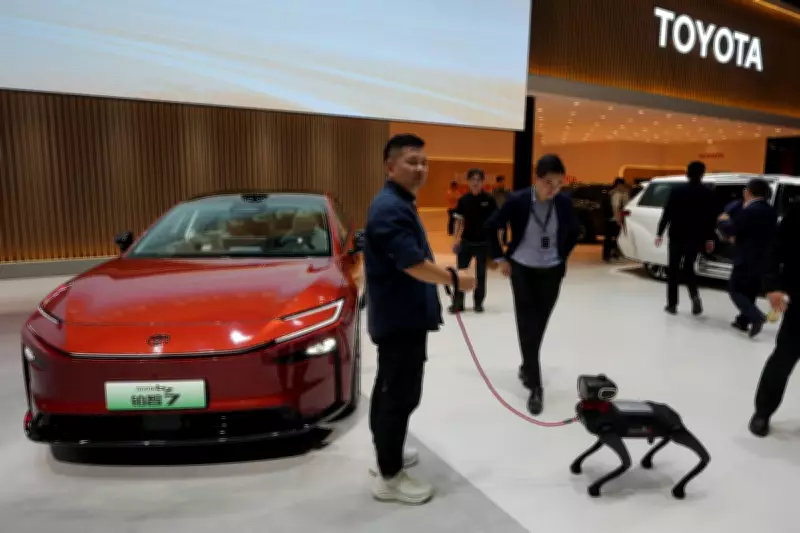
At the Beijing auto show, Chinese carmakers are unveiling their latest models and technologies, from intelligent driving to ultrafast charging, as they intensify competition with global rivals in overseas markets. The biennial event, which opened to media on Friday, underscores how China's auto industry is setting the global pace for cutting-edge technologies in electric vehicles (EVs) and batteries, overshadowing many foreign brands that once dominated the market.
Record Number of Vehicles on Display
This year's show features over 1,450 vehicles, including 181 global debuts. The exhibition runs until May 3, offering a platform for Chinese automakers to showcase their advancements. Among the highlights is XPeng's new GX model, a six-seater SUV with a third row that can lie completely flat. Founder and CEO He Xiaopeng drew large crowds as he described the vehicle's high-tech features, including a system that can detect if the driver falls asleep or becomes unwell, automatically pulling over and alerting emergency services.
Fast-Charging Battery Innovations
BYD showcased its next-generation "blade" EV battery, first unveiled last month, which can achieve a near-full charge in nine minutes. The company also demonstrated charging capabilities at minus 30 degrees Celsius. Meanwhile, Yijing, a joint venture between Dongfeng Motor Corp. and Huawei, presented the X9, a flagship six-seat SUV equipped with Huawei's next-generation Qiankun intelligent driving system and HarmonyOS cockpit. Ahead of the show, CATL introduced a new version of its "Shenxing" battery, capable of charging from 10% to 98% in about six-and-a-half minutes.

China's Aggressive Advancements
Tu Le, managing director of Sino Auto Insights, noted that the auto show highlights the "speed and aggressiveness of advancement" among Chinese automakers, reinforcing their leadership in EVs, batteries, and intelligent driving. Chris Liu, senior analyst at Omdia, added that China has become one of the fastest-moving markets for deploying and iterating new vehicle technologies, giving consumers early access to advanced features. China's status as the world's largest car exporter is bolstered by cost advantages from scale and government subsidies, enabling rapid scaling and faster rollout of new models compared to foreign competitors.
Challenges and Market Pressures
Despite these strengths, Chinese automakers face intense price wars. The government has scaled back subsidies for EVs and plug-in hybrids, weighing on domestic demand. Passenger car sales in China dropped 23% in the first quarter of 2026 year-on-year to about 4 million vehicles, according to the China Association of Automobile Manufacturers. However, exports surged 63% to nearly 2 million vehicles, driven by inroads in Europe, Southeast Asia, and Latin America. Omdia forecasts China's passenger vehicle exports will grow by around 14% year-on-year in 2026. The hypercompetitive market has pulled vehicle prices down by a fifth over the past two years, according to AlixPartners.
Limited Export of New Technologies
Liu noted that few of the showcased technologies may be exported in the short term due to regulatory and safety challenges, but they signal capabilities that can be refined for global markets over time. Foreign automakers, having lost market share in China, are staging a comeback. Volkswagen Group announced plans to install "agentic" AI in its vehicles for China and unveiled new EV models, including the UNYX 09 sedan co-developed with XPeng. However, Andreas Radics of Berylls by AlixPartners believes that while foreign brands may stabilize their market share, regaining significant lost ground is unrealistic.
Shift to Overseas Production
Given growing demand and better profitability abroad, Chinese automakers are shifting from exporting cars to building factories overseas, including in Hungary and Turkey, to increase supplies and avoid trade friction. AlixPartners estimates Chinese carmakers will nearly triple overseas production by 2030 to 3.4 million vehicles from 1.2 million last year.